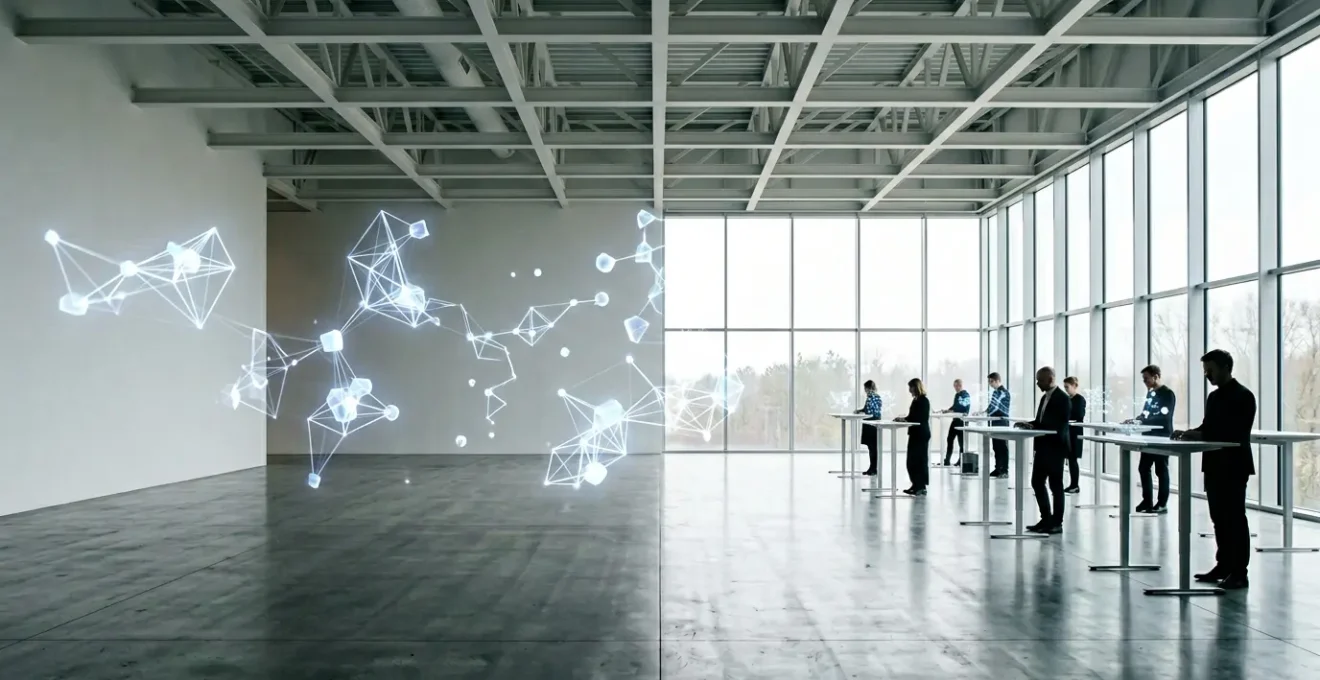
The failure of large-scale digital collections stems not from technology, but from a critical lack of administrative governance over digital assets.
- A robust taxonomy requires standardising data entry protocols across all curatorial departments *before* migration, not after.
- Implementing automated data hygiene and scheduled audits is essential for preventing metadata decay and managing storage costs effectively.
Recommendation: The immediate priority is to establish a cross-departmental taxonomy governance board to create, enforce, and maintain all data standards.
For the Chief Digital Officer of a major cultural institution, the promise of a vast, accessible digital collection can quickly devolve into a nightmare. You are presiding over a digital landfill of 500,000 assets—unorganised, mislabelled, and effectively unsearchable. The institutional memory, critical research data, and public-facing content are lost in a data swamp. The common response is to seek a technological fix: a new Digital Asset Management (DAM) system, better search algorithms, or AI-powered tagging. These are merely expensive patches on a foundational, structural problem.
The core issue is a failure of governance. Without a rigorously defined and strictly enforced administrative framework, any technological solution is destined to fail. This is where we must pivot our thinking. The key is not to ask which software is best, but to establish how the institution will manage its digital assets with the same rigour it applies to its physical collections. The real solution lies in creating an overarching taxonomy governance that dictates policy, standardises procedures, and ensures data integrity from the point of creation to long-term archival.
This article will not evaluate software. Instead, it provides the architectural blueprint for that governance framework. We will dissect the root causes of metadata failure, establish protocols for inter-departmental standardisation, analyse critical infrastructure decisions, and outline preservation strategies for the most complex digital objects, such as generative art. This is a guide to building a system that lasts.
The following sections provide a structured approach to developing and implementing this institutional governance. Each part addresses a critical layer of the taxonomy system, from foundational principles to advanced preservation challenges, designed to create a coherent and sustainable digital collection.
Summary: A Governance-First Approach to Museum Cloud Taxonomy
- Why Do Poor Metadata Tagging Systems Render Massive Digital Collections Completely Unsearchable?
- How to Standardise File Naming Conventions Across Five Different Curatorial Departments?
- The Bulk Upload Flaw That Overwrites Critical Provenance Data in the Cloud
- On-Premise Servers or Enterprise Cloud Storage: Which Offers Faster Retrieval for Curators?
- When to Schedule Annual Audits to Delete Redundant Drafts and Free Up Terabytes?
- Physical LTO Tape Backups or Cloud Redundancy: Which Survives Institutional Bankruptcies Better?
- How to Document Seed Values to Ensure Algorithmic Randomness Can Be Accurately Recreated?
- How to Preserve Live Generative Art to Function Predictably on Future Systems?
Why Do Poor Metadata Tagging Systems Render Massive Digital Collections Completely Unsearchable?
A poor metadata system is not merely inefficient; it is an active barrier to discovery that renders a collection invisible. When metadata is inconsistent, incomplete, or non-existent, assets become digital ghosts. Curators cannot locate works for an exhibition, researchers cannot find primary sources, and the public cannot engage with the collection. This failure is a direct result of treating metadata as an administrative afterthought rather than a core component of the asset itself. Without a controlled vocabulary, curators in different departments might tag a single artwork with “20th Century,” “Modern,” and “1900s,” effectively fracturing its identity across the system.
The consequences extend beyond simple search failure. It leads to redundant acquisitions, as the institution may re-acquire digital surrogates it already owns but cannot find. It cripples interoperability, preventing the collection from being integrated with external research platforms or internal applications. A successful system, by contrast, functions as a central nervous system. For instance, the Art Institute of Chicago’s API data hub collects and standardises information from all its internal systems, making collection data uniformly available to its website, mobile apps, and in-gallery interactives. This level of integration is impossible without a foundational, well-governed metadata schema.
The root cause is a lack of a central taxonomic authority. In its absence, each user and department applies their own logic, leading to a state of entropy known as metadata decay. The system does not just fail to organise new assets; the value of existing metadata degrades over time as standards shift and inconsistent data is added. Correcting this requires a shift from passive tagging to active governance, where metadata standards are defined, enforced, and maintained with institutional authority.
How to Standardise File Naming Conventions Across Five Different Curatorial Departments?
Standardising file naming conventions across diverse and often siloed curatorial departments is a political and procedural challenge before it is a technical one. Each department—from Prints & Drawings to Digital Art—has its own legacy methods, creating a babel of identifiers that makes central management impossible. The solution is not to impose a single, rigid convention, but to establish a flexible, system-wide governance protocol that accommodates departmental needs within a unified structure. This begins with the formation of a Taxonomy Governance Board, comprising representatives from each department, IT, and archives.
This board’s first mandate is to collaboratively design a “Core + Extension” framework. The “Core” is a mandatory, immutable string of data applied to every asset in the institution, regardless of origin. It typically includes fundamental identifiers like the accession number, artist’s last name, and year of creation. The “Extension” is a department-specific code that provides relevant context. This hybrid approach ensures every file has a consistent, searchable baseline while allowing departments the autonomy to include information critical to their specific workflows. The process of agreeing upon this framework is as important as the framework itself, as it builds institutional buy-in.
The table below illustrates a functional Core + Extension framework. Note how the core string remains consistent, while the departmental extension code allows for immediate sorting and identification. This structure is simple, scalable, and enforceable through automated validation scripts upon file ingest. It transforms the file name from a chaotic label into a rich, structured piece of metadata.
| Department | Core String (Mandatory) | Extension Code | Example |
|---|---|---|---|
| Prints & Drawings | AccessionNumber_ArtistLastName_Year | PD_ | 2024.156_Turner_1840_PD |
| Fashion & Textiles | AccessionNumber_ArtistLastName_Year | TX_ | 2024.157_Westwood_1985_TX |
| Theatre & Performance | AccessionNumber_ArtistLastName_Year | TP_ | 2024.158_Pinter_1975_TP |
| Digital Art | AccessionNumber_ArtistLastName_Year | DA_ | 2024.159_Eliasson_2020_DA |
| Sculpture | AccessionNumber_ArtistLastName_Year | SC_ | 2024.160_Hepworth_1965_SC |
The Bulk Upload Flaw That Overwrites Critical Provenance Data in the Cloud
The bulk upload feature of cloud storage and DAM systems is a powerful tool for migrating large volumes of data, but it is also one of the most significant sources of catastrophic data loss. The primary flaw lies in how these systems handle metadata conflicts during ingest. Often, a default setting or a misconfigured import template will overwrite existing, meticulously gathered provenance information with generic or incomplete data. For a museum, where an object’s history of ownership, exhibition record, and conservation notes are as valuable as the object itself, this is an unforgivable error. This risk is amplified by the sheer scale of museum collections; for example, a single department such as the American Museum of Natural History’s herpetology collection alone contains over 300,000 specimens, where a single flawed upload could erase decades of research.
This flaw is not a technical bug but a failure of process governance. Institutions must establish a strict protocol for all bulk operations. This protocol must include several non-negotiable stages. First, a “dry run” in a sandboxed environment is required to simulate the upload and identify potential data overwrites without affecting the live collection. Second, every bulk upload must be initiated using a pre-approved and version-controlled template that explicitly maps source fields to destination fields, ensuring no critical data is discarded or overwritten. Third, a post-ingest validation report must be generated and reviewed to confirm that all key provenance fields have been transferred correctly.
Furthermore, access to bulk upload functionalities must be severely restricted to a small number of trained data managers. Granting this capability to general curatorial staff is an invitation for disaster. The administrative overhead of this controlled process is insignificant compared to the cost of attempting to reconstruct lost provenance data, a task that is often impossible. The system’s integrity depends on treating every data migration, no matter the size, with procedural diligence and technical caution.
On-Premise Servers or Enterprise Cloud Storage: Which Offers Faster Retrieval for Curators?
When evaluating storage infrastructure, the primary concern for curatorial staff is retrieval speed. The debate between on-premise servers and enterprise cloud storage often incorrectly focuses on theoretical network bandwidth. In practice, for a large-scale museum, cloud storage almost invariably offers faster and more reliable retrieval due to superior architecture and specialised services. On-premise servers, while offering low latency on a local network, are often bottlenecked by their own hardware limitations, server load from other institutional tasks, and the complexities of internal network configuration. A curator trying to download a 5GB TIFF file for a publication may find themselves competing for resources with the finance department’s end-of-month reporting.
Enterprise cloud providers (like AWS S3, Azure Blob Storage, or Google Cloud Storage) are engineered specifically for rapid retrieval of large objects at scale. Their infrastructure is globally distributed, using Content Delivery Networks (CDNs) to cache frequently accessed files closer to the user, dramatically reducing download times. More importantly, their systems are designed for massive parallel processing. As demonstrated by the Ashmolean Museum’s migration to a cloud-based DAM, the performance gains are significant. Their team reported the ability to export data for 600,000 objects in just 15 minutes, a task that would cripple most on-premise systems. This level of performance is not about raw speed but about architectural efficiency.
The choice also has profound implications for total cost of ownership and IT resource allocation. On-premise solutions require significant capital investment in hardware, dedicated IT staff for maintenance and security, and a hardware refresh cycle every 5-7 years. Cloud solutions operate on a subscription model (SaaS), eliminating hardware costs and shifting the burden of security, updates, and disaster recovery to the provider. This allows the institution’s IT team to focus on strategic digital initiatives rather than server maintenance.
When to Schedule Annual Audits to Delete Redundant Drafts and Free Up Terabytes?
Relying on annual, manual audits to manage data hygiene is an outdated and inefficient model. In a large-scale digital environment, redundant files, drafts, and low-quality surrogates accumulate at a rate that quickly outpaces any manual review cycle. This “data bloat” not only consumes terabytes of expensive storage but also clutters search results, slows down system performance, and increases security risks. The effective solution is not a yearly clean-up, but a continuous, automated data hygiene protocol integrated directly into the collection’s lifecycle management policy. The question should not be “when to schedule an audit,” but “how to automate the audit process.”
This protocol should be built on a series of automated scripts and defined rules. For instance, a policy could automatically flag any file designated as a “draft” that has not been modified in 180 days, sending a notification to the owner with a 30-day deadline for action before archival or deletion. Scripts can also perform regular checks for “orphaned files”—assets that are not linked to any official collection record—which are often the result of abandoned projects or incomplete data entry. This proactive approach prevents the build-up of digital detritus from the outset.
A key part of this strategy is to move beyond simple deletion and implement a more nuanced approach based on asset value. By creating a “Data Value Score” calculated from factors like metadata completeness, linkage to other records, access frequency, and curatorial importance, the system can make smarter decisions. Low-scoring assets can be flagged for curatorial review and enrichment, while high-scoring assets are prioritised for premium storage and preservation. This turns the audit from a simple janitorial task into a strategic collection management tool.
Action plan: a continuous automated data hygiene protocol
- Configure automated scripts to flag draft files older than 180 days after notifying the owner.
- Run quarterly audits for ‘Orphaned files’—assets not linked to any collection record in the system.
- Implement checks for ‘Taxonomic decay’—tags that are no longer used or are inconsistent with current standards.
- Identify ‘Access pattern anomalies’ by flagging large portions of the collection that are never accessed, suggesting poor discoverability.
- Establish a ‘Data Value Score’ based on metadata completeness, linkage, and access frequency to prioritise assets for review or strategic archiving.
Physical LTO Tape Backups or Cloud Redundancy: Which Survives Institutional Bankruptcies Better?
The question of institutional survival is a stark one, forcing a shift in perspective from data backup (recovery from technical failure) to data sovereignty (long-term control and ownership independent of the institution’s fate). Historically, physical LTO (Linear Tape-Open) backups were the standard for archival, offering the security of a tangible asset held in a vault. However, in the context of bankruptcy or institutional dissolution, LTO tapes present significant long-term liabilities. They require climate-controlled storage, periodic migration to new tape generations every 5-7 years, and, most critically, access to increasingly rare legacy hardware for retrieval. An LTO tape is useless without a functioning, compatible tape drive, which may be impossible to source 30 years from now.
A modern, multi-cloud redundancy strategy, when structured correctly, offers superior long-term survivability. This approach involves replicating data across multiple, geographically distinct cloud providers with a legal escrow agreement in place. This agreement ensures that, in the event of the primary institution’s collapse, a designated successor (such as a national archive or another cultural body) can legally take control of the data. This model ensures data sovereignty is maintained. It effectively decouples the data’s existence from the institution’s financial health. Platforms like Terentia are designed for this very purpose, providing cloud-native solutions that empower the stewardship and repatriation of cultural heritage while ensuring data remains secure and accessible for future generations.
The total cost of ownership over a 30-year period further highlights the advantages of a cloud strategy, as it eliminates the immense logistical and financial burden of repeated media migration cycles and specialised hardware sourcing.
As a comparative analysis of long-term costs shows, the cloud model provides a more sustainable financial and operational path for permanent archival.
| Factor | LTO Tape Strategy | Multi-Cloud Escrow Strategy |
|---|---|---|
| Media Migration Cycles | Every 5-7 years (5-6 cycles) | Not required |
| Climate-Controlled Storage | 30 years continuous cost | Included in service |
| Legacy Hardware Sourcing | Increasing difficulty over time | Provider managed |
| Bankruptcy Protection | Physical control retained | Legal escrow agreements |
| Geographic Redundancy | Single location vulnerability | Multiple data center replication |
| Recovery Time Objective | Days to weeks | Hours to days |
How to Document Seed Values to Ensure Algorithmic Randomness Can Be Accurately Recreated?
The preservation of generative art, which uses algorithms to create works that can be different with each execution, presents a unique challenge. The concept of a single, final art object is replaced by a system capable of producing infinite variations. The key to preserving such a work is not to save one specific output, but to document the exact conditions required to recreate any output predictably. The “randomness” in generative art is almost always pseudo-random, meaning it is generated by an algorithm that starts with an initial number, or “seed value.” The same seed value will always produce the exact same sequence of “random” numbers, and therefore the exact same artwork.
Consequently, documenting the seed value is the most critical piece of metadata for a generative artwork. However, it is not sufficient on its own. The output of the algorithm also depends on the entire software and hardware environment in which it is run. A piece of code written in the Processing language in 2010 may produce a completely different result—or fail to run at all—on the version of Processing available in 2030. Therefore, a comprehensive “Execution Parameters” documentation framework is required.
This framework must be enforced as a mandatory part of the accessioning process for any generative work. It involves capturing not just the seed, but a complete snapshot of its digital context. This includes:
- The specific software version (e.g., Processing 4.0.1) and all library dependencies.
- The operating system and version (e.g., macOS 12.6.1).
- Hardware specifications if they influence the output (e.g., NVIDIA RTX 3080 GPU for shader-based art).
- A reference render or screenshot created with the documented parameters to serve as a visual checksum.
This information must be stored as structured metadata directly linked to the artwork’s record in the CMS/DAM. Failure to capture these execution parameters renders the artwork’s long-term preservation impossible.
Key takeaways
- A taxonomy’s failure is a failure of governance, not technology. Establish a cross-departmental governance board before investing in software.
- Standardise naming conventions with a ‘Core + Extension’ framework to ensure both institutional consistency and departmental autonomy.
- Implement automated, continuous data hygiene protocols to manage storage and prevent metadata decay, replacing inefficient annual manual audits.
How to Preserve Live Generative Art to Function Predictably on Future Systems?
Preserving live generative art requires a strategy that goes beyond simply documenting its code and execution parameters. The core challenge is ensuring the work can function predictably on future, unknown computer systems. Hardware and software obsolescence is inevitable. A strategy that relies on finding and maintaining vintage hardware is a losing battle. The most robust and forward-looking approach is virtualisation and containerisation—creating a self-contained digital “vessel” that packages the artwork’s code along with its entire operating environment.
Technologies like Docker allow archivists to create a lightweight, portable container that includes the specific version of the operating system, all necessary software libraries, dependencies, and the artwork’s code. This container can then be run on virtually any modern computer, executing the artwork within its original, perfectly replicated environment. This approach, a form of emulation, shifts the preservation focus from the transient hardware to the stable, self-contained software environment. It ensures that the piece will render exactly as the artist intended, regardless of the underlying future technology.
Developing a preservation strategy for these complex digital objects requires a new way of classifying them. A proposed three-dimensional taxonomy for digital museum integrations offers a theoretical framework, classifying works based on their level of virtualisation and interaction. Applying such a framework allows an institution to create tiered preservation policies, dedicating the most resource-intensive strategies, like full environment containerisation, to the most complex and fragile works. As a systematic review by the ScienceDirect Research Team notes, technologies like AI and cloud computing are key to enhancing exhibit management and creating sophisticated preservation pathways.
DTTs such as artificial intelligence, immersive technologies, additive manufacturing, the Internet of Things, and cloud computing can help create engaging designs, improve accessibility and inclusivity, enhance educational potential, and allow for sophisticated visitor experience data collection and analyses, improving exhibit management
– ScienceDirect Research Team, A systematic review of digital transformation technologies in museum exhibition
The successful implementation of a cloud taxonomy system is therefore the first step in a broader digital transformation. The first actionable step for any institution is to charter a cross-departmental governance committee, empowering it to formalise the framework outlined here and begin the essential work of building a collection that is not only stored, but truly accessible and preserved for generations to come.