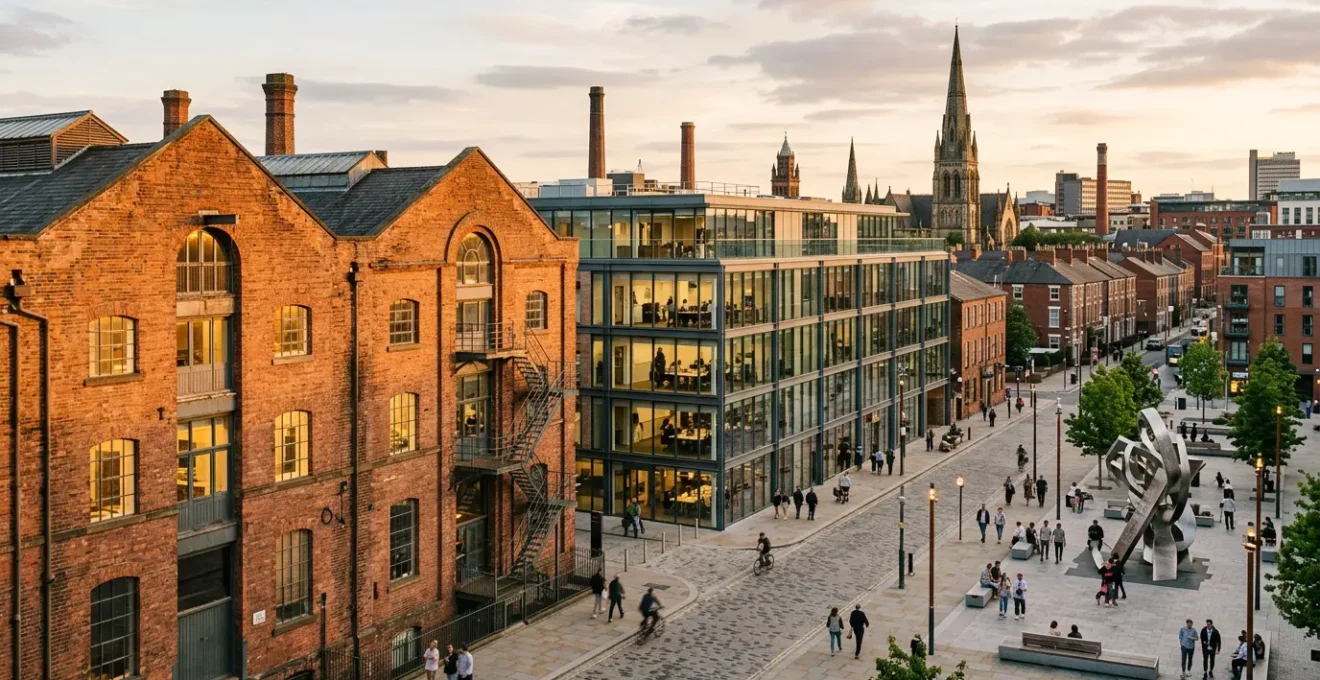
Investing in visual arts districts is the most predictable way to engineer significant commercial property value uplift in post-industrial UK cities.
- Independent studio clusters create more resilient, diversified economic growth than monolithic retail parks.
- Managing gentrification proactively with UK-specific legal tools like CLTs and Section 106 agreements protects the asset’s core authenticity and long-term value.
Recommendation: Focus on building an “Authenticity-to-Asset” pipeline, starting with low-cost warehouse conversions and culminating in high-impact public art masterplans to maximise ROI.
For commercial developers and city planners surveying the post-industrial landscape of Northern UK cities, the challenge is consistent: how to transform dormant liabilities like abandoned warehouses into high-yield assets. The conventional wisdom often points towards retail-led regeneration, a model increasingly showing its fragility. While the idea that art “makes a place nicer” is a common platitude, this view fundamentally misunderstands its economic power. It overlooks the potent, engineerable engine that visual arts can represent for commercial property valuation and urban renewal.
The real opportunity lies not in simply installing a gallery, but in architecting a complete ecosystem—an “Authenticity-to-Asset” pipeline. This strategy moves beyond superficial beautification to cultivate a resilient creative economy that drives sustained demand and significant value uplift. The process begins with the raw authenticity of independent artist studios and culminates in a vibrant, mixed-use district that becomes a destination in its own right. The key is to see cultural placemaking not as a cost, but as a primary driver of ROI.
This article provides a commercial-first framework for leveraging visual arts districts as a strategic development tool. We will deconstruct the economic mechanics that make independent studios a superior catalyst for growth, provide a roadmap for converting industrial heritage into profitable creative hubs, and offer actionable strategies to manage the risk of gentrification. By understanding the specific triggers for property value spikes and the long-term benefits of different cultural models, you can build a robust investment case for art-led regeneration that delivers both cultural vibrancy and outstanding financial returns.
This in-depth analysis will guide you through the key strategic decisions involved in transforming underutilised urban areas into thriving, high-value creative quarters. The following sections break down the process, from initial investment to long-term growth, providing a practical blueprint for developers and planners.
Summary: A Commercial Blueprint for Art-Led Regeneration in the UK
- Why Do Independent Studios Drive Urban Regeneration Faster Than Retail Parks?
- How to Repurpose Abandoned Industrial Warehouses into Profitable Art Spaces?
- The Gentrification Pitfall That Displaces the Very Artists Who Built the Area
- Mixed-Use Creative Zones or Dedicated Museums: Which Sustains Long-Term Growth?
- When Should Property Developers Integrate Public Art into Their Masterplans?
- When Do Local Property Prices Spike After a Major Gallery Announcement?
- Purpose-Built Centres or Refurbished Heritage Sites: Which Inspires More Youth?
- How Modern Architectural Design Enhances Creative Learning in UK Communities?
Why Do Independent Studios Drive Urban Regeneration Faster Than Retail Parks?
The traditional regeneration model, anchored by large retail parks, is a high-capital, high-risk proposition vulnerable to economic shifts. In contrast, a cluster of independent creative studios offers a more agile, resilient, and ultimately more profitable foundation for urban renewal. This is not about aesthetics; it is about superior economic mechanics. Independent studios ignite what is known as the Creative Cluster Effect. They don’t just occupy space; they build an intricate B2B supply chain of printers, fabricators, digital agencies, and specialist services. This creates a diversified, anti-fragile local economy that a monolithic retail centre cannot replicate.
The financial model is also more attractive. The initial investment is lower, spread across multiple small units rather than being dependent on securing a single, large anchor tenant. This de-risks the project from the outset. More importantly, these studios generate an authentic cultural identity organically. The artists and creators become the area’s best marketers, producing a constant stream of social media content and real-world events that build a powerful, credible brand for the district. This “engineered serendipity” attracts further talent and investment, creating a self-reinforcing cycle of growth.
The results of this approach are not theoretical. Liverpool’s Baltic Triangle provides a powerful proof of concept. The area, driven by a community-led model of creative enterprise, has seen property price growth of 25% over 5 years. The Baltic Creative CIC, a cornerstone of this success, converted former warehouses into studios for over 150 creative and digital companies. These businesses now employ around 500 people and contribute £8.35 million in GVA to the city region annually, demonstrating a tangible and sustainable return on investment that far outstrips the speculative promise of retail.
How to Repurpose Abandoned Industrial Warehouses into Profitable Art Spaces?
The vast, character-rich industrial warehouses of Northern UK cities represent a significant, underleveraged asset class. Their high ceilings, large floor plates, and robust construction are perfectly suited for conversion into creative studios, galleries, and performance venues. The key to unlocking their profitability lies in a strategic approach to refurbishment that preserves their authentic industrial character while integrating modern, flexible workspaces. This “heritage-tech” fusion is what creative tenants are actively seeking and willing to pay a premium for.
This transformation is not just about architectural intervention; it’s about a viable investment model. Analysis of successful UK creative districts reveals a clear pattern of public-private partnership and phased investment. The initial capital outlay, while significant, is often supported by city council initiatives and regeneration funds, mitigating developer risk. The ongoing investment is then driven by the commercial success of the tenants themselves, creating a self-sustaining financial ecosystem.
The following table, drawing on data from prominent UK regeneration projects, illustrates the scale of investment and the corresponding economic impact. It provides a commercial benchmark for developers and planners considering this route. As shown, substantial investment in areas like Liverpool’s Baltic Triangle and Manchester’s MediaCityUK has yielded thousands of jobs and hundreds of businesses, cementing their status as leading creative clusters.
| Regeneration Model | Initial Investment | Ongoing Investment | Economic Impact |
|---|---|---|---|
| Baltic Triangle (Liverpool) | £128 million since 2012 | £62 million currently underway | 500+ businesses, 3,000+ jobs created |
| MediaCity UK (Manchester) | £44 billion public/private | Ongoing tech hub expansion | Europe’s largest creative cluster |
| Digbeth (Birmingham) | £150 million BBC investment | Ongoing creative quarter development | 15% property value increase over 5 years |
The Gentrification Pitfall That Displaces the Very Artists Who Built the Area
The very success of an arts-led regeneration project creates its most significant risk: gentrification that displaces the founding creative community. As an area becomes fashionable, property values and rents rise, pushing out the very artists and independent businesses who generated the initial “authenticity” that made the district attractive. This is not just a social issue; it is a critical business risk. Killing the “golden goose” of authenticity destroys the long-term value and unique selling proposition of the asset. As the public body Historic England notes, this is a predictable cycle.
Often, once they come, the area becomes more fashionable and property prices rise, leading to the gentrification of the neighbourhood. This then drives out the very people who made the area attractive and distinctive in the first place.
– Historic England, Heritage Counts 2018 Case Study
Therefore, proactive gentrification management is an essential component of a successful development strategy. The goal is to control the pace of change and lock in the creative community as stakeholders. The Baltic Triangle provides the blueprint once again. The creative community, learning from past mistakes, worked with the City Council to establish a ‘Spatial Regeneration Framework’ (SRF). This Supplementary Planning Document gives the council greater control over future development, ensuring that new applications align with the area’s established character and protect creative spaces.
For a developer, engaging with these mechanisms is not a concession; it’s a strategy to secure long-term asset value. By integrating these tools into your plan, you demonstrate a commitment to sustainable growth that planning authorities favour and that protects your investment from self-sabotage.
Your Action Plan: UK Legal Tools for Proactive Gentrification Management
- Assess Feasibility for Community Land Trusts (CLTs): Investigate legal structures that give the creative community a collective ownership stake, aligning their interests with property value growth.
- Propose Section 106 Agreements: During planning, offer to include planning obligations that formally commit a percentage of the development to affordable, long-term creative workspace.
- Lobby for Creative Enterprise Zone (CEZ) Designation: Work with local authorities to designate the area as a CEZ, which can provide planning protections against commercial rent hikes.
- Develop Incubation Lease Frameworks: Create and offer long-term, capped-rent leases for foundational artists in exchange for their active participation in community-building and placemaking events.
- Align with Supplementary Planning Documents (SPDs): Actively incorporate the principles of any existing or emerging SPDs or SRFs into your application to streamline approval and ensure long-term viability.
Mixed-Use Creative Zones or Dedicated Museums: Which Sustains Long-Term Growth?
When planning a cultural anchor, developers face a critical choice: champion a single, high-profile institution like a museum, or foster a more organic, mixed-use creative zone. Both models can drive regeneration, but they deliver different types of growth and ROI. The decision must be aligned with the long-term commercial vision for the district.
A dedicated, architecturally significant gallery—a “cathedral of culture”—acts as a powerful magnet for tourism and media attention. The Turner Contemporary in Margate is a prime example. A study found the gallery was responsible for generating an impressive £70 million for the local economy in its first six years. This model excels at creating a “day-trip” economy and rapidly shifting the external perception of a location. It delivers a sharp, concentrated burst of economic activity primarily driven by visitors.
In contrast, a mixed-use creative zone, like Liverpool’s Baltic Triangle, fosters a more resilient and diversified “live-work-play” economy. Instead of relying on a single anchor, it builds a complex ecosystem of hundreds of small businesses. While it may not have the same initial iconic impact as a standalone museum, its economic effects are arguably more profound and sustainable. The Baltic Triangle is home to over 500 businesses employing more than 3,000 people, creating deep-rooted employment and a self-sustaining internal economy. This model creates a 24/7 community, driving residential demand alongside commercial and leisure, leading to a more robust and integrated property market.
The optimal strategy may be a hybrid approach: using a flagship institution as the initial catalyst, while simultaneously laying the groundwork for a surrounding mixed-use zone to capture and sustain the long-term growth.
When Should Property Developers Integrate Public Art into Their Masterplans?
Public art should not be an afterthought or a decorative flourish added at the end of a project. For maximum ROI, it must be a strategic tool integrated into the development masterplan from its inception. When timed correctly, public art can be a powerful driver of marketing, community engagement, and ultimately, property value. It is a key component of the “Authenticity-to-Asset” pipeline, transforming a construction site into a cultural destination long before it is completed.
The strategic timeline for integrating public art begins on Day 0, during the pre-planning phase. Commissioning artists to help shape the narrative of the development creates powerful marketing assets and a story that resonates with both planners and future tenants. During the planning application, proposed art installations can be used to satisfy cultural obligations under Section 106 agreements, smoothing the path to approval. As construction progresses, the creation of the art itself becomes a content marketing campaign, generating buzz and engagement.
Crucially, installing “Instagrammable” landmark pieces 6-12 months before launch can generate enormous social media momentum, effectively pre-selling the location’s cultural cachet. The investment required for this can be modest compared to the impact. For example, the Baltic Triangle transformation required a £1.4 million public realm investment, a fraction of the total development value, yet it was critical in establishing the area’s unique identity. A continuous commissioning programme post-opening ensures the district remains culturally relevant and a constant source of media interest, protecting its long-term desirability.
When Do Local Property Prices Spike After a Major Gallery Announcement?
For a developer, timing is everything. Understanding the specific “value uplift triggers” associated with a major cultural announcement allows for strategic acquisition and positioning. The announcement of a new major gallery or museum does not cause a single, monolithic price rise. Instead, it unleashes three distinct and predictable waves of property value appreciation, each driven by a different class of buyer.
The first is the Speculator Wave, which hits almost immediately after the announcement (0-12 months). This wave is driven by savvy investors and developers who understand the long-term potential. They act on the news, not the reality, leading to a quick 5-10% speculation premium as they acquire land and properties before the wider market catches on. The second, the Confidence Wave, builds during the construction phase (1-3 years). As the project becomes tangible, local businesses and smaller-scale investors move in. Key indicators include a surge in new business registrations and planning applications for ancillary developments like cafes, bars, and boutique hotels. This phase typically sees steady appreciation of 10-15%.
The final and most significant is the Maturity Wave, occurring 1-3 years after the gallery opens. This wave is driven by proven success: validated footfall data, a thriving local economy, and a new generation of residential buyers and commercial tenants attracted to the established cultural scene. This is where sustained growth of 15-25% or more is realised, cementing the area’s new, higher property value baseline. Understanding this timeline is critical for timing entry and exit points to maximize returns.
| Wave Phase | Timing | Key Indicators | Typical Price Impact |
|---|---|---|---|
| Speculator Wave | Post-announcement (0-12 months) | Increased property viewings, investor inquiries | 5-10% immediate speculation premium |
| Confidence Wave | During construction (1-3 years) | New business registrations, planning applications surge | 10-15% steady appreciation |
| Maturity Wave | Post-opening (1-3 years after) | Proven footfall data, established cultural economy | 15-25% sustained growth |
Purpose-Built Centres or Refurbished Heritage Sites: Which Inspires More Youth?
A key long-term goal for any creative district is to cultivate the next generation of talent, ensuring a sustainable pipeline for the creative cluster. This raises a strategic question: what type of environment is more effective at engaging young people—a brand-new, purpose-built centre or a refurbished heritage site? Both have distinct advantages in capturing the imagination of youth.
Purpose-built centres, like the Turner Contemporary in Margate, offer a “wow factor.” Their iconic, modern architecture can become a landmark and a source of civic pride, drawing in school groups and families. The pristine, professional environment can make art feel important and accessible. The success of their educational outreach is evident; in 2018 alone, over 1,800 students and teachers from Kent and Medway participated in its prestigious Portfolio competition. This model excels at formal, structured engagement and positioning art as a high-status academic and career path.
Conversely, refurbished heritage sites—the converted warehouses of the Baltic Triangle or the mills of Manchester—offer something different: authenticity and attainability. For a young aspiring creator, seeing a thriving community in a gritty, repurposed factory can be more inspiring than a polished “white cube” gallery. It feels more real, more accessible, and more connected to the act of making. This environment suggests that creativity is not just for museums, but is a living, breathing part of the city’s fabric. It inspires a different kind of engagement, one rooted in grassroots participation, experimentation, and entrepreneurial spirit.
The ideal approach is a balance. A district needs both: the inspirational landmark to draw people in and the authentic, accessible workshops and studios where young people can see a viable future for themselves as creators.
Key Takeaways
- Art-led regeneration is an engineerable investment strategy, not a speculative amenity.
- Independent studio clusters offer a lower-risk, higher-resilience economic base than traditional retail anchors.
- Proactive gentrification management using UK-specific legal tools is essential to protect the asset’s core authenticity and long-term value.
How Modern Architectural Design Enhances Creative Learning in UK Communities?
Beyond simply housing art, visionary modern architecture can itself become a powerful tool for regeneration and creative learning. A well-designed cultural building does more than provide functional space; it creates an iconic landmark, inspires community pride, and actively shapes the public’s interaction with the creative sector. It becomes a physical manifestation of a city’s forward-looking ambitions.
David Chipperfield’s design for the Turner Contemporary is a masterclass in this principle. Sited on a plinth facing the sea, the building is not just a gallery but a beacon, visible from the moment one arrives in Margate. It forms a focal point on the horizon, fundamentally re-branding the town from a struggling seaside resort to a vibrant cultural destination. According to the architect, its success in consistently exceeding visitor numbers is a direct result of its design’s response to its dramatic location and its broad community appeal. This demonstrates that architecture itself can be the primary placemaking asset.
This principle is being replicated across the UK. In Cardiff, the BBC Wales’ new regional headquarters in Central Square is cited as a prime example of an inspiring facility that is not only a hub of technology but also a catalyst for the regeneration of the city centre’s creative sector. These buildings act as ‘learning environments’ in the broadest sense. Their transparency, public-facing design, and integration into the urban fabric break down barriers between the creative industries and the community, inspiring curiosity and fostering a culture of innovation. For a developer, investing in high-quality design is not an expense; it is an investment in creating a landmark asset with enduring value and appeal.
Central Square in Cardiff is also the location for BBC Wales’ new regional headquarters—an inspiring facility that is not only engaging new technologies but also supporting an exciting regeneration in the city center, particularly for the creative sector.
– PCMA, UK Creative Cities Report
By moving beyond platitudes and adopting an engineered, ROI-focused approach, developers and planners can transform the UK’s post-industrial heritage into the engine of its future creative economy. The “Authenticity-to-Asset” pipeline provides a proven, strategic framework to de-risk investment, drive predictable value uplift, and build resilient, high-growth commercial assets. Your next step is to identify potential warehouse districts in your target city and begin assessing them against this commercial-first cultural regeneration model.