Designing a community arts centre is not an expense, but a high-return investment in socio-economic regeneration.
- Strategic spatial design, including open-plan layouts and sophisticated acoustic zoning, directly drives creative collaboration and long-term usability.
- Integrating heritage sites and fostering independent studio clusters creates authentic urban regeneration far more effectively than generic retail development.
Recommendation: Shift from a building-first mindset to a community-impact framework, using participatory co-design and data to prove economic value from day one.
For any civic architect or council director, commissioning a multi-million-pound cultural hub is a legacy-defining decision. The conventional approach often focuses on aesthetics and functionality, ticking boxes for capacity and basic amenities. We are told that flexible spaces and community consultation are the keys to success. But this perspective often misses the fundamental point: a truly successful cultural centre is not merely a building; it is a powerful engine for creative learning and a catalyst for profound socio-economic regeneration.
The challenge lies in moving beyond the blueprint to understand the invisible forces at play. How does the geometry of a room influence cross-disciplinary innovation? What is the quantifiable economic uplift for local businesses? And how can we transform heritage constraints into active assets that inspire, rather than limit, a new generation? The real task is to master the strategic interplay between spatial programming, architectural form, and economic impact.
This guide abandons platitudes to offer a strategic framework for visionary leaders. We will deconstruct the mechanisms that turn architectural spaces into thriving ecosystems. Instead of just building a centre for the arts, we will explore how to design a centre of community gravity—a place that actively generates creative, social, and commercial value for decades to come. This is about designing for impact, not just for occupancy.
This article provides a detailed roadmap for achieving these goals. We will explore the specific architectural strategies, consultation timings, and economic models that underpin the UK’s most successful cultural hubs.
Summary: A Strategic Framework for Designing Regenerative Cultural Hubs in the UK
- Why Do Open-Plan Studio Layouts Improve Cross-Disciplinary Student Collaboration?
- How to Retrofit Victorian Civic Buildings for High-Tech Multimedia Arts?
- The Acoustic Oversight That Ruins Spoken Word Performances in Shared Hubs
- Purpose-Built Centres or Refurbished Heritage Sites: Which Inspires More Youth?
- When to Initiate Public Consultations for a New Neighbourhood Cultural Hub?
- Why Do Subsidised Cultural Hubs Increase Footfall for Neighbouring Retailers?
- Why Do Independent Studios Drive Urban Regeneration Faster Than Retail Parks?
- How Regional Arts Funding Impacts Local Business Revenue Across the UK?
Why Do Open-Plan Studio Layouts Improve Cross-Disciplinary Student Collaboration?
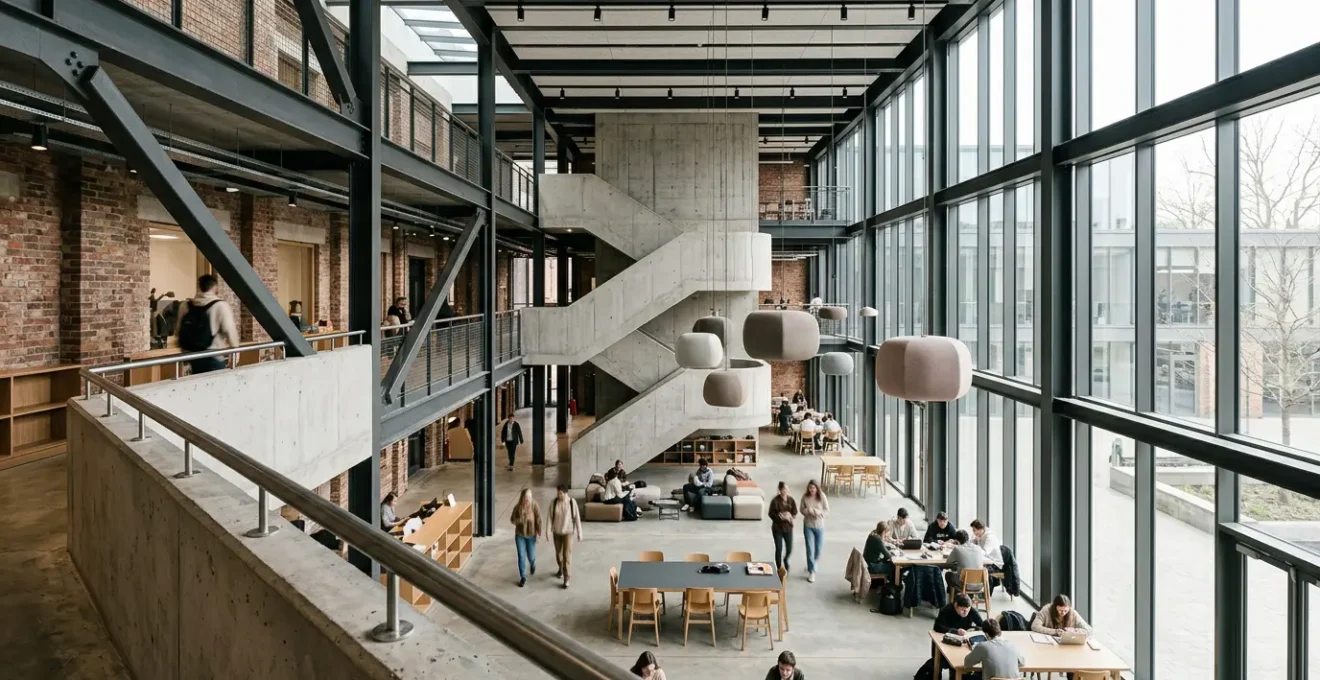
The traditional model of siloed classrooms and isolated departments is an architectural relic that stifles the very collaboration modern creative education seeks to foster. The power of open-plan layouts lies not in the absence of walls, but in the deliberate cultivation of what is known as socio-spatial programming. This is the art of designing spaces that engineer serendipitous encounters, visual cross-pollination, and informal peer-to-peer learning. When a graphic design student can see the work of a sculpture student in their peripheral vision, or a coder walks past a textile workshop, the potential for unexpected creative fusion multiplies.
These are not just theoretical benefits; they are being implemented at a significant scale. Leading institutions are re-imagining their entire estates around this principle of a distributed collaborative network. For instance, The Bartlett School of Architecture hosts over 1,700 students and 400 staff working across multiple sites, creating a vast transdisciplinary hub. Their transformation of 22 Gordon Street and expansion into the UCL East campus on the Queen Elizabeth Olympic Park is a testament to this philosophy, bringing disparate faculties together to fuel research and engagement.
The key for a civic architect is to design for “visual permeability.” This involves using internal glazing, varied floor levels, and shared “collision spaces” like project areas or cafes that are strategically placed on circulation routes. The goal is to make the creative process visible and accessible, transforming the building itself into a passive mentor and an active catalyst for cross-disciplinary innovation.
How to Retrofit Victorian Civic Buildings for High-Tech Multimedia Arts?
Adapting the UK’s rich stock of Victorian civic buildings for 21st-century multimedia arts presents a profound challenge: how to weave high-tech infrastructure into a delicate heritage fabric without compromising its historical integrity. The answer lies in treating the building not as a static shell, but as a partner in a dialogue. The goal is not to hide the new, but to create a respectful and legible conversation between old and new materials and technologies. This requires a mindset of “reversible intervention,” where modern additions can be removed in the future without permanently scarring the original structure.
This approach moves beyond simple conservation to see heritage as an active asset. The texture of aged brick, the volume of a vaulted hall, or the intricacy of ironwork can provide a powerful, authentic backdrop that a new build can never replicate. The contrast between a raw Victorian wall and a sleek glass multimedia pod creates a dynamic tension that enriches the user’s experience. This strategy requires meticulous planning and a deep understanding of both historic materials and modern technical demands.
The process is complex, but a clear methodology exists for civic leaders to follow. It involves a synthesis of cutting-edge survey technology and established conservation principles to ensure every decision is informed and deliberate. The focus is on consolidating services, using modular systems, and documenting everything to create a building that is both a historical artefact and a future-proofed creative tool.
Your Action Plan: Key Steps for a Sensitive Tech Retrofit
- Assess Significance: Conduct detailed building surveys using 3D laser scanning technology to precisely map and understand the heritage fabric before any design work begins.
- Apply Reversibility: Implement ‘reversible intervention’ strategies by using modular, self-contained tech pod systems that touch the original structure lightly.
- Consolidate Services: Group modern services like HVAC, data, and power into discrete, carefully placed vertical cores to minimise widespread disruption to historic walls and floors.
- Document & Reuse: Catalogue all original materials that are disturbed, with a clear strategy for their reuse within the project, contributing to a circular economy approach.
- Isolate Impact: Integrate high-performance acoustic and vibrational isolation systems from the outset to contain the impact of multimedia activities and protect both the building and its users.
The Acoustic Oversight That Ruins Spoken Word Performances in Shared Hubs
One of the most common and catastrophic failures in multi-use cultural hubs is acoustic oversight. A space designed to be a vibrant, open community hub during the day can become an unusable echo chamber for an intimate spoken word performance or a film screening at night. The mistake is designing for a single acoustic scenario. A visionary architect must instead implement strategic acoustic zoning, creating a building with multiple, variable acoustic personalities that can be adapted to the specific needs of each event.
This goes far beyond simply adding a few sound-absorbing panels. It involves a deep analysis of reverberation times, sound transmission between adjacent spaces, and background noise from HVAC systems. The intensity of use in modern creative centres makes this critical; for example, the Roundhouse in London has hosted over 30,000 hours of creative studio use in 20 years, demonstrating the immense acoustic demands placed on such a venue. A failure in acoustic design doesn’t just reduce quality; it renders parts of a multi-million-pound investment unfit for purpose.
The solutions are both architectural and technological. They include the use of heavy, full-height curtains, retractable acoustic walls, and variable absorption panels whose surfaces can be changed to either reflect or absorb sound. By thinking about the materiality of sound from the project’s inception, a space can be tuned like an instrument. It can be bright and lively for a bustling café, then become warm, dead, and intimate for a poetry slam just a few hours later, maximising the building’s utility and commercial potential.
Purpose-Built Centres or Refurbished Heritage Sites: Which Inspires More Youth?
The debate between a gleaming, purpose-built cultural centre and the complex refurbishment of a heritage site often revolves around cost and efficiency. However, for a project aimed at youth engagement, the most important metric should be inspiration. While a new building offers a blank canvas, a refurbished heritage site offers something far more powerful: a narrative. An old railway engine shed, a disused mill, or a former town hall tells a story of transformation that can deeply resonate with young people navigating their own paths of change and self-discovery.
The Roundhouse in London stands as a world-class example. Originally built in 1846 as a railway locomotive shed, its unique circular form and raw industrial character were not erased but celebrated during its conversion into a cultural venue. The survival of its cast-iron columns, turntable, and original flooring provides a tangible link to the past. This Grade II* listed building demonstrates that industrial heritage is not a liability but a unique creative stimulant. It provides an authentic sense of place and a “wow factor” that a generic new build struggles to match.
This sense of authenticity is crucial for engaging younger audiences who are often wary of sterile, corporate environments. The raw textures, epic scale, and visible history of a refurbished site provide a backdrop for creativity that feels grounded and real. It tells them that their community has a history of innovation and that they are the next chapter in that story. For a civic leader, choosing to refurbish a heritage site is not just an act of preservation; it is a strategic decision to invest in a building with a soul, creating a powerful symbol of urban resilience and renewal.
When to Initiate Public Consultations for a New Neighbourhood Cultural Hub?
The traditional model of public consultation is often a tokenistic exercise, where architects present nearly-finished plans to a community for “feedback” when all major decisions have already been made. This approach breeds cynicism and leads to spaces that fail to meet genuine community needs. To create a truly successful neighbourhood hub, a civic leader must abandon this model and embrace a process of deep, participatory co-design. This means the first conversation with the community should happen before the first line is ever drawn on a blueprint.
The crucial shift is to initiate co-design workshops with community leaders, artists, and residents *before* the formal project brief is even written. This allows the community’s aspirations, memories, and practical needs to shape the project’s core purpose from the outset. This pre-briefing phase is the single most important step in de-risking a multi-million-pound investment, ensuring that what gets built is what is actually wanted and needed. It transforms the community from a passive recipient into an active partner in the design process.
This early engagement builds trust and ownership, turning potential objectors into the project’s most passionate advocates. As the design develops, this partnership can be deepened using innovative tools like ‘test and learn’ pop-up activities on the proposed site to gather real-world data, or VR walkthroughs of early concepts to get intuitive feedback on spatial experiences. This iterative process ensures the final building is not an architect’s vision imposed upon a neighbourhood, but a physical manifestation of the community’s collective ambition.
Why Do Subsidised Cultural Hubs Increase Footfall for Neighbouring Retailers?
A subsidised cultural hub should not be viewed by a local council as a financial drain, but as a strategic investment in the local economy. These centres act as powerful “anchor institutions,” drawing a consistent and diverse stream of people into a neighbourhood, which directly translates into increased revenue for surrounding businesses. This is not anecdotal; the footfall generated by a successful arts venue is substantial. Major venues like the Roundhouse, for example, attract an audience of 400,000 people annually, a significant portion of whom will spend money at local cafes, bars, and shops.
The key to maximising this positive economic externality is to understand that different types of cultural programming generate different patterns of footfall. A one-off evening concert creates a high-intensity surge for pre-show dinners and post-show drinks. Conversely, a free-to-enter gallery or a popular café provides a steady, ambient flow of visitors throughout the day, benefiting local boutiques and services. Youth workshops create regular, predictable traffic during after-school hours. By curating a diverse programme, a cultural hub can inject economic activity into a neighbourhood across different times of the day and week, increasing resilience for local retailers.
The following table, based on analysis from bodies like the Arts Council, illustrates how a varied programme creates a multi-layered economic impact.
| Programming Type | Footfall Pattern | Retailer Impact | Time Window |
|---|---|---|---|
| Specific Events (concerts) | High-intensity peaks | Restaurants, bars | Evening surge |
| Ambient Offerings (café, gallery) | Steady daily flow | Cafés, boutiques | Daytime consistent |
| Youth Workshops | Regular weekly patterns | Local services | After-school hours |
| Festival Programming | Multi-day intensity | Hotels, transport | Extended periods |
For a council director, this means the design of the hub and its programming strategy are inseparable from the wider economic development goals for the area. The building is not an isolated island but the pulsing heart of a commercial ecosystem.
Why Do Independent Studios Drive Urban Regeneration Faster Than Retail Parks?
The traditional model of urban regeneration often involves large-scale, top-down developments like retail parks. While these projects promise jobs and investment, they frequently create monolithic, sterile environments that lack character and resilience. A far more agile and authentic form of regeneration is driven by the clustering of independent creative studios. This “low-overhead, high-innovation” model creates a dense, collaborative ecosystem that revitalises a neighbourhood from the ground up, fostering a unique identity that cannot be replicated.
The economic structure of the arts and culture industry is the key to its regenerative power. Unlike the retail sector, which is dominated by large corporations, the creative industries are a network of micro-enterprises. In the UK, a staggering 92% of arts and culture businesses have one or no employees. This means that a refurbished warehouse converted into 20 small studios brings 20 independent, agile businesses into an area, compared to a single large retail unit. This density creates a vibrant street life and a robust local economic network through informal knowledge sharing and collaboration.
This creative clustering effect is what drives true urban regeneration. The influx of artists and makers attracts specialist suppliers, independent cafes, and galleries, creating a unique neighbourhood character. This authenticity, in turn, draws in more residents and visitors, increasing property values and creating a positive feedback loop of investment and growth. For a civic leader, supporting the development of affordable studio space is a far more sustainable and impactful regeneration strategy than simply chasing a large retail anchor tenant. It is an investment in human capital and local identity, not just in bricks and mortar.
Key Takeaways
- Shift from Building to Catalyst: View a cultural hub not as a static container, but as a dynamic engine for creative, social, and economic change.
- Embrace the Economic Multiplier: Frame the project as a high-return investment, using data on footfall and local spending to justify public funding.
- Prioritise Co-Design over Consultation: Engage the community as a design partner before the brief is written to de-risk the project and ensure genuine long-term value.
How Regional Arts Funding Impacts Local Business Revenue Across the UK?
The decision to allocate public funds to a new cultural hub is often subject to intense scrutiny. However, the data provides a clear and compelling justification: arts funding is not a subsidy, but a powerful economic investment with a quantifiable return. This is the crucial concept of the “economic multiplier effect.” For every pound of public money invested in the arts, a significant and measurable amount of economic activity is generated in the wider local economy through job creation, supply chain spending, and increased tourism.
The figures are compelling. As the Centre for Economic and Business Research highlights, the impact cascades through the economy. Their analysis provides a powerful metric for any council director making the case for investment:
For every £1 of salary paid by the arts and culture industry, an additional £2.01 is generated in the wider economy through indirect and induced multiplier impacts.
– Centre for Economic and Business Research, The Value of Arts and Culture to the People and Society
This return is not a theoretical concept. Data from Arts Council England demonstrates that public investment generates substantial tax revenue, effectively paying for itself over time. Their research shows that for every £1 of public arts funding, an average of £5 in tax revenue is generated. This funding is distributed nationwide, with Arts Council England investing £446 million annually from 2023 to 2026 across nearly 1,000 organisations, with a strategic increase in funding for regions outside of London. This national strategy ensures that the economic benefits of culture are felt in local economies across the UK, supporting everything from theatres and museums to libraries and dance companies.
By embracing this strategic, evidence-based approach, civic leaders can move beyond simply commissioning buildings and begin architecting thriving, resilient, and creative communities for the future. The next step is to apply this framework to your own local context and champion a new era of culturally-led regeneration.
Frequently Asked Questions on Designing Community Cultural Hubs
Should consultation begin before the formal project brief is written?
Yes, absolutely. Initiating co-design workshops with community leaders and residents before the formal brief is drafted is a critical step. This allows the community to fundamentally shape the project’s core purpose from the very beginning, embedding their needs and aspirations into the project’s DNA according to participatory design principles.
When should digital twin and VR technologies be introduced in consultations?
These powerful visualisation tools are most effective when introduced after the initial concept has been developed but before the detailed design phase begins. Using VR walkthroughs at this stage allows residents to provide highly intuitive feedback on spatial experiences, atmosphere, and flow, which is far more valuable than asking them to interpret abstract 2D plans.
How long should ‘test and learn’ pop-up phases run before finalizing design?
For maximum benefit, pop-up cultural activities should be run for a significant period, ideally 6 to 12 months, on or near the proposed site. This timeframe is necessary to gather robust, real-world data on actual community usage patterns, test different programming ideas, and understand seasonal variations before finalising the architectural programme and committing to a final design.