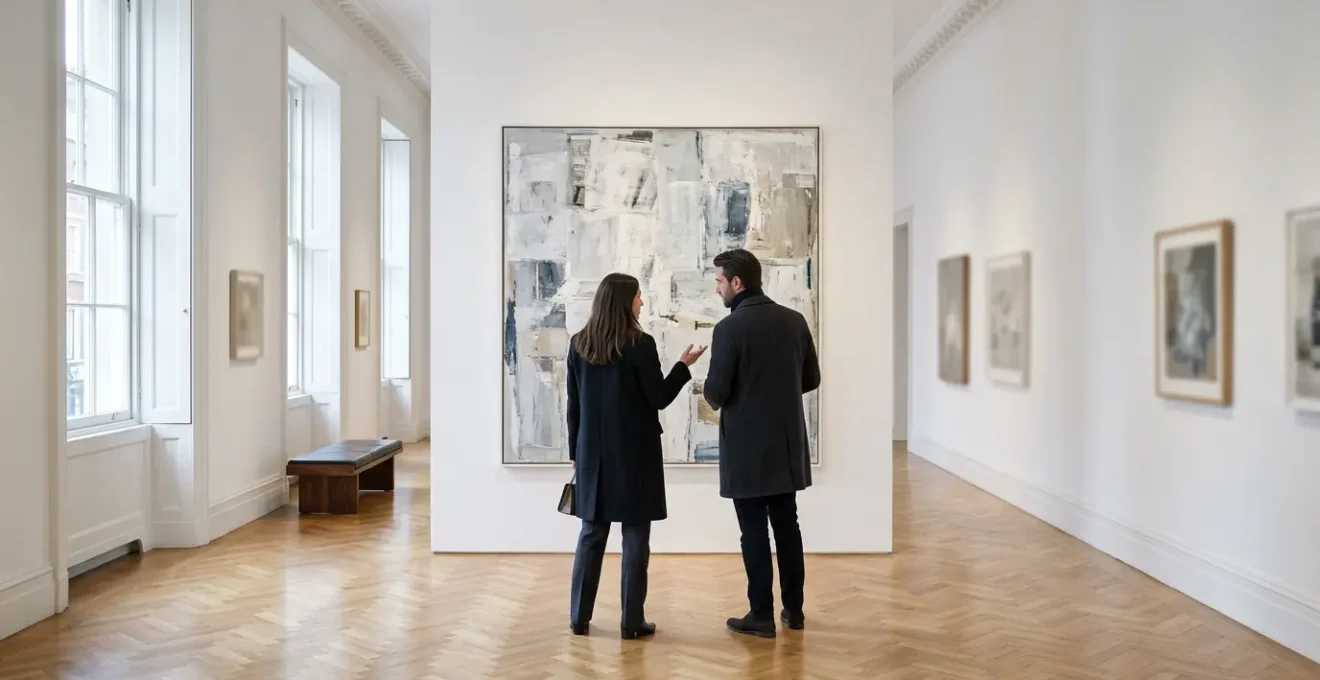
Contrary to popular belief, a £5,000 budget is not your entry ticket into London’s serious art scene; it’s the price of your audition.
- Elite galleries are not retail spaces; they are curated networks that prioritise long-term relationships over one-off sales.
- Your initial approach is a test of your potential as a collector, where demonstrating knowledge and etiquette (cultural capital) is more important than your bank balance.
Recommendation: Shift your mindset from ‘buying’ to ‘building rapport’. Your first purchase is the foundation of a relationship that grants future access to the best works.
The allure of London’s art scene is undeniable. For a successful professional, the desire to transition from admirer to collector is a natural step, a way to translate professional success into cultural legacy. Yet, the hushed, minimalist interiors of Mayfair galleries can feel more intimidating than a boardroom. You have a budget—say, a respectable £5,000 for a first piece—but a sinking feeling that a simple email inquiry will vanish into a digital void. You are not wrong.
Common advice often misses the point. You will be told to “buy what you love” or “visit as many galleries as possible.” While not incorrect, this counsel fails to address the fundamental misunderstanding most new buyers have about this ecosystem. A high-end gallery is not a shop. It operates within a sophisticated, relationship-based economy where trust and credibility are the primary currencies. They are not merely selling objects; they are placing an artist’s career into the hands of custodians. Your first approach is, therefore, less of a transaction and more of an audition.
This guide is not about telling you what to buy. It’s about decoding the unwritten rules of engagement. It will equip you with an insider’s perspective, transforming you from an ‘unverified’ inquiry into a ‘collector-in-the-making’ that gallerists are eager to cultivate. We will move beyond the platitudes and explore the strategic steps required to not only make your first acquisition but to lay the groundwork for a lifetime of collecting.
This article provides a clear roadmap for navigating this exclusive world. From understanding the gallery’s perspective to cultivating the relationships that unlock a deeper level of access, you will learn the precise etiquette and strategies to make your first purchase a success.
Summary: A Strategic Guide to Your First London Art Acquisition
- Why Do Top Mayfair Galleries Ignore Inquiries from New Unverified Buyers?
- How to Secure Your First Original Canvas From a Reputable UK Gallery?
- The Private Viewing Mistake That Immediately Flags You as an Amateur
- Independent Art Advisor or Direct Gallery Purchase: Which Saves You More Money?
- When to Request a Discount on Contemporary Canvas Pieces Without Offending?
- How to Leverage Small Initial Purchases to Access the Hidden Back Room?
- Why Do Elite London Dealers Keep Their Best Inventory Off the Public Website?
- How to Cultivate Meaningful Relationships with UK Gallerists for VIP Access?
Why Do Top Mayfair Galleries Ignore Inquiries from New Unverified Buyers?
The silence that meets a generic email—”I’m interested in your artists, what do you have for around £5,000?”—is not arrogance; it’s a highly efficient filtering mechanism. A top gallery receives dozens of such inquiries daily. They are not filtering for wealth, but for seriousness. Their primary responsibility is to their artists: to build their careers, protect their market value, and place their works with collectors who will become long-term advocates, not fleeting speculators. An unverified buyer presents a risk. Are you a genuine enthusiast or a decorator looking for a colour match? Will you hold the work, or flip it at auction next year, potentially damaging the artist’s market?
To bypass this filter, you must demonstrate cultural capital before you even mention your budget. This means showing you have invested time and effort. Your initial contact should prove you are not a novice. It must signal that you understand the gallery’s programme, you have a specific interest, and you respect the unwritten rules of this world. This is your audition, and passing it requires careful preparation to build a baseline of credibility. It’s about showing you’ve done your homework and are approaching them as a potential partner in the artist’s journey, not just as a customer.
Your Action Plan: Building a Credibility Packet
- Initial Reconnaissance: Follow at least five target galleries and their key artists on social media. Observe their exhibition schedule and the discourse around their work for a minimum of 30 days before contact.
- Field Study: Attend a gallery opening or a public viewing with the sole intention of observing. Note the etiquette, the nature of conversations, and the general atmosphere. Do not try to engage or purchase.
- Informed Inquiry: Draft your initial email. Reference a specific, current artwork or exhibition. State what you are looking for in terms of style or concept, not just budget, and show you are open to their guidance.
- Demonstrate Knowledge: Ask one specific, intelligent question about an artist’s technique, recent evolution, or a particular body of work. This signals genuine interest over a purely financial one.
- Establish Your Trajectory: Briefly mention any art you already collect, even if it’s prints or works by emerging artists. This provides context and shows you are already on the path of a collector.
How to Secure Your First Original Canvas From a Reputable UK Gallery?
Securing a piece from a reputable gallery is a process of deliberate and respectful courtship. London’s art market is a global powerhouse; a 2024 report confirmed that London remains the second-largest art market in the world after New York. In this competitive environment, you cannot simply walk in and expect to buy a significant work off the wall. The path to acquisition is paved with preparation.
The goal is to transform yourself from a stranger into a familiar, welcome face. This involves immersing yourself in the gallery’s world long before you signal an intent to purchase. Attend graduate shows at the Royal College of Art or the Slade; the artists you see there may be represented by major galleries in a few years. Sign up for newsletters from leading galleries like Victoria Miro or The Approach to get early information on exhibitions. By the time you introduce yourself to a gallery assistant, they should ideally have a flicker of recognition, having seen you at openings or engaging thoughtfully online. This slow, steady engagement demonstrates a commitment to the art itself, not just the transaction.
When you do make your approach, your prior research allows you to speak with specificity. Instead of “I like abstracts,” you can say, “I’ve been following the new series by [Artist’s Name] and was particularly struck by the use of texture in their piece at the last show.” This is the language of a collector. It invites a meaningful conversation with the gallery staff, who are the knowledgeable gatekeepers and your greatest allies in this journey. They are trained to identify and nurture genuine interest, and showing it is your key to the door.
The Private Viewing Mistake That Immediately Flags You as an Amateur
You have successfully navigated the initial steps and secured a private viewing. The gallery director quietly leads you into a pristine, white-walled room where the canvas awaits. The silence is heavy with expectation. It is in this moment that the most common and revealing mistake is made: filling the silence with nervous, uninformed chatter. The amateur feels a compulsive need to perform knowledge, offering immediate, superficial judgments or asking basic questions about price and dimensions.
The seasoned collector does the opposite. They embrace the silence. As noted in a guide on the power of educated silence, the best collectors will spend five to ten minutes simply looking at a work without speaking. This is not an affectation; it is an act of informed contemplation. It signals confidence and respect for the artwork. You are allowing the piece to reveal itself to you, and in doing so, you are revealing your seriousness to the gallerist. They are observing your process, judging your eye and your patience.
When you do speak, the quality of your question is paramount. Avoid anything that can be answered by a label. Instead, your questions should open a dialogue about the work’s context and significance. A gallery etiquette expert suggests framing questions that show you’re thinking about the artist’s career, not just the single object:
Where does this piece fit into the artist’s recent evolution?
– Gallery etiquette expert, Art Galleries and the Business of Buying Art in London
Asking about the work’s place in the artist’s oeuvre, its technical challenges, or its dialogue with art history demonstrates that you are thinking like a collector. You are assessing its long-term value and story, not just its decorative appeal. This is the single most effective way to communicate your potential and to be remembered long after the viewing is over.
Independent Art Advisor or Direct Gallery Purchase: Which Saves You More Money?
As you contemplate your first £5,000 purchase, a critical question arises: should you go it alone or hire an independent art advisor? The answer hinges on your long-term goals. Financially, the direct approach seems obvious. An advisor typically charges a commission of 10-20%, which on a £5,000 piece amounts to a significant £500-£1,000 fee. Buying directly from the gallery has no such upfront cost.
However, the calculation is not purely financial. The primary asset you are building with your first purchase is not the artwork itself, but your relationship with the gallery. When you buy directly, you are investing your ‘social capital’ in that institution. You become a known entity, a client who has shown commitment. This direct rapport is invaluable; it is the currency that grants future access to private viewings, artist dinners, and the much-coveted ‘back room’ inventory. An advisor, while offering expert guidance, acts as an intermediary. The relationship is formed with them, not with you. The gallery sees a transaction facilitated by a professional, not the birth of a new collector they should personally nurture.
For a new collector, the gallery’s own staff are often the best advisors, and their guidance is part of the service. They possess unparalleled knowledge of their artists’ careers. The standard gallery model operates on a commission from the artist’s sale price—often a 50% standard gallery commission—which funds their expertise, exhibition space, and promotional efforts. Your purchase supports this entire ecosystem. The choice between an advisor and a direct purchase therefore becomes a strategic one, as this table illustrates.
| Aspect | Independent Advisor | Direct Gallery Purchase |
|---|---|---|
| Commission Cost | 10-20% (£500-£1,000) | £0 |
| Relationship Building | Indirect/Limited | Direct with gallery |
| Future Access | Depends on advisor | Builds personal standing |
| Expert Guidance | Professional throughout | Gallery staff assistance |
| Time Investment | Minimal | 30-60 days preparation |
For your first purchase, the strategic advantage lies in forging a direct bond. The money you ‘save’ on an advisor’s fee is better thought of as capital you are investing in your own reputation within the gallery system. This is the foundation of your future patronage trajectory.
When to Request a Discount on Contemporary Canvas Pieces Without Offending?
In the world of contemporary art, the question of asking for a discount is perhaps the most delicate dance of all. Approached incorrectly, it can instantly mark you as a crass bargainer, undoing all the credibility you have carefully built. The cardinal rule for your very first purchase is simple: never ask for a discount. Paying the full asking price is a powerful, non-verbal signal. It communicates that you respect the artist’s work, you value the gallery’s role, and you are a serious collector, not a bargain hunter. This act establishes a baseline of goodwill that will pay dividends in the future.
Discounting, or offering ‘collector pricing’, is a privilege reserved for established relationships. It is a gallery’s way of rewarding loyalty and encouraging repeat business. The etiquette for approaching this follows a clear, unwritten timeline. It might be appropriate on your second purchase, particularly if you are acquiring multiple works at once, to gently inquire about “flexibility for a repeat collector.” The language is crucial; it frames the request as part of an ongoing relationship, not a one-off haggle. For pieces on the secondary market (works being resold), negotiation is more commonplace and expected, with a 10-15% discount often being achievable.
The timing of your purchase can also create opportunities. Galleries are often more flexible towards the end of an exhibition, as they need to clear walls for the next show, or during traditionally quiet periods like August and January. However, this should always be a secondary consideration. Your primary focus must remain on demonstrating genuine appreciation for the art. The most successful collectors are those who understand that the greatest value they receive is not a 10% discount, but the long-term trust and access granted by the gallery.
How to Leverage Small Initial Purchases to Access the Hidden Back Room?
Your first £5,000 purchase is not the destination; it is the key that can, with correct use, unlock the door to the gallery’s inner sanctum. The ‘back room’—a physical or metaphorical space where a gallery holds works not on public display—is where the real collecting begins. Access is not granted based on the size of your first cheque, but on the quality of your conduct afterwards. Your post-purchase behaviour is a critical part of your ongoing audition.
Immediately after the artwork is delivered, your ‘post-purchase protocol’ should begin. A simple, sincere thank-you email to the gallerist reinforces your appreciation. A month later, sharing a high-quality photograph of the artwork installed in your home, perhaps with a thoughtful caption on social media tagging the artist and gallery, is a powerful gesture. It shows you are a proud custodian, giving the work a good home. This is precisely what galleries want to see. This consistent, respectful engagement keeps you on their radar and builds your profile as a committed collector in a market where the number of transactions in the global art market grew to 40.5 million in 2024.
Continue to be a presence. Attend the gallery’s next few openings, say hello to the staff, and reference your purchase. This builds a narrative of sustained interest. After about six months of this consistent, low-pressure engagement, the time is right to make your move. You can approach the gallerist and say, “I continue to enjoy the piece by [Artist’s Name] so much. I’m now curious about their earlier studies or works on paper. Do you happen to have anything not currently on display?” This is the polite, insider’s way of asking to see the back room. You are not demanding access; you are expressing an educated, evolving interest, which is the most compelling invitation you can offer.
Why Do Elite London Dealers Keep Their Best Inventory Off the Public Website?
As you browse gallery websites, you may notice a curious phenomenon: the most exciting, career-defining works by their top artists are often nowhere to be found. This is not an oversight. It is a deliberate and fundamental strategy of the primary art market. The public website is for the public; the best inventory is reserved for a tiered list of trusted collectors. This exclusivity serves two critical purposes: it protects the artist and it rewards patronage.
Firstly, offering a masterpiece privately prevents it from being ‘shopped around’ or over-exposed, which can devalue the work and the artist’s brand. It maintains an aura of scarcity and desirability. Secondly, and more importantly, it is the primary mechanism through which galleries maintain their relationship-based economy. The privilege of having the first right of refusal on a new work is the most valuable currency a gallery can offer its best clients. It is a reward for their loyalty, their championing of the gallery’s programme, and their commitment as long-term custodians of the art.
Case Study: The Rise of Private Sales at Auction Houses
The strategy is not limited to galleries. Top auction houses like Christie’s and Sotheby’s have increasingly focused on this model. While their public auctions saw declines, an Art Basel report noted that private sales advanced by 14% year-on-year. This shift demonstrates that at the highest levels of the market, the most valuable inventory is changing hands through discreet, relationship-driven transactions, far from public view. This maintains exclusivity and maximizes value for a select group of collectors.
A London gallery director put it succinctly: they are cultivating a hierarchy of access. To get on that list, you must first prove your worth as a collector through smaller, thoughtful purchases and sustained engagement.
The best works are often sold before a show even opens. They are offered privately and sequentially to a tiered list of collectors.
– London Gallery Director, Art Market Analysis
Understanding this hidden architecture is key. Your goal as a new collector is not to find a masterpiece on a website, but to earn a place on the list of people who are offered it before it ever gets there.
Key Takeaways
- Collecting is a marathon, not a sprint: Your first purchase is the start of a long-term relationship, not a one-off transaction.
- Cultural capital over financial capital: Demonstrating knowledge, etiquette, and genuine interest is more valuable than flashing a large budget.
- Access is earned, not bought: The path to the best artworks is paved with loyalty, trust, and consistent engagement with a gallery’s program.
How to Cultivate Meaningful Relationships with UK Gallerists for VIP Access?
The journey from a first-time buyer to a valued patron with VIP access is a multi-year process built on the foundations of predictability and genuine ambassadorship. With sales in the UK art market reaching $10.4 billion in 2024, you are entering a significant cultural and economic sphere. Your goal is to become part of its fabric. This is achieved by evolving from a client into a trusted member of the gallery’s community.
The first year is about consistency. Make one or two thoughtful purchases from the same gallery to establish your commitment. Attend every opening, not just for the art but to become a familiar face. Remember the names of the staff, from the director down to the junior assistants—they are the future leaders of the art world. In your second year, you can begin to act as a ‘micro-ambassador’. If you have friends who are genuinely interested in collecting, introduce them to the gallery. This act of bringing new, serious enthusiasts into their circle is immensely valuable and will be noted.
By the third year and beyond, the key is predictable patronage. A consistent purchase every 12 to 18 months, even if modest, establishes you as a reliable pillar of support for the gallery and its artists. This rhythm demonstrates a long-term commitment that is far more meaningful than a single, large, erratic purchase. You become someone they can count on. In return, you will be counted among their priority collectors. You will be invited to private dinners with artists, given early access to art fair previews, and, most importantly, you will be one of the first people they call when a truly exceptional piece becomes available. You will have completed the audition and earned your place in the inner circle.
Your journey into collecting begins not with a transaction, but with the first thoughtful step you take into a gallery. By approaching the art world with respect, curiosity, and a strategic, long-term vision, you can transform an intimidating process into a deeply rewarding pursuit. Start building your cultural capital today.