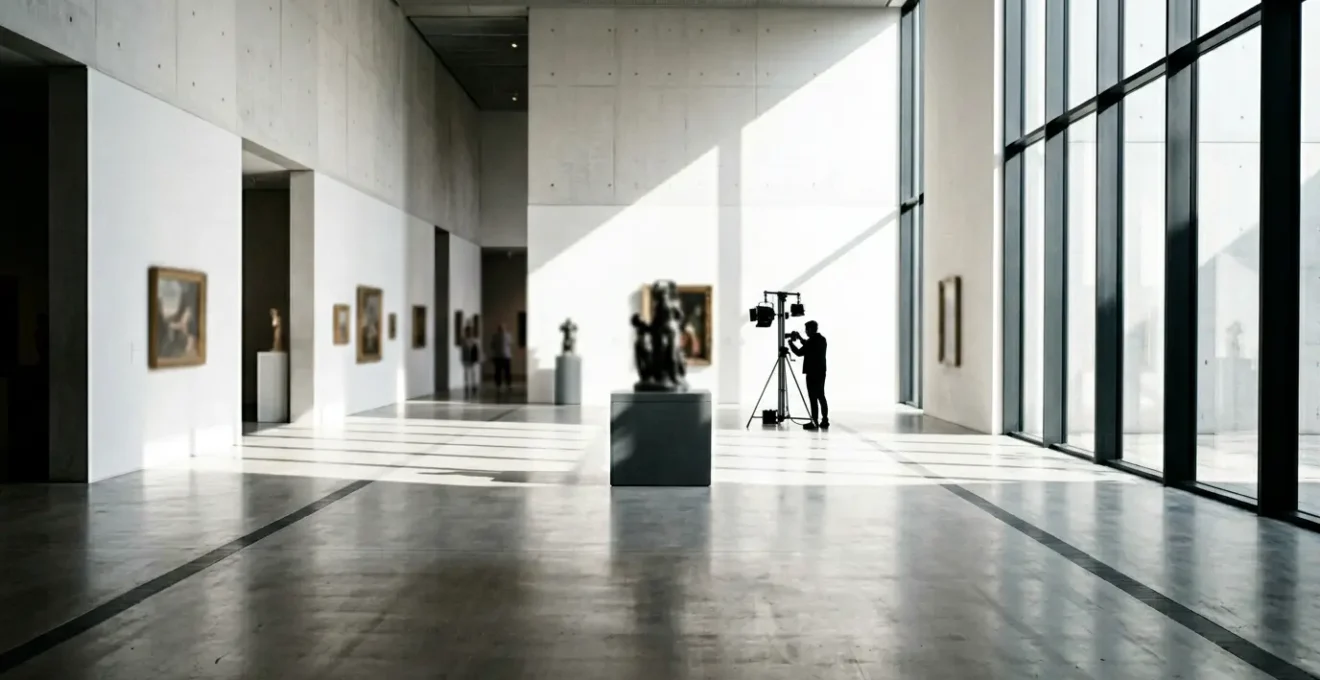
The true archival of a temporary exhibition lies not in creating a disposable VR tour, but in building a sovereign, permanent digital asset that preserves curatorial intent for generations.
- Photogrammetry is non-negotiable for capturing the material truth of objects, far surpassing simple video or 360° photos.
- Long-term survival depends on owning your data through platform-agnostic formats and physical backups like LTO tapes, which can outlast institutional bankruptcy.
Recommendation: Prioritize developing an in-house digital preservation policy that focuses on data sovereignty and archival-grade capture techniques over reliance on third-party viewing platforms.
For any museum director or chief archivist, the closing of a temporary exhibition represents a moment of profound loss. Months, sometimes years, of intense curatorial effort, storytelling, and physical arrangement vanish, leaving only catalogs and photographs as a faint echo. The standard response in the digital age has been to commission video walkthroughs or simple 360-degree photo tours. While these provide a fleeting glimpse, they are fundamentally marketing tools, not archival records. They fail to capture the material texture, the spatial relationships, and the nuanced lighting that constituted the core of the curatorial vision.
The central anxiety remains: how can the immense intellectual and artistic capital of an exhibition be preserved with integrity once the physical objects are dispersed? The answer is not found in creating another ephemeral digital product. Instead, it requires a paradigm shift. We must move from thinking about “virtual tours” to creating permanent, institutionally-owned archival assets. This involves a rigorous, technical approach to capture, hosting, and long-term storage that is resilient to technological obsolescence, platform closures, and even financial instability.
This article provides a technical framework for exactly that. It moves beyond the superficial to address the core challenges a preservationist faces: ensuring the digital replica is a faithful representation, that it remains accessible on the institution’s own terms, and that it is stored in a format that has a chance of surviving for a century or more. We will explore the specific technologies, the critical workflow decisions, and the long-term strategies required to transform a temporary show into a permanent, globally accessible record.
This guide offers a structured approach to the technical and strategic decisions involved in creating a true digital archive of a physical space. The following sections break down the critical components, from initial data capture to long-term storage, providing a roadmap for establishing a resilient preservation strategy.
Summary: A Technical Framework for Permanent Digital Exhibition Archives
- Why Do Photogrammetry Scans Preserve Curatorial Intent Better Than Video Tours?
- How to Host a 3D Gallery Replica on a Standard Institutional Web Server?
- The Lighting Rendering Issue That Makes Virtual Oil Paintings Look Flat
- Interactive 360 Photography or Fully Modelled VR: Which Suits Smaller Budgets?
- When is the Best Time to Scan a Physical Exhibition Without Disrupting Visitors?
- Physical LTO Tape Backups or Cloud Redundancy: Which Survives Institutional Bankruptcies Better?
- Why Do Poor Metadata Tagging Systems Render Massive Digital Collections Completely Unsearchable?
- How to Formulate a Long-Term Archival Strategy for Unstable Interactive Art?
Why Do Photogrammetry Scans Preserve Curatorial Intent Better Than Video Tours?
A video tour, no matter how high the resolution, is a passive and linear experience. It forces the viewer into a single, predetermined path and perspective, fundamentally violating the principle of visitor agency that is core to exhibition design. The curator’s careful arrangement of objects in space, designed to be discovered and experienced from multiple angles, is flattened into a single narrative. Furthermore, video fails to capture the material essence of the artifacts. The subtle texture of an oil painting’s impasto, the specific sheen of a ceramic glaze, or the intricate corrosion on a bronze sculpture are lost to video compression and fixed lighting.
Photogrammetry, by contrast, is a process of reconstruction. It is not about recording a view; it is about capturing the object’s form and surface as a dataset. By stitching together thousands of high-resolution photographs from every conceivable angle, the process creates a 3D model with volumetric and textural accuracy. This preserves the curator’s intent in several key ways. First, it restores visitor agency, allowing the remote user to navigate the space freely and examine objects from any viewpoint. Second, it captures the material truth of the artwork. The resulting digital object contains detailed information about its surface texture and color, which is essential for scholarly research and authentic viewing.
This method transforms the exhibition from a transient experience into a permanent, data-rich archival asset. While a video is a mere recording, a photogrammetry scan is a digital surrogate, a durable and measurable copy of the physical space and its contents. For any institution serious about long-term preservation, the choice is not one of preference but of archival principle. Video is documentation; photogrammetry is preservation.
How to Host a 3D Gallery Replica on a Standard Institutional Web Server?
Relying on third-party commercial platforms to host a digital exhibition archive introduces a significant long-term risk. These platforms can change their pricing, alter their terms of service, compress your data, or cease operations entirely, taking your institution’s cultural assets with them. Achieving true institutional sovereignty requires hosting the 3D replica on your own web infrastructure. While this may seem daunting, it is entirely feasible using standard, open-source web technologies that ensure longevity and control.
The primary components are a standard web server (like Apache or Nginx) and a client-side rendering engine built with WebGL, a JavaScript API that runs in any modern browser without plugins. The 3D models themselves should be in an open format like glTF (.gltf or .glb), which is the “JPEG of 3D” and is designed for efficient transmission over the web. The key technical challenge is not the hosting itself, but the optimization required to deliver a large, complex 3D scene smoothly over varying internet connections. This involves a multi-layered approach to asset management.
Effective delivery hinges on performance optimization. This isn’t just about server speed; it’s about intelligently managing the data sent to the user’s browser. Techniques like implementing Level of Detail (LOD) systems, which serve simpler versions of models when they are far from the virtual camera, are critical. Similarly, texture streaming and compression are essential for reducing initial load times. By mastering these configurations, an institution can ensure its archival asset is not only secure and owned, but also performant and accessible to a global audience directly from its own domain.
Action Plan: Configuring a Server for 3D Asset Hosting
- Configure MIME types: Ensure your Apache/Nginx server settings correctly identify .gltf, .glb, and .bin files to serve them properly.
- Implement Level of Detail (LOD): Set up systems that automatically load simplified, lower-polygon models for objects at a distance to reduce GPU load.
- Enable texture streaming: Use a format like Basis Universal compression to optimize texture delivery, dramatically reducing bandwidth and load times.
- Set up CORS headers: Configure Cross-Origin Resource Sharing (CORS) headers correctly if assets are loaded from a separate Content Delivery Network (CDN) for performance.
- Use standard web technologies: Build the viewer using standard HTML5, WebGL, and JavaScript to guarantee maximum compatibility and avoid proprietary, plugin-based solutions.
The Lighting Rendering Issue That Makes Virtual Oil Paintings Look Flat
One of the most common failings of digital art replicas is their inability to capture the way light interacts with a surface. An oil painting is not a flat image; it is a shallow-relief sculpture of dried paint. The glossy varnish, the thick texture of impasto, and the subtle variations in pigment create a complex play of specular highlights and shadows that define its character. When a painting is digitized using a single photograph or a basic scan, it captures only the albedo—the base color—and the result is a lifeless, flat image that betrays the artist’s technique and the curator’s lighting design.
To solve this, archivists must adopt the principles of Physically-Based Rendering (PBR). PBR is a computer graphics methodology that seeks to simulate the flow of light in a physically plausible way. Instead of just a color map, a true PBR material is composed of multiple data layers. Research into physically-based rendering demonstrates that at a minimum, four data types are required: the Albedo (base color), a Roughness map (defining how light scatters across the varnish), a Normal map (encoding the fine bumps and texture of the impasto), and a Specular map (controlling the intensity of reflections).
Capturing these layers requires specialized scanning techniques, but the result is transformative. The digital object can then be lit dynamically by the virtual environment, with light realistically glancing off the varnish and catching the edges of the brushstrokes. This restores the painting’s three-dimensional presence and preserves a critical aspect of curatorial intent: the mood and focus created by the exhibition’s physical lighting design.
Case Study: The Met 360° Project’s Lighting Realizations
During its Met 360° Project, the Metropolitan Museum of Art encountered this exact challenge. To capture the spaces authentically, the team removed protective vitrines from artworks and used specialized camera rigs. They quickly discovered that while 360° technology could capture the geometry of a space, the raw output often lost the carefully crafted ambiance. The project revealed that restoring the curator’s intended mood and focus required significant post-processing work to digitally redesign the lighting, proving that capturing light is as important as capturing form.
Interactive 360 Photography or Fully Modelled VR: Which Suits Smaller Budgets?
For institutions with limited budgets, the prospect of a full photogrammetry-based VR reconstruction can seem prohibitive. The decision often comes down to two primary alternatives: interactive 360° photography (typified by platforms like Matterport) and full VR created from photogrammetry. While they may appear similar to the end-user, they are fundamentally different in terms of cost, data ownership, and long-term archival viability. Making the right choice requires a clear understanding of these trade-offs.
Interactive 360° photography is significantly cheaper and faster to produce. It involves capturing a series of spherical photos from fixed points and linking them together to create a “dollhouse” walkthrough. However, the institution rarely owns the raw data and is often locked into a monthly subscription on a proprietary platform. If that platform shuts down, the archive disappears. Furthermore, this method provides only a surface-level view; users cannot move freely or examine objects in true 3D. It is suitable for exhibitions heavy on text panels or 2D works but fails to capture the essence of sculpture or detailed artifacts.
Full VR from photogrammetry has a higher initial cost but yields a permanent, ownable archival asset. The institution possesses the final 3D models and can host them independently, ensuring permanent access. This method is superior for preserving sculpture, installations, and any object where form and texture are paramount. The following table breaks down the key decision factors for an archivist.
| Factor | 360 Photography | Full VR (Photogrammetry) |
|---|---|---|
| Initial Cost | $5,000-15,000 | $25,000-100,000+ |
| Platform Fees | Monthly subscriptions (Matterport) | One-time hosting costs |
| Data Ownership | Platform-dependent | Full ownership of files |
| Suitable For | Gallery overviews, text-based art | Sculpture, detailed artifacts |
| Processing Time | 1-2 weeks | 1-3 months |
| Long-term Access | Risk of platform closure | Permanent archive possible |
A pragmatic approach for many institutions is a hybrid model. This involves using affordable 360° photography for general gallery navigation and circulation spaces while dedicating the photogrammetry budget to creating high-fidelity models of “hero” pieces—the most significant artworks in the exhibition. This “Hybrid Hero Piece Strategy” allows institutions to allocate resources strategically, ensuring the most critical artifacts receive archival-grade preservation while still providing a comprehensive overview of the entire exhibition space.
When is the Best Time to Scan a Physical Exhibition Without Disrupting Visitors?
One of the most significant logistical hurdles in a digital preservation project is the physical act of scanning. Both photogrammetry and laser scanning require controlled lighting and an environment free of public foot traffic. A single visitor walking through a shot can compromise a portion of the dataset, creating hours of corrective work. Therefore, scheduling the capture process requires careful strategic planning in coordination with curatorial, installation, and visitor services departments.
The ideal window for capture is often during the liminal phases of the exhibition’s life: just after installation is complete but before the official public opening, or immediately after it closes to the public but before the de-installation crew begins. These periods provide a clean, complete, and static environment. However, these windows can be extremely tight. A more flexible approach is a “patchwork” or “progressive” capture. This involves scanning the exhibition in sections during non-public hours over several days or weeks, such as on a designated closure day or overnight. The resulting datasets are then digitally stitched together in post-production.
There are several viable strategic windows, each with its own advantages and challenges:
- De-Installation Window: Schedule scanning immediately after the public closing but before any artwork is moved. This captures the exhibition in its final, complete state.
- Off-Hours Progressive Capture: Utilize overnight periods or scheduled closure days (e.g., “Maintenance Mondays”) for systematic, section-by-section documentation over the course of the exhibition.
- Patchwork Installation Scan: Capture completed sections of the gallery during the pre-opening setup phase and digitally assemble the full exhibition later.
- Live Digital Preservation Event: A more radical approach is to market the scanning process itself as a special public engagement event, demonstrating the museum’s commitment to digital preservation and offering educational value.
Ultimately, the chosen strategy must be a compromise between archival perfection and operational reality. The key is to secure dedicated, uninterrupted time in the space, a goal that requires buy-in from all institutional stakeholders from the project’s inception.
Physical LTO Tape Backups or Cloud Redundancy: Which Survives Institutional Bankruptcies Better?
While cloud storage offers convenience and apparent redundancy, it presents a critical long-term vulnerability for a memory institution: dependency. Cloud storage is a service, not an asset. If the institution faces a financial crisis and fails to pay its monthly bill, the service is terminated, and the data may be irretrievably deleted. In a bankruptcy scenario, a cloud subscription is a liability that gets cut, not a tangible asset to be transferred. This is where a physical, offline storage medium like LTO (Linear Tape-Open) tape demonstrates its profound archival superiority.
LTO is a magnetic tape data storage technology designed for high-capacity, long-term archiving. It is an open standard, meaning it is not controlled by a single company, which mitigates the risk of vendor lock-in. Current LTO-9 tapes store 18TB of uncompressed data, with a specified archival life of 30 years or more when stored in a climate-controlled environment. The core advantage in an institutional crisis is that an LTO tape is a physical, ownable asset. It can be held in a vault, legally transferred to a successor institution, or sold as part of the estate. The data exists independently of any ongoing subscription payment.
A robust archival strategy employs the “3-2-1” rule: three copies of the data, on two different media types, with one copy stored off-site. The Museum of Modern Art (MoMA) provides an exemplary model for this.
Case Study: MoMA’s LTO-6 Migration and Data Sovereignty Strategy
In its digital preservation efforts, MoMA transitioned to an LTO-6 tape-based storage system for its critical assets. Their strategy involves writing data to three separate tapes. Two are stored online or near-line for accessibility, while the crucial third copy is stored offline in a separate geographic location. This ensures that even in the event of a catastrophic failure at the primary site, the data survives. Crucially, this strategy guarantees that during any institutional crisis, these physical LTO tapes remain as tangible assets that can be legally secured and transferred, a guarantee no cloud provider can offer.
For an institution concerned with permanence, the cloud is for access and distribution, but LTO tape is for true preservation. It provides the ultimate safeguard for the institution’s digital legacy, ensuring it can survive the very institution that created it.
Why Do Poor Metadata Tagging Systems Render Massive Digital Collections Completely Unsearchable?
An archive without a catalog is not an archive; it is a hoard. This principle is brutally true in the digital realm. An institution can spend millions of dollars creating a petabyte-scale digital repository of its exhibitions, but if that data is not described with rich, structured, and searchable metadata, it is effectively lost. The inability to find a specific asset is functionally identical to it not existing at all. Poor metadata practices are the single greatest threat to the long-term usability of any digital collection.
The problem often stems from a lack of a standardized vocabulary or “schema.” If one archivist tags an object as “vase,” another as “vessel,” and a third with its French name “pot,” a search for “vase” will fail to retrieve all relevant items. This creates data silos within the archive itself. A robust metadata strategy must include a controlled vocabulary, an authority file for artist names, and a consistent schema (like Dublin Core, VRA Core, or a custom institutional framework) for describing key attributes: creator, date, materials, dimensions, provenance, and curatorial notes.
Consider a hypothetical search in a poorly tagged archive for an “18th-century French blue vase.” Without structured metadata, the system can only perform a simple text search on filenames or unstructured description fields. It might miss an object tagged as “Pot bleu, 1789, Sèvres” because the term “vase” and the searchable date “18th-century” are absent. The searchability of the collection becomes entirely dependent on the user’s ability to guess the exact terminology used by the original cataloger decades prior—an impossible task. Good metadata makes data findable over time; bad metadata is a slow-acting poison that renders an archive useless.
Therefore, a significant portion of any digital preservation budget must be allocated to the meticulous, often manual, process of metadata creation. It is not an afterthought but a core component of the archival process, as critical as the initial scan itself. It is the intellectual framework that gives the raw data long-term meaning and value.
Key Takeaways
- True preservation is about creating a permanent, ownable “archival asset,” not a temporary “virtual tour.”
- Technological sovereignty is paramount. Prioritize open standards (glTF) and self-hosting over proprietary, subscription-based platforms.
- Long-term survival depends on physical, offline backups. LTO tape is an archival-grade medium that can outlast institutional solvency, unlike cloud services.
How to Formulate a Long-Term Archival Strategy for Unstable Interactive Art?
While preserving static objects and spaces with photogrammetry is a complex but solvable problem, the archival of “born-digital” or interactive art presents a far greater challenge. These works often rely on specific, and frequently obsolete, hardware, software, programming languages, or operating systems. An artwork created in Macromedia Director in 1998 will not run on a modern computer. A simple backup of the source files is insufficient because the technological environment required for its execution has vanished.
A long-term archival strategy for such unstable media must therefore be multifaceted, focusing on preserving the work’s behavior and dependencies, not just its files. The first and most critical step is to archive the source code itself, along with any custom libraries and detailed documentation from the artist about their process and technical dependencies. This is the “master” record. However, this alone does not guarantee future access.
The next layer of strategy is emulation or virtualization. This involves creating a digital “container” that simulates the original hardware and software environment. An archivist might create a virtual machine running Windows 98 with the specific graphics card drivers and browser plugins needed to experience the artwork as intended. This entire virtual machine is then archived as a single, executable package. This approach preserves the look, feel, and interactive behavior of the original piece far more effectively than a simple video recording of someone else using it.
For works that cannot be emulated, the strategy shifts to migration. This involves re-coding the artwork in a modern, more stable language or platform (e.g., rewriting a Flash-based piece in HTML5 and JavaScript). While this ensures future accessibility, it is a form of interpretation and risks altering the original character of the work. It should only be undertaken with extensive documentation and, if possible, in consultation with the original artist or their estate. This comprehensive approach—combining source code archiving, emulation, and carefully considered migration—is the only viable path to ensuring that unstable, interactive artworks can survive for future generations to study and experience.
The ultimate goal of this entire process is to ensure the curatorial and artistic work invested in an exhibition endures. By adopting a rigorous, technical, and forward-looking archival policy, you transform a fleeting event into a permanent contribution to cultural knowledge. The first step is to begin the conversation within your institution and formulate a dedicated digital preservation strategy today.