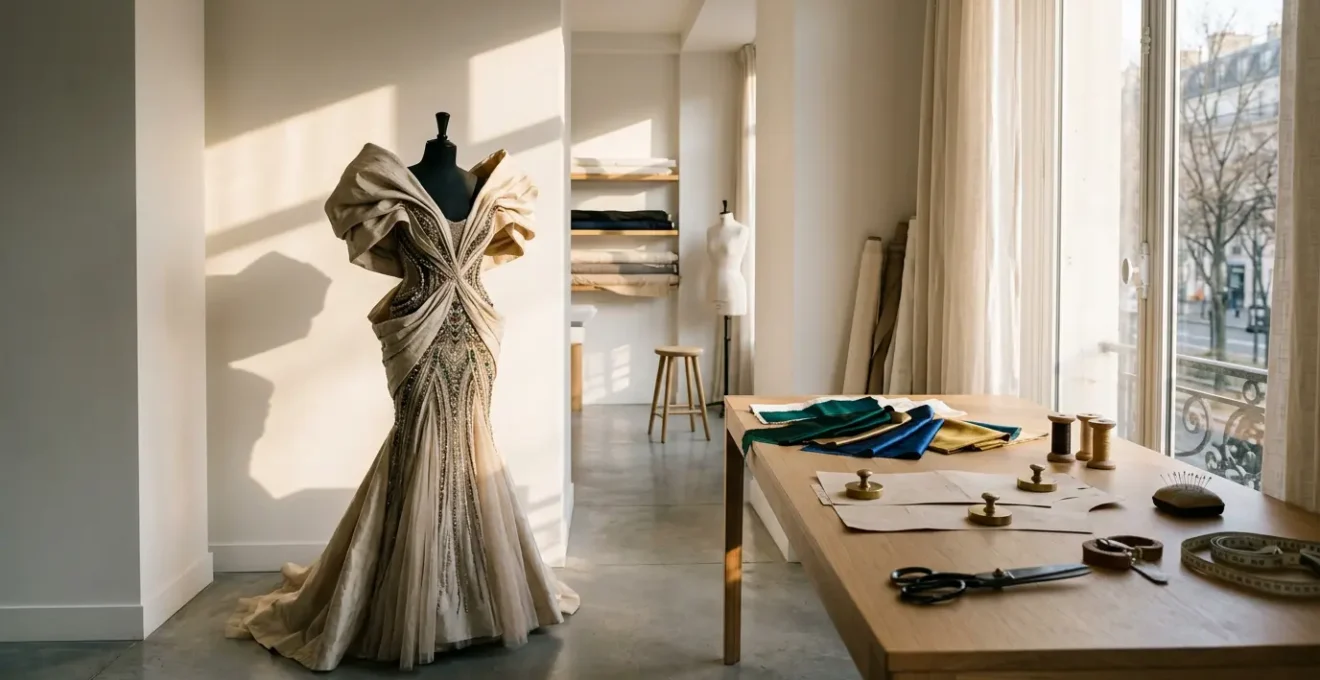
Stop thinking about a red carpet dress as an outfit; start treating it as a meticulously engineered media asset designed to generate quantifiable press coverage.
- Avant-garde, sculptural silhouettes are not just an aesthetic choice; they are a strategic tool proven to generate significantly more media engagement than classic designs.
- Commissioning a bespoke gown is a 6-month strategic campaign involving precise communication, architectural planning, and narrative control, not a last-minute shopping decision.
Recommendation: Shift your core question from “What should I wear?” to “What headline do we want to create, and how will this garment architect that story?”
In the ruthless theatre of the red carpet, particularly at a high-stakes event like the BAFTAs, arriving in a merely “beautiful” dress is a declaration of surrender. The emerging actress or public figure who aims to capture the zeitgeist understands a fundamental truth: the gown is not the goal, it’s the weapon. While others focus on classic elegance—a safe but silent choice—the strategist focuses on a silhouette that can hijack the news cycle. The objective isn’t to be well-dressed; it’s to become the conversation.
The common advice revolves around colour palettes and finding a “flattering fit.” This is tactical minutiae, not strategy. The real work lies in commissioning a piece of wearable art, a sculptural garment so compelling in its form and narrative that photographers have no choice but to linger and editors have no choice but to lead with your image. It’s about understanding that a dress’s success is not measured in compliments, but in column inches, social media velocity, and its power to become a cultural touchstone.
This is not a matter of taste, but of media physics. The difference between a forgotten look and an iconic moment is engineering. This guide deconstructs that process. We will move beyond the superficial and into the strategic framework of commissioning a bespoke sculptural garment. We will analyze why certain forms create disproportionate media value, how to manage the complex creation process, and how to leverage every stitch and seam into a powerful PR narrative that guarantees you don’t just walk the carpet—you own it.
This article provides a complete strategic roadmap for transforming a garment into a career-defining media moment. We will cover the data behind daring silhouettes, the practicalities of a couture timeline, the critical decisions in choosing a designer, and the art of building a narrative that resonates long after the flashbulbs fade.
Summary: A Strategist’s Guide to Red Carpet Domination
- Why Do Avant-Garde Silhouettes Generate 300% More Media Coverage Than Classic Dresses?
- How to Communicate Movement Constraints to a Designer Building a 30kg Dress?
- The Undergarment Flaw That Ruins the Architecture of a Sculptural Couture Gown
- Established Heritage House or Emerging Avant-Garde Designer: Which Secures Better Headlines?
- When to Begin Initial Fittings for a Bespoke Gown to Avoid Last-Minute Disasters?
- How to Negotiate Royalties for Your Digital Assets with UK Retail Chains?
- Why Do UK Department Stores Ignore Great Collections That Lack a Clear Pricing Strategy?
- How to Leverage Paris Runway Exposure to Secure Major UK Retail Orders?
Why Do Avant-Garde Silhouettes Generate 300% More Media Coverage Than Classic Dresses?
A classic, elegant gown earns a polite nod. A sculptural, avant-garde silhouette earns a headline. The reason is rooted in the basic economy of media attention: visual disruption creates value. A simple column dress is easily described and dismissed, but a complex, architectural form demands analysis, discussion, and, most importantly, screen time. It is inherently more “newsworthy.” This isn’t opinion; it’s a quantifiable reality. According to fashion industry analysis, celebrity red carpet appearances in standout pieces can boost designer brand searches by over 300% within 24 hours. That surge isn’t generated by a “nice” dress; it’s triggered by a look that is impossible to ignore.
The power of an avant-garde piece lies in its ability to fulfill several media functions simultaneously. First, it offers a distinct silhouette recognizable in thumbnails and across crowded social media feeds. Second, the best designs incorporate a ‘moment of motion’—a feature that comes alive as the wearer moves, creating dynamic photo opportunities that static dresses cannot offer. Think of layers that billow, structures that shift, or textures that catch the light in unexpected ways.
Finally, it provides what we call “narrative craftsmanship.” A story is built into the garment itself. When a publicist can brief the press that a piece, like those from innovators such as Iris van Herpen, required hundreds of hours of hand-stitching or utilized a groundbreaking 3D-printing technique, the dress ceases to be just clothing. It becomes a testament to artistry and innovation, giving journalists a deeper angle to explore. It’s the difference between reporting “Actress wears a red dress” and “Actress wears a 3D-printed ‘kinetic’ gown that took 700 hours to create.” One is a caption, the other is a feature story.
How to Communicate Movement Constraints to a Designer Building a 30kg Dress?
Commissioning a true sculptural garment means entering the world of bespoke creation, a process fundamentally different from standard dressmaking. The key to success is not just a clear vision, but a rigorous and detailed dialogue with the designer, especially concerning the garment’s physical realities. A 30kg dress is an engineering project as much as a fashion statement. Your ability to sit, walk, and even breathe depends on communicating constraints from the very first meeting. This is where understanding the bespoke process is non-negotiable.
Unlike made-to-measure, which merely alters a pre-existing pattern, bespoke tailoring creates a pattern from scratch based on dozens of measurements. This allows for the accommodation of unique body shapes and, crucially, for the planned integration of weight and structure. The dialogue must be brutally practical. You need to map out the entire event journey: how long will you be standing? Will you need to navigate stairs? Will you be seated for a two-hour ceremony? This “mission profile” dictates the architectural requirements. For example, discreet internal harnessing might be needed to distribute weight from the shoulders to the hips, or a seemingly rigid skirt might be engineered with hidden flexible panels to allow for seating.
This technical fitting is where the art of communication is paramount. It involves testing prototypes (a ‘toile’) not just for fit, but for performance. The table below illustrates the key differences in process, highlighting why bespoke is the only viable path for a truly architectural gown.
As the image above suggests, these fittings are intensive, hands-on sessions. Every potential point of failure—a seam under strain, a structural element that restricts a key movement—must be identified and solved. Your feedback must be precise. “It feels heavy” is useless. “The weight is pulling on my left shoulder when I raise my arm” is actionable data for the couturier.
| Aspect | Bespoke | Made-to-Measure |
|---|---|---|
| Pattern Creation | Pattern designed from scratch based on 20+ measurements | Alters a standard-sized pattern to fit |
| Fittings Required | Usually 2-3 fittings | 1-2 fittings typical |
| Timeframe | 2-3 months typical | 4-6 weeks typical |
| Body Accommodation | Adjusts for short/long necks, high/low shoulders, excess girth | Cannot adjust for these shapes and slopes |
The Undergarment Flaw That Ruins the Architecture of a Sculptural Couture Gown
A multi-thousand-pound sculptural gown can be rendered a catastrophic failure by a ten-pound mistake: the wrong foundation. The undergarment is not an accessory; it is the invisible architecture that supports the entire vision. In bespoke couture, the foundation garment is often designed and constructed in tandem with the gown itself. It is the load-bearing wall to the gown’s façade. Using an off-the-shelf corset or shapewear is one of the most common and disastrous errors a team can make. It introduces unpredictable lines, fails to support the garment’s weight correctly, and can create lumps or bumps that are magnified under the unforgiving glare of flash photography.
The structural integrity of a sculptural piece relies on a perfectly integrated foundation. This internal structure is often a masterpiece of engineering in its own right, using materials like horsehair canvas, silk organza, and custom boning to create a rigid yet flexible base. The selection of these textiles is obsessive, focusing on high-quality fabrics sourced from specialized suppliers. This foundation does more than just shape the body; it provides the anchor points for the external embellishments and ensures the garment’s weight is distributed correctly, allowing the wearer to move with a semblance of grace.
The problem arises when there’s a disconnect between the couturier and the stylist. The designer assumes a custom foundation will be used, while the team, in a last-minute rush, grabs a generic solution. This single flaw can cause the entire structure to sag, buckle, or hang incorrectly. The meticulously planned silhouette collapses. The press doesn’t see a couture masterpiece; they see an ill-fitting dress. Therefore, the budget and timeline for creating the integrated foundation garment must be treated as a non-negotiable line item from day one. It is the most critical investment in ensuring the architectural vision is perfectly executed on the red carpet.
Established Heritage House or Emerging Avant-Garde Designer: Which Secures Better Headlines?
Choosing the right creator for your bespoke gown is a critical PR calculation, a strategic move we call “headline arbitrage.” The choice is rarely between a “good” and “bad” designer, but between two different media outcomes. On one hand, you have the established heritage house—a Chanel, a Dior, a Schiaparelli. On the other, the emerging avant-garde designer, a name whispered in fashion circles but not yet a household brand. The decision carries significant weight, especially when you consider that certain haute couture pieces are valued at upwards of $100,000, making this a substantial investment in a media narrative.
Partnering with a heritage house is the safe, blue-chip investment. It guarantees a baseline of prestigious coverage. The headline reads: “Actress [Name] Stuns in Dior at the BAFTAs.” It’s respectable, elegant, and reinforces the celebrity’s A-list status. The brand’s own formidable PR machine works in your favour. However, the story is often more about the brand than the wearer. You become a beautiful vehicle for their legacy. The narrative is controlled and predictable, but rarely explosive.
Choosing an emerging avant-garde designer is a high-risk, high-reward venture. The potential for a blockbuster headline is far greater. The story becomes: “Who Is [Designer’s Name]? The Unknown Genius Behind Actress [Name]’s Show-Stopping BAFTA Gown.” You are no longer just wearing a dress; you are a tastemaker, a discoverer of talent. This narrative is electric for the media, especially for fashion-forward publications in the UK. Once a dress like this debuts on the red carpet, as noted by observers of Paris Haute Couture Week, it captures immense media attention and becomes inextricably linked to both the celebrity’s image and the designer’s burgeoning legacy. The risk is that a lesser-known designer may lack the resources for flawless execution or the PR clout to amplify the moment. A misstep can lead to silence or, worse, ridicule. The choice depends entirely on your strategic goal: are you looking to confirm your status or to catapult it?
When to Begin Initial Fittings for a Bespoke Gown to Avoid Last-Minute Disasters?
The creation of a bespoke sculptural gown is not a transaction; it is a campaign. The single greatest cause of red carpet disasters is a compressed timeline. To avoid a last-minute catastrophe—rushed alterations, compromised designs, a garment that simply doesn’t work—the process must begin a minimum of six months before the event. This is non-negotiable. Any agent or publicist who suggests otherwise is inexperienced and setting their client up for failure.
A six-month timeline allows for the meticulous, multi-stage process that couture demands. It provides the necessary buffer for sourcing rare materials, for international shipping of fabrics, and for the hundreds of hours of hand-labour required. More importantly, it accommodates the essential series of fittings where the garment’s architecture is tested, refined, and perfected. The initial consultation is not just about a sketch; it’s about finding a tailor who understands the specific aesthetic goal, whether it’s conveying authority or pure red-carpet glamour.
The most critical phase is the series of toile fittings, where a prototype of the gown made from inexpensive muslin is used to resolve all structural and fit issues before the priceless final fabrics are even cut. The final weeks are reserved for detail work and a “Red Team” fitting—a full dress rehearsal where every element is stress-tested. You must try sitting, walking, and being photographed from all angles to ensure every seam and button is perfect. The following timeline is the industry-standard battle plan for success.
| Milestone | Timing Before Event | Key Actions |
|---|---|---|
| Initial Consultation | 6 months | Find a tailor who understands your aesthetic goals and conduct initial measurements. |
| Design Approval | 5 months | Finalize sketches and fabric selection. Lock the creative vision. |
| First Fitting (Toile) | 3 months | Fit the muslin prototype. Make major structural and silhouette adjustments. |
| Press Materials | 3-4 months | Submit initial details and sketches to long-lead press (print magazines) for coverage. |
| Final ‘Red Team’ Fitting | 1-2 weeks | Verify button functionality, seam alignment, and overall garment drape. Try sitting, reaching, and walking. |
How to Secure the Digital Legacy of Your Red Carpet Moment
The moment the red carpet event ends, a new campaign begins: controlling the narrative and monetizing the digital assets you’ve just created. The images, the “making of” videos, and the social media content are not just memories; they are valuable intellectual property. An inexperienced team focuses only on the night itself; a strategic team has a post-event plan in place months in advance. The core of this strategy is a clear, legally-sound understanding of rights ownership.
The contract with the designer must explicitly state who owns the rights to what. Typically, the design rights remain with the designer, allowing them to loan the physical dress to a museum or exhibit it as part of their archive. However, the image rights—the photos of you wearing the dress—belong to you. The most valuable and often-contested assets are the behind-the-scenes content. The “making of” footage is gold for documentaries, social media campaigns, and brand collaborations. Ownership and usage rights for this content must be negotiated upfront, not as an afterthought.
In the current digital landscape, you must also consider the future. Contracts should now address the rights for creating a digital twin of the garment for use in the metaverse or as an NFT. Securing these rights can open up future revenue streams and extend the life of the PR moment indefinitely. The goal is to ensure that you and your team, not third parties, control how this iconic moment is remembered, shared, and potentially monetized for years to come. This foresight separates a fleeting fashion moment from a lasting legacy.
How to Engineer Perceived Value Beyond the Price Tag
The power of a sculptural red carpet gown is not just in its immediate visual impact, but in its perceived and actual long-term value. This value is a constructed narrative, a key part of the PR strategy that elevates a dress from an expensive outfit to a piece of cultural history. While the initial price may be high, the true value is built through storytelling, craftsmanship, and legacy. The ultimate proof of this is the afterlife of iconic gowns at auction. For a UK-centric example, Princess Diana’s ‘Travolta Gown’ demonstrates this power; a dress she wore in 1985 was later sold at auction in 2019 for over $340,000. This is the long-term ROI of a strategic red carpet choice.
This value is engineered by emphasizing the pillars of haute couture. First, the investment of human skill. A key press talking point is the sheer amount of labour involved. As industry experts note, some haute couture pieces can take upwards of 700 hours to create, with every bead and stitch applied by hand. This “narrative craftsmanship” is a powerful story that justifies the garment’s importance and differentiates it from mass-produced luxury.
Second, the exclusivity of its creation. True haute couture is a protected designation with strict rules. Brands must be approved annually, create made-to-order dresses for private clients, and maintain an atelier in Paris employing at least 15 full-time skilled artisans. Briefing the media on these details frames the gown not as fashion, but as a work from a certified master artisan’s studio. It adds a layer of connoisseurship and gravitas. By strategically communicating these elements of time, skill, and exclusivity, you are not just wearing a dress; you are curating a future museum piece and a historical asset.
Key Takeaways
- A red carpet gown’s success is measured in media impact, not just aesthetics. A sculptural, avant-garde design is a strategic tool for generating press.
- The commissioning process is a 6-month campaign requiring a detailed timeline, precise communication with the designer, and a dedicated budget for a custom-built foundation garment.
- The choice between a heritage house and an emerging designer is a calculated PR decision (“headline arbitrage”) that defines the media narrative you will achieve.
How to Leverage Global Runways for Local Media Dominance
The ultimate power play in red carpet strategy is to leverage the global fashion stage to create an exclusive media moment in your target market. For a UK actress aiming to conquer the BAFTAs, this means using Paris Haute Couture Week as a launchpad to secure major UK media coverage. The goal is to frame your red carpet appearance not as just another celebrity look, but as the exclusive UK ‘premiere’ of a significant piece of runway art. As the legendary Giorgio Armani stated, “Haute couture represents the peak of my world – a realm where creativity, imagination and the freedom to experiment thrive.” By bringing a piece of that world to a UK event, you elevate its status immeasurably.
This strategy requires proactive coordination. Your stylist should be on the ground during Paris Fashion Week, identifying key statement pieces that can translate from the runway’s fantasy to the red carpet’s reality. Relationships are paramount; front-row attendance and post-show appointments are where these deals are brokered. Once a piece is secured, the PR campaign pivots to the UK press.
The key is to create an ecosystem of exclusivity. You schedule private, embargoed viewings for senior editors at the London bureaus of international publications like Vogue and Harper’s Bazaar. The story is pitched with a specific angle: this is the first time this major runway piece will be seen off the catwalk, and it’s happening here, in London. This gives UK media a global exclusive, a story they can own. This plan turns a simple appearance into a carefully orchestrated media event.
Action Plan: Leveraging Paris Fashion Week for UK Press
- Secure the Gown: Attend Paris Haute Couture Week to identify and secure a statement piece directly from the runway.
- Schedule London Previews: Arrange private, embargoed viewings for top-tier UK fashion editors in London weeks before the red carpet event.
- Craft the “Premiere” Narrative: Frame all press communications around the UK appearance being the exclusive “premiere” of this specific runway look.
- Target Key Journalists: Focus outreach on journalists and stylists who attended the Paris show, as they already have context and interest in the piece.
- Coordinate the Reveal: Ensure your arrival and photo opportunities are managed to maximize the impact of the gown’s debut on the red carpet.
Frequently Asked Questions on Commissioning Couture
Who owns the rights to behind-the-scenes content?
This must be negotiated upfront in the contract. While the designer often retains rights to the dress’s design, the celebrity’s team should fight to own the “making of” content, as it is a highly valuable asset for social media, documentaries, and future brand partnerships.
What’s the difference between image rights and design rights?
Image rights belong to the celebrity and cover the use of their likeness wearing the dress. Design rights belong to the couturier and protect the unique design of the garment itself, which is crucial for museum loans, archive exhibitions, or authorized reproductions.
Should digital twin rights be included in contracts?
Absolutely. In the current media landscape, securing the rights to create and distribute digital versions of bespoke garments (as NFTs or for metaverse applications) is a forward-thinking and increasingly critical consideration in modern couture contracts to control the full legacy of the look.
Now that you understand the strategic framework—from engineering a media-friendly silhouette to managing a six-month creation timeline—the final step is to shift your mindset entirely. A red carpet appearance is a business objective with a measurable outcome. For an emerging star, this is your opportunity to demonstrate not just style, but savvy. It’s a statement that you understand the industry’s mechanics and are ready to play the game at the highest level. To put these strategies into practice, the first step is to redefine success not as looking beautiful, but as becoming unforgettable.