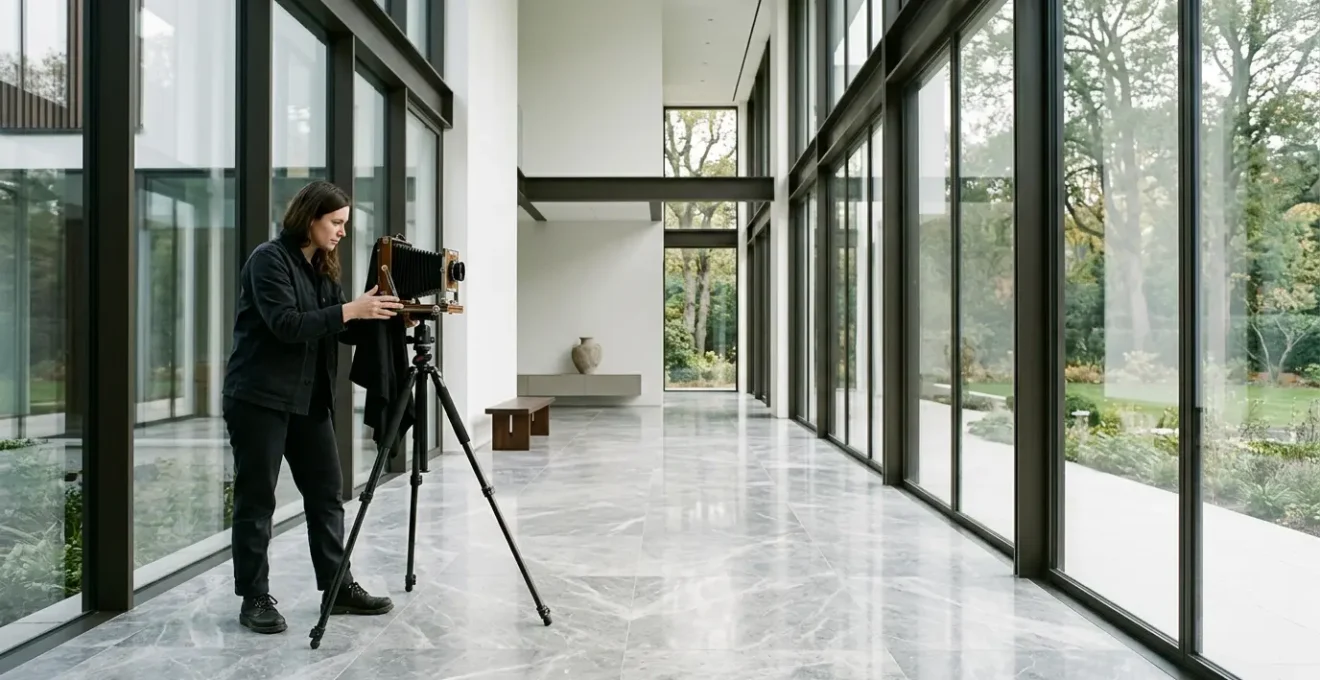
To drastically increase a luxury property’s valuation, you must shift from standard real estate documentation to commissioning a fine art visual narrative.
- Technical mastery of light and composition is used not to make rooms look bigger, but to communicate architectural intent and material quality.
- The most successful agents sell the “cultural capital” of a location, leveraging local arts investment as a tangible indicator of desirability and future growth.
Recommendation: Audit your current listings not for their clarity, but for their emotional impact and narrative power. If they lack a story, they are costing you value.
You have a masterpiece on your books. A £5 million architectural statement, meticulously designed and exquisitely finished. Yet, on the major property portals, it looks flat, distorted, and frankly, cheap. The soul of the building is lost in translation, reduced to a series of wide, uninspired images that fail to capture its essence. This is the critical disconnect that costs high-end agents millions in perceived value. The common advice—tidy up, use a wide-angle lens, shoot on a sunny day—is not just inadequate; it’s often destructive for the luxury market.
The problem is a fundamental misunderstanding of the goal. You are not selling square footage; you are selling a vision, a lifestyle, an asset. Standard photography documents a space, but fine art photography tells its story. It translates the architect’s intent, the quality of the materials, and the emotional resonance of a room into a compelling visual narrative. But what if the true key to unlocking maximum value lies not just in the images of the property itself, but in understanding and leveraging the cultural ecosystem that surrounds it?
This article moves beyond generic tips. We will dissect the specific photographic techniques that create perceived value, from controlling light to staging for the camera’s eye. More importantly, we will explore the undeniable link between a region’s cultural vibrancy—driven by arts funding—and the rising value of its property. It’s time to stop thinking like a documentarian and start commissioning work like a gallerist, because in the ultra-luxury market, perception isn’t just everything—it’s the entire valuation.
This guide provides a comprehensive framework for commissioning photography that doesn’t just show a property, but elevates it. We will explore the technical missteps that devalue a home and the strategic insights that connect its worth to the cultural landscape.
Summary: A Photographer’s Guide to Elevating Property Value Beyond the Lens
- Why Do Wide-Angle Real Estate Lenses Destroy the Intended Geometry of a Premium Room?
- How to Stage Mid-Century Modern Furniture to Enhance Spatial Volume on Camera?
- The Twilight Editing Error That Makes a £2M Home Look Like a Cheap Digital Render
- Natural Ambient Light or Strobe Flashes: Which Captures High-End Finishes Better?
- When is the Exact Golden Hour to Photograph a South-Facing Glass Facade?
- When Do Local Property Prices Spike After a Major Gallery Announcement?
- Why Do Smartphone AR Experiences Significantly Increase Museum Dwell Time?
- How Regional Arts Funding Impacts Local Business Revenue Across the UK?
Why Do Wide-Angle Real Estate Lenses Destroy the Intended Geometry of a Premium Room?
The most pervasive myth in property photography is that wider is better. Agents request wide-angle shots to “make the room look bigger,” but in the luxury market, this is a fatal error. These lenses introduce dramatic distortion, bending straight lines and stretching corners into a grotesque, funhouse-mirror version of the space. An elegant room with considered proportions is rendered as a cavernous, impersonal void. This technique screams “desperate to sell space,” not “confident in inherent value.” It destroys the architectural intent, sacrificing geometric integrity for a false sense of scale.
A premium property’s value is in its details: the precise joinery, the rational flow between spaces, the quality of the light. A wide-angle lens pushes these details to the periphery and creates vast, empty, and uninteresting foregrounds. The professional alternative is to use longer lenses. A 50mm or even an 85mm lens forces the photographer to be more selective. It compresses the space, creating images with more deliberate density and intimacy. Instead of seeing everything at once, the viewer’s eye is guided to a specific vignette—a reading nook, the view through a doorway, the texture of a stone wall. This approach creates a visual narrative, a sequence of images that reveals the home’s character piece by piece, inviting curiosity and desire.
Techniques like perspective control or “shift” lenses, and even advanced panoramic stitching, allow for a wide field of view without the distorting effect of a conventional wide-angle lens. The goal is to represent the room as the human eye perceives it—with straight verticals and a natural sense of proportion. By rejecting the wide-angle cliché, you preserve the integrity of the design and communicate a message of quality over sheer quantity.
Your Action Plan: Auditing Your Property’s Visual Narrative
- Points of Contact: List all visual channels where the property is represented (e.g., Rightmove, Zoopla, your agency website, social media, print brochures).
- Collecte: Inventory the existing hero shots. Are they all wide, distorted views? Or are there any detail shots, vignettes, or shots showing material texture?
- Cohérence: Compare the photos to the architect’s or designer’s original vision. Do the images convey intimacy, grandeur, or minimalism as intended, or do they flatten it?
- Mémorabilité/Émotion: Score each image. Is it a generic photo of a room, or does it evoke a specific feeling (e.g., serenity, drama, warmth)? Separate the functional from the emotional.
- Plan d’intégration: Identify the narrative gaps. Prioritise commissioning new shots that tell a story—focusing on material honesty, light, and curated details—to replace the generic wide angles.
How to Stage Mid-Century Modern Furniture to Enhance Spatial Volume on Camera?
Staging a luxury property is not about filling it with furniture; it’s about curating objects in space to define its purpose and scale. With a style like Mid-Century Modern, defined by clean lines and organic forms, the camera requires a specific approach. The goal is to enhance what I call “emotional volume”—not just the physical size of the room, but the *feeling* of the space. Is it airy and expansive, or intimate and cosy? The key is strategic placement and, most importantly, the masterful use of negative space.
Instead of pushing furniture against the walls, pull it into the room to create defined conversational groupings. An iconic Eames lounge chair, for example, shouldn’t be just another seat; it’s a sculptural hero piece. Position it off-centre, allowing “breathing room” around it. This negative space is a powerful signal of luxury. It tells the viewer that the property is so generous, it doesn’t need to be cluttered. Group smaller items in threes or fives at varying heights to create visual interest and guide the eye through the frame, building a sense of depth and flow.
As this composition demonstrates, the interplay of objects and voids is what creates a compelling image. The camera lens, especially a longer one, will flatten depth. Your staging must counteract this. By creating layers—a plant in the foreground, a seating area in the mid-ground, and a window with a view in the background—you build a three-dimensional story within a two-dimensional medium. This isn’t about showing how much furniture fits; it’s about showing how beautifully the space accommodates life, art, and design.
The Twilight Editing Error That Makes a £2M Home Look Like a Cheap Digital Render
The “hero shot” of a property, taken at twilight, can be your single most powerful marketing asset. It’s a moment of pure magic, where the cool, deep blue of the sky is perfectly balanced against the warm, inviting glow from within the home. Done correctly, it’s an irresistible image that screams luxury. In fact, research on luxury property marketing shows that using twilight photography as the main photo can increase views by an average of 76%. Yet, this is where amateur photography and cheap editing reveal themselves most starkly, turning a multi-million-pound asset into something that looks like a bad video game render.
The cardinal sin is over-saturation and a lack of subtlety. Amateurs will crank up the colours, resulting in an electric, uniform blue sky and a syrupy, artificial orange glow from every window. They will brighten the foreground so much that the house appears to be floating, disconnected from its landscape. This flat, hyper-real look is devoid of mystery and sophistication. A professional approach is about nuance and realism. The sky isn’t one colour; it’s a complex gradient of purples, magentas, and deep blues. The interior lights shouldn’t be a flat orange; they should have varied intensity and colour temperatures, with subtle reflections visible on the windows that hint at the life within.
The difference between a convincing, high-value twilight shot and a cheap-looking render lies entirely in the subtle details of light and shadow. This table breaks down the common mistakes versus the professional techniques that preserve realism and convey luxury.
| Aspect | Amateur Error | Professional Technique |
|---|---|---|
| Window Glow | Uniform intensity, same color temperature | Varied intensity with subtle interior reflections |
| Color Palette | Oversaturated orange/blue only | Complex twilight tones: greens, magentas, deep purples |
| Sky Treatment | Electric-blue, overly perfect | Evocative realism with natural variations |
| Foreground | Unnaturally brightened, floating effect | Rich detailed shadows anchoring the building |
| Light Fall-off | No gradation, flat lighting | Natural light fall-off preserving depth |
Natural Ambient Light or Strobe Flashes: Which Captures High-End Finishes Better?
The choice of lighting is a defining decision in architectural photography, a choice that separates the documentarian from the artist. Do you use the soft, moody, and often unpredictable ambient light that exists in the space? Or do you overpower it with powerful, controlled strobe flashes to create a bright, clean, and perfectly exposed image? For a high-end property, the answer is almost always: you must use both. Relying on one or the other leads to compromised results that fail to capture the true value of the home.
Using only natural ambient light can create beautiful, atmospheric images full of mood and character. However, it often struggles to render colours accurately and can plunge important areas into deep shadow, losing critical detail. The light from a window might be a different colour temperature than an interior lamp, creating distracting colour casts. Conversely, using only strobe flashes creates a hyper-realistic, catalogue-like image. Every corner is bright, colours are accurate, and every detail is sharp. But this clinical perfection comes at a cost: the soul of the room is obliterated. The soft shadows that create depth and the subtle interplay of light that gives a room its unique feeling are gone, replaced by a flat, sterile environment.
This is why top-tier architectural photographers have mastered a hybrid technique. It’s a craft that combines the best of both worlds to achieve what we call material honesty—representing the look and feel of a room with absolute fidelity.
The “Flambient” Method: Achieving Perfect Balance
The ‘flambient’ method is a rapidly growing technique in high-end real estate photography that blends flash and ambient light. As described in professional best practices for property imaging, the photographer takes multiple exposures. The first shot captures the ambient light, preserving the room’s natural mood and the realistic view through the windows. A second shot is then taken with a carefully placed flash to “pop” light into the space, ensuring colour-accurate walls, sharp details on furniture, and texture in the finishes. In post-production, these layers are meticulously blended. The result is an image that feels both authentic and perfectly polished, capturing the room exactly as it would feel to stand in it—the ultimate goal of luxury property photography.
When is the Exact Golden Hour to Photograph a South-Facing Glass Facade?
The term “golden hour” is often thrown around as a catch-all for “the best time to take photos.” But for an architectural photographer working on a multi-million-pound property, particularly one with a dominant glass facade, the concept is far more scientific and strategic. There isn’t one “golden hour”; there is a series of precise, fleeting moments, each offering a unique opportunity to tell a different story about the building. The key is to define your photographic goal *before* you even look at the sun.
For a south-facing glass facade, your strategy depends on what you want to communicate. Are you selling transparency and the connection between inside and out? Then your moment is the “blue hour,” just after the sun has set, when the interior lights are on and the exterior ambient light is perfectly balanced, allowing the viewer to see straight through the glass into the warm, lit interior. Are you selling the building as a sculptural object reflecting its environment? Then your moment is midday on a bright day, using a polarising filter to manage the reflections and capture the dramatic shapes of clouds or trees on the building’s surface. Or are you selling texture and form? Then your moment is when the sun is very low in the sky, creating a “raking light” that skims across the surface, highlighting the texture of the facade materials and creating long, dramatic shadows that reveal its form.
A true professional doesn’t guess. They use sophisticated tools to plan their shoot with millimetric precision, ensuring they are in the right place at the right time to capture the building as the architect intended. This isn’t just taking a picture; it’s a planned intersection of astronomy, architecture, and art.
Your Strategy Sheet: Timing the Perfect Glass Facade Shot
- Evening/Nighttime for Atmosphere: Utilise this time to showcase the home’s curated ambient lighting, from interior lamps to exterior pathway illumination, creating a warm, deeply inviting feel.
- Blue Hour for Balance: The period just after sunset or before sunrise provides a naturally balanced light between the interior and exterior, perfect for showcasing transparency in glass facades without harsh glare.
- Sun Calculators for Precision: Use professional apps like PhotoPills or Sun Seeker to determine the exact date and time the sun’s angle will create the specific architectural effect you want to capture (e.g., a sunbeam hitting a particular wall).
- Define the Goal: Transparency, Reflection, or Texture: Decide your primary narrative. Is it the seamless indoor-outdoor flow (post-sunset), the building as a mirror to its landscape (midday with a polariser), or its material form (low-angle raking light)?
- Leverage Overcast Days: Don’t discount a day with high, thin overcast clouds. This acts as a giant natural softbox, eliminating harsh reflections and glare, which is ideal for showing the pure architectural form of the building.
When Do Local Property Prices Spike After a Major Gallery Announcement?
A savvy estate agent understands that they are not just selling bricks and mortar; they are selling access to a lifestyle. The single greatest indicator of a neighbourhood’s rising cultural and financial tide is often the announcement of a new major art gallery or significant investment in a local cultural institution. This is the moment when “cultural capital” begins its conversion into tangible property value. The price spike isn’t immediate, but the smart money—and the smart agent—moves in anticipation of it. This trend is no longer just an anecdotal observation; it’s a deliberate, government-backed strategy in the UK.
The “Levelling Up” agenda has channelled significant public funds into the arts outside of London. For example, government data reveals that Arts Council England (ACE) has committed an extra £45 million in both 2023-24 and 2024-25 to be invested in organisations outside of the capital. This isn’t just about supporting the arts; it’s an economic catalyst. A new gallery or a newly-funded theatre doesn’t just bring art; it brings destination restaurants, independent boutiques, and a wealthier, more discerning demographic of homebuyers. The initial price ripple begins with the announcement, builds as construction starts, and crests as the institution opens its doors and the area’s new identity solidifies.
This shift is a formal acknowledgement of past imbalances and a clear signal of future growth areas. As one parliamentary report notes, this strategic redistribution of funding is creating a new map of cultural and economic opportunity across the country.
ACE has recently acknowledged that its investment in certain parts of England has historically been too low and has committed to a fairer distribution of funding. To achieve the government’s aim, cultural investment by the government through ACE to places outside London would rise to almost £250mn by 2025. This increase would see some arts and culture organisations become ‘national portfolio organisations’ for the first time.
– House of Lords Library, Arts Council England: Funding and regional distribution
Why Do Smartphone AR Experiences Significantly Increase Museum Dwell Time?
In the art world, curators have discovered a powerful tool for engaging audiences: Augmented Reality (AR). By allowing visitors to use their smartphones to see hidden layers of information, view an artist’s preliminary sketches overlaid on a finished painting, or watch a sculpture come to life, museums have found they can dramatically increase how long people stay and how deeply they connect with the art. The lesson for the luxury property market is profound: today’s high-net-worth buyers expect more than static images. They expect an immersive, interactive, and personalised digital experience.
The clunky, low-resolution virtual tours of the past are no longer sufficient. The technology has evolved, and so have buyer expectations. This is not a gimmick; it’s a proven sales tool. In fact, recent market research demonstrates that a staggering 63% of people who bought a home in 2020 made an offer for a property based on a virtual tour alone. For the luxury sector, the opportunity is to elevate this experience from a simple walkthrough to a curated digital interaction. Imagine sending a potential buyer a link where they can use their own phone to not only tour a £5M property, but also to virtually stage an empty room with different furniture sets, or even to see how a specific piece of commissioned art from a local gallery would look on the living room wall.
This is about bridging the imagination gap. It allows a buyer to emotionally inhabit the space before they ever set foot in it. For off-plan developments, AR can overlay the finished architectural design onto a live view of the construction site, making the future vision tangible. By embedding AR “hotspots” in your digital marketing, you can tell stories about the craftsmanship of the materials or the history of the location. You are no longer just showing a house; you are providing a rich, multi-layered experience that mirrors the sophistication of the property itself—and the buyers you want to attract.
Key Takeaways
- Narrative Over Documentation: Commission photography that tells a story of value, emotion, and architectural intent, not just one that documents empty space.
- Light and Composition Are Value: The sophisticated use of light, shadow, and composition communicates luxury far more effectively than a wide-angle lens ever could.
- Sell the Ecosystem, Not Just the House: A property’s valuation is inextricably linked to the cultural capital of its location. Use data on local arts funding as a powerful sales argument.
How Regional Arts Funding Impacts Local Business Revenue Across the UK?
The value of a luxury property is a reflection of its ecosystem. A home does not exist in a vacuum; its desirability is profoundly influenced by the quality of the shops, restaurants, and cultural life surrounding it. The strategic injection of arts funding into a region is one of the most reliable lead indicators of a burgeoning local economy and, consequently, a rising property market. This is the ripple effect of cultural capital in action: public investment in the arts directly stimulates private-sector growth and enhances the perceived value of an entire area.
When Arts Council England shifts its investment focus, it creates hotspots of opportunity. A new theatre or expanded museum doesn’t just employ artists; it drives footfall to local cafes, fills hotel rooms, and creates a demand for high-end retail. This creates a vibrant, desirable neighbourhood that attracts affluent residents who are willing to pay a premium to live there. This is not a theoretical concept; it is a measurable financial trend. The data clearly shows a deliberate rebalancing of cultural investment across the UK, creating new centres of gravity for wealth and lifestyle.
This table, based on House of Lords library data, illustrates the significant shift in Arts Council England funding allocations, with regions outside London seeing substantial increases. For a high-end estate agent, this data is a sales tool.
| Region | 2018-22 Average | 2023-26 Allocation | Change |
|---|---|---|---|
| London | £159.0m | £152.2m | -4.3% |
| North | £71.8m | £80.1m | +11.6% |
| Midlands | £58.6m | £68.1m | +16.2% |
| South West | £34.2m | £41.8m | +22.2% |
| South East | £42.4m | £52.5m | +23.8% |
Therefore, when commissioning photography, seek a partner who understands both narratives. You need a photographer with the technical artistry to capture the soul of the building and the commercial acumen to understand that you’re selling a stake in a thriving cultural landscape. This dual focus is what will ultimately elevate your listings and secure the highest possible valuation for your clients’ masterpieces.