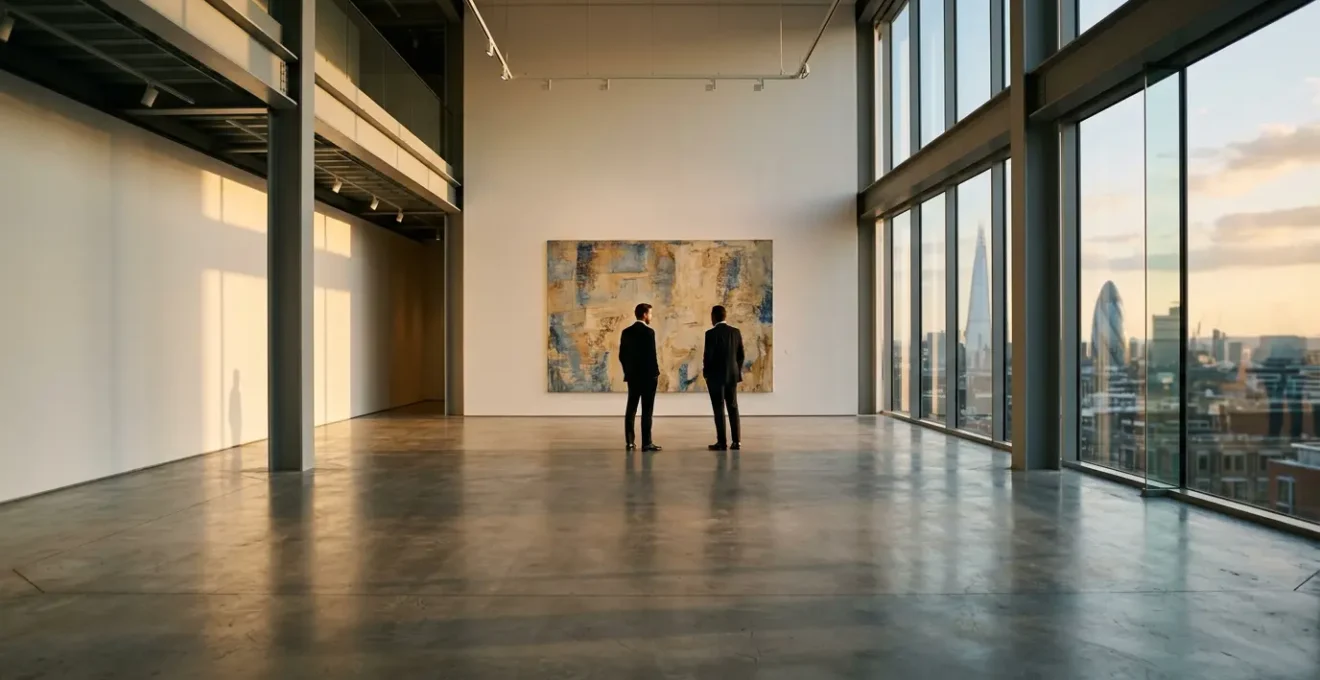
Accessing London’s inner art circle is a social chess game where strategic commitment and cultural capital consistently outperform simple purchasing power.
- Building a relationship ledger through small, strategic purchases is more effective than waiting for a blockbuster acquisition.
- Genuine engagement with a gallery’s full programme, including its emerging artists, signals you as a long-term partner, not just a client.
Recommendation: Shift your focus from “how much to spend” to “how to demonstrate value,” starting with patronage of public institutions to build your collector profile.
For the passionate collector, the London art scene can feel like a paradox. It’s a city teeming with creativity and opportunity, yet the doors to the most sought-after works often seem firmly closed. You follow the right galleries, attend the openings, and have your funds ready, only to be told an artist’s new collection is “fully subscribed” before it’s even hung. The common advice—”go to openings,” “talk to the gallerist”—is true, but it’s tragically incomplete. It’s like being told the rules of checkers when everyone else is playing a silent, high-stakes game of chess.
The frustration is understandable. You see others gaining access, securing works from artists on the brink of stardom, and being invited to the exclusive dinners that seem to decide everything. What do they know that you don’t? The secret isn’t about outspending the competition. It’s about out-thinking them. It involves understanding that every interaction is an entry in a ‘relationship ledger’ with the gallery, and that your demonstrated taste and commitment—your cultural capital—can be your most valuable asset.
But what if the real key to unlocking the gallery’s back room wasn’t about the size of your first purchase, but its strategic intelligence? What if the most powerful connections were forged not in the crowded chaos of an art fair, but in the quiet of an artist’s studio? This guide moves beyond the platitudes to reveal the insider’s playbook. We will deconstruct the social codes, strategic manoeuvres, and subtle signals that separate the amateur enthusiast from the collector who gets the first call.
This article will guide you through the nuanced strategies required to navigate the London art world. Below, you will find a breakdown of the key tactics, from leveraging small purchases to mastering the art of the follow-up, that will transform you from a spectator into a valued player.
Summary: Your Guide to Cultivating Relationships with UK Gallerists
- Why Do VIP Gala Dinners Dictate Who Gets First Refusal on New Collections?
- How to Leverage Small Initial Purchases to Access the Hidden Back Room?
- The Networking Blunder That Gets You Blacklisted from London Art Fairs
- Studio Visit or Gallery Opening: Which Builds Stronger Artist Connections?
- When to Follow Up After an Exhibition Without Appearing Overly Aggressive?
- The Private Viewing Mistake That Immediately Flags You as an Amateur
- Why Do Tate Memberships Serve as the Ultimate Stepping Stone for New Patrons?
- How to Transition from Casual Museum Visitor to Active Patron in London?
Why Do VIP Gala Dinners Dictate Who Gets First Refusal on New Collections?
Gallery dinners are not merely social events; they are the final round of a long-term vetting process. By the time invitations are sent, the gallery has already curated the guest list to include collectors who have proven their commitment. These dinners are where a gallery solidifies its relationship with its most valued patrons, rewarding their loyalty with priority access. It’s an ecosystem built on reciprocity. Gallerists use these intimate settings to gauge a collector’s seriousness, their understanding of the gallery’s programme, and their potential for future ambassadorship. Being at the table means you’ve already been recognised as a partner, not just a customer. This is especially critical in a dense market, as 6% of global collectors reside in London, making the competition for access intense.
The conversations at these dinners rarely revolve around price. Instead, they focus on the artist’s vision, the narrative of a collection, and its place within art history. A collector who can engage in this dialogue demonstrates their cultural capital, signalling to the gallerist that they are a custodian of the work, not just a buyer. This is your opportunity to build your collector profile beyond your bank account. Proving you are a thoughtful, long-term supporter is what secures your place on the ‘first refusal’ list for the next major exhibition.
Your Action Plan: Building a Collector Profile at Gallery Dinners
- Demonstrate Long-Term Vision: Discuss your collecting philosophy and how you see your collection evolving over the next decade, rather than focusing on immediate purchasing power.
- Articulate a Narrative: Explain how a potential new acquisition would complement the existing story of your collection, showing you are a curator of your own space.
- Support the Ecosystem: Express genuine interest in the gallery’s emerging artists and its broader programme, not just the established, blue-chip names.
- Become a Connector: Casually mention your connections to museum boards or curatorial departments, suggesting potential for future institutional loans which adds value to the artwork.
- Focus on the ‘Why’: Engage in meaningful dialogue about the artist’s creative process, influences, and intent, moving the conversation away from simple market value.
How to Leverage Small Initial Purchases to Access the Hidden Back Room?
The gallery back room, a semi-mythical space where the best works are often held, is not unlocked with a single, large cheque. Instead, access is earned through a series of intelligent, strategic moves. A small, well-chosen initial purchase is arguably the most powerful of these. It’s a low-risk way to initiate a ‘relationship ledger’ with a gallery, moving you from an anonymous visitor to a documented collector. However, not all small purchases are created equal. The key is curatorial alignment—choosing a piece that signals a shared taste and a deep understanding of the gallery’s vision.
This strategy shows you are invested in the gallery’s programme, not just a single famous artist. As the experience of artist Dennis Osadebe shows, collectors who demonstrate a genuine belief in an artist’s growth create far stronger bonds. Expressing investment in a gallery’s future stars is a powerful signal. A thoughtful purchase of a work on paper by an emerging artist says much more about your commitment than buying a secondary market print from a household name. It tells the gallerist you are a fellow risk-taker and a true supporter of the arts, making them more inclined to show you what’s hidden from the general public.
The following table illustrates how different small purchase strategies are perceived by a gallery, directly impacting the development of your relationship.
| Purchase Type | Gallery Signal | Relationship Impact |
|---|---|---|
| Emerging artist work on paper | Alignment with gallery’s future vision | High – Shows strategic thinking |
| Established artist print | Safe, predictable interest | Medium – Standard collector behavior |
| Experimental/new medium piece | Risk-taking, adventurous taste | High – Demonstrates curatorial confidence |
The Networking Blunder That Gets You Blacklisted from London Art Fairs
London art fairs like Frieze or Photo London are a compressed, high-stakes version of the gallery ecosystem. With hundreds of galleries and thousands of visitors, the temptation is to adopt a “more is more” approach—flitting from booth to booth, collecting business cards, and trying to see everything. This is, unequivocally, the single biggest blunder a serious collector can make. It immediately flags you as a tourist, not a player. Gallerists are experts at reading body language and intent; they can spot a superficial browser from across the aisle. This frantic activity is what insiders call ‘burning social capital’.
The goal at an art fair is not breadth, but depth. As one expert in a Contemporary Art Issue analysis noted, having deep, 15-minute conversations at two or three galleries is infinitely more valuable than fleeting interactions at twenty. This is the moment for strategic patience. Identify your top 3-5 target galleries beforehand, research the artists they are showing, and approach their booths with a clear purpose. Your aim is to have a memorable, intelligent conversation that can be referenced in a follow-up email. Asking about price within the first 30 seconds is a cardinal sin; it signals you see art as a commodity, not a creation. By demonstrating respect for the art and the gallerist’s time, you differentiate yourself from the crowd and begin to build a meaningful connection.
Gallery-hopping and rapidly moving between booths, collecting cards, and showing superficial interest at 20 galleries is far worse than having deep, 15-minute conversations at just two or three.
– Art Market Expert, Contemporary Art Issue Analysis
To avoid being dismissed, adhere to this unspoken code of conduct:
- Never ask about the price or request a price list before engaging with the art for at least five minutes.
- Avoid approaching senior gallerists when they are in deep conversation with known clients or museum curators.
- Do not name-drop rival galleries or aggressively list the contents of your collection.
- Respect the physical and psychological boundary of the booth; never wander into storage areas without a clear invitation.
- Keep your initial fair conversations to a concise 10-15 minutes unless the gallerist explicitly extends the interaction.
Studio Visit or Gallery Opening: Which Builds Stronger Artist Connections?
Gallery openings and studio visits are both crucial touchpoints, but they serve very different strategic purposes in a collector’s journey. A gallery opening is a public-facing event; it’s about being seen, showing support for the gallery, and participating in the community’s social fabric. While you might get a moment with the artist, the conversation will be brief and social. Its primary value is in maintaining visibility within the gallery’s ecosystem. A studio visit, on the other hand, is an entirely different proposition. It is a private, earned privilege that offers unparalleled insight into an artist’s practice.
Securing a studio visit is a significant milestone. It means the gallery, and by extension the artist, sees you as more than just a potential buyer; you are a serious connoisseur worthy of a deeper conversation. This is where true rapport is built. You are not just seeing finished works, but the process, the failures, the experiments, and the intellectual labour behind the art. The etiquette is critical: this is not a shopping trip. Price should never be discussed unless the artist or gallerist initiates it. Your role is to listen, ask intelligent questions, and show genuine curiosity. A successful studio visit solidifies your status in a way no number of opening appearances ever could, creating a personal connection that often translates into priority access to future works.
The choice between these two opportunities depends entirely on your objective, as each offers a distinct type of connection and requires a different approach.
| Aspect | Studio Visit | Gallery Opening |
|---|---|---|
| Connection Type | Deep, personal rapport with one artist | Broad visibility with gallery ecosystem |
| Access Method | Earned through genuine engagement | Open invitation or RSVP |
| Conversation Depth | Intimate, process-focused | Brief, social interactions |
| Etiquette Priority | Never touch without asking, no price talk | Circulate, don’t monopolize artist’s time |
When to Follow Up After an Exhibition Without Appearing Overly Aggressive?
The art of the follow-up is perhaps the most delicate dance in the gallery-collector relationship. Eagerness can easily be misinterpreted as aggression or desperation—the dreaded “soft no” from a gallery is often delivered through silence. The key is to add value, not to make demands. A follow-up email sent the day after an opening that simply says “It was great to meet you” is digital noise. A strategic follow-up, however, can solidify your position and keep you top-of-mind.
The most effective approach is to wait approximately one week. This gives the gallery staff time to decompress from the exhibition launch. Your email should be personal, specific, and generous. Instead of asking what works are available, reference a specific piece you enjoyed and connect it to something outside the gallery—an article you read, another exhibition you saw, or a thought it provoked. This demonstrates thoughtful engagement, not just purchasing intent. As Andrea Giordano, Director at Eve Leibe Gallery, mentioned in an interview with Artsy, the best collectors are those with whom you can share ideas and discoveries. Your goal is to initiate this kind of dialogue. If you don’t receive a response, do not send a demanding second email. Instead, switch to a lower-touch method, like a thoughtful comment on the gallery’s Instagram. The aim is to maintain a warm, consistent presence, not to chase a transaction.
A structured, patient timeline is essential to nurturing the relationship effectively:
- Day 7-10: Send your first follow-up. It should be a value-add message, perhaps linking to a relevant article or mentioning a connection the exhibition sparked for you.
- Week 3: If there has been no response, engage in a low-touch way. A relevant, non-demanding comment on a gallery Instagram post is ideal.
- Week 6: You can send a second personalized email. This should contain a specific question or a genuine update from your end, not just a “checking in” message.
- After Week 8: If two direct attempts have yielded no response, it’s a signal. Redirect your energy towards more receptive galleries. The London scene is vast.
- Ongoing: Continue to attend events and show your face. Presence without pressure demonstrates long-term commitment.
The Private Viewing Mistake That Immediately Flags You as an Amateur
The private view, or ‘PV’, is the first hurdle where new collectors often stumble. The allure of being first to see the work is powerful, but the reality of a popular London PV is often a crowded, noisy room where it’s nearly impossible to truly appreciate the art. The single biggest mistake an aspiring collector makes is treating the PV as a serious viewing opportunity. Experienced collectors know this is primarily a social event for the gallery ecosystem. They understand that trying to have a deep, meaningful experience with an artwork while being jostled and struggling to hear over the chatter is a fool’s errand.
The professional move is to use the PV for what it is: a chance to show your face, briefly congratulate the artist, and acknowledge the gallery staff with a nod and a smile. Then, you leave. The real viewing happens a day or two later, during a quiet Tuesday afternoon. Returning to the gallery when the space is empty allows for a contemplative, uninterrupted experience with the work. This act alone sends a powerful signal to the gallery staff. It says you are serious about the art, not just the free wine or the social scene. It demonstrates a level of sophistication and respect for the artwork that is the hallmark of a true connoisseur. While everyone else is nursing a hangover, you are having a quiet, informed conversation with a junior gallery assistant who, having seen your dedication, might just remember your name when the director asks if anyone has shown serious interest.
The amateur fills the space with noise and chatter; the professional seeks out silence and contemplation. The following etiquette points are non-negotiable for anyone wishing to be taken seriously:
- Always acknowledge the gallery staff, even with a simple nod. Being ignored makes them feel invisible and devalued.
- Never loudly proclaim your dislike for the art. Taste is subjective, but respect for the artist’s effort is mandatory.
- Do not monopolize the artist’s time. They are the host of the evening and must greet all their guests.
- Be mindful of your plus-one. Bringing a companion who is audibly skeptical or asks “my five-year-old could do that” questions is a reflection on you.
- Spend more time looking than talking. Contemplative silence is a sign of respect and deep engagement.
Key Takeaways
- Access is a game of social strategy and demonstrated commitment, not just financial capacity.
- Building your ‘cultural capital’ through patronage and informed conversation is your most valuable asset.
- The goal is to transition from a ‘client’ to a ‘partner’ in the gallery’s vision by supporting their entire programme.
Why Do Tate Memberships Serve as the Ultimate Stepping Stone for New Patrons?
Before you can become a valued patron of a commercial gallery, you must first demonstrate that you are a genuine supporter of the broader arts ecosystem. There is no more effective or efficient way to do this in London than by becoming a member of the Tate. For what is a relatively modest investment— Tate membership starts from just £78 per year—you gain more than just free entry to exhibitions. You are buying a stake in the cultural heart of the city.
A Tate membership serves as a powerful, non-verbal signal. It appears on your CV as a collector. When you mention it in passing to a gallerist, it instantly communicates a baseline of seriousness and commitment. It shows you are engaged with art on an institutional level, interested in its history, and invested in its future. Furthermore, the members’ events, talks, and private views at the Tate are unparalleled networking opportunities. You are not just meeting other collectors; you are mingling with curators, trustees, and arts journalists in a non-commercial, intellectually-driven environment. This is where you build your cultural credibility and network, which you can then leverage within the commercial world. A gallerist is far more likely to take a meeting with a known ‘Tate Patron’ than an unknown person who walked in off the street. It is the ultimate foundational stone upon which a serious collection is built.
Moreover, this strategy extends beyond the Tate. London’s art scene is a rich tapestry of institutions. As highlighted by discerning collectors, smaller public galleries like the Camden Art Centre, the ICA, or Studio Voltaire are where the cutting edge of the scene is forged. Supporting these vital spaces further cements your reputation as a true patron of the arts, deeply embedded in the community you wish to be a part of.
How to Transition from Casual Museum Visitor to Active Patron in London?
The journey from a casual admirer of art to an active and respected patron is a deliberate and strategic one. It’s about shifting your mindset from consumption to contribution. This transition is what ultimately separates the hobbyist from the collector who is taken seriously by the art world’s gatekeepers. It begins with identifying where you can provide value beyond a simple financial transaction. As prominent London collector Grazyna Kulczyk advises, building these foundational relationships is what enriches your understanding and your collection.
Becoming a patron isn’t about writing a seven-figure cheque to have your name on a wall. It’s a progressive process of engagement. It starts with a basic membership and a commitment to show up. By attending member events, you begin to build relationships with development staff and other patrons, learning the institution’s priorities. Perhaps the most powerful, yet overlooked, strategy is to offer your professional expertise pro-bono. Are you a lawyer, a marketer, a web developer? The development departments of museums and public galleries are often under-resourced and would value your skills. This creates a deep, authentic connection and provides you with unparalleled insight into the inner workings of the art world. This journey builds your reputation and network, making you a known and respected entity. When you later approach a commercial gallery, you are no longer an unknown quantity; you are a patron of the arts, and that changes everything.
Building relationships with galleries, curators, and artists will help enrich your understanding.
– Grazyna Kulczyk, Prominent London Collector
This transition follows a clear, actionable pathway:
- Start with Accessible Membership: Join institutions like the Serpentine, Whitechapel Gallery, or the Royal Academy of Arts to begin your journey.
- Attend and Engage: Go to member events consistently to build relationships with staff and fellow patrons, moving from a face in the crowd to a familiar presence.
- Identify Impact Areas: Speak to development staff to find underfunded areas—such as educational programmes or conservation projects—where your support can make a tangible difference.
- Offer Professional Expertise: Leverage your day-job skills. Offer pro-bono support to development or marketing departments to build deep institutional ties.
- Seek Informational Meetings: Request a coffee meeting with mid-level development staff to simply learn about their priorities, demonstrating your interest in partnership, not just transactions.
By embracing these strategies, you shift from being a passive consumer to an active participant in the cultural landscape. This transformation is the ultimate key to not only building a world-class art collection but also to finding a meaningful and permanent place within the art world itself. The next step is to begin building your cultural capital today.