Truly inclusive design for neurodiverse audiences isn’t about sensory removal, but about providing sensory agency.
- Effective installations are modulable environments, allowing users to adjust light, sound, and interaction levels.
- Success lies in offering a spectrum of sensory experiences, from calming haptic feedback to focused, non-triggering olfactory elements.
Recommendation: Shift your design philosophy from creating restrictive ‘safe’ spaces to building ’empowering’ environments where every visitor can control and curate their own experience.
As an exhibition designer or accessibility officer, you face a constant challenge: how do you create an interactive installation that is engaging and memorable for the many, without being overwhelming and exclusionary for the few? The standard advice often revolves around sensory reduction—dim the lights, lower the volume, and provide a designated quiet room. While these are valuable first steps, they treat neurodiversity as a problem to be mitigated, often resulting in experiences that are sterile or separate from the main exhibition.
This approach misses the fundamental point. Many neurodiverse individuals, including those with autism or sensory processing disorders, don’t necessarily want less stimuli; they want control over it. The key to truly inclusive and impactful design lies in a paradigm shift. What if, instead of focusing on sensory avoidance, we focused on providing sensory agency? This means designing flexible, modulable, and intuitive environments that empower visitors to self-regulate, choose their own level of engagement, and feel a sense of mastery over their experience. It’s about building a toolkit within the installation itself.
This guide will provide a practical framework for achieving that goal. We will move beyond the basics and explore the science and strategy behind designing with sensory agency in mind. We’ll examine how to use haptic feedback for grounding, balance olfactory elements safely, avoid common lighting mistakes, and make strategic decisions about sound. Ultimately, you’ll learn how to create installations that are not just tolerable, but genuinely welcoming and enriching for every single visitor.
To navigate these complex considerations, this article breaks down the core components of neuro-inclusive design. The following sections offer a detailed exploration of each sensory modality, providing practical strategies and evidence-based insights to guide your next project.
Summary: A Framework for Neuro-Inclusive Sensory Design
- Why Do Haptic Feedback Floors Calm Overstimulated Visitors in Busy Galleries?
- How to Balance Olfactory Elements Without Triggering Asthma or Allergies?
- The High-Contrast Lighting Error That Excludes Visitors with Visual Processing Issues
- Ambient Soundscapes or Complete Silence: Which Aids Deeper Art Comprehension?
- When Should Curators Schedule Dedicated Quiet Hours for Sensory Installations?
- Why Do Complex Controller Buttons Immediately Frustrate Visitors Over the Age of 60?
- Why Do Open-Plan Studio Layouts Improve Cross-Disciplinary Student Collaboration?
- How to Design Hybrid Physical-Digital Shows for Non-Technical Museum-Goers?
Why Do Haptic Feedback Floors Calm Overstimulated Visitors in Busy Galleries?
The calming effect of haptic feedback floors goes deeper than simple vibration; it taps into the foundational sensory system of proprioception—our brain’s awareness of our body’s position in space. For a neurodiverse individual experiencing sensory overload, the world can feel disorienting and chaotic. The clear, consistent, and predictable input from a haptic floor provides a powerful grounding sensation. It gives the nervous system a stable point of reference, helping to reduce anxiety and allowing the brain to re-organize other sensory inputs. It’s a physical anchor in a sea of overwhelming stimuli.
Instead of just being a novel feature, haptic technology becomes a tool for self-regulation. By providing different zones of texture and vibration, you offer visitors sensory agency. They can choose to stand on a gently humming surface to ground themselves or walk across a more intensely textured path to increase their body awareness. The implementation at the Le Corbusier Museum’s VR exhibition, which used a tactile feedback floor to simulate walking, demonstrates how haptic input can make an abstract space feel more real and navigable, reducing cognitive load.
The key is to think of the floor not as a uniform surface, but as a sensory landscape. This approach allows you to design ‘sensory retreat spaces’ directly within the main gallery flow, without having to build a separate room.
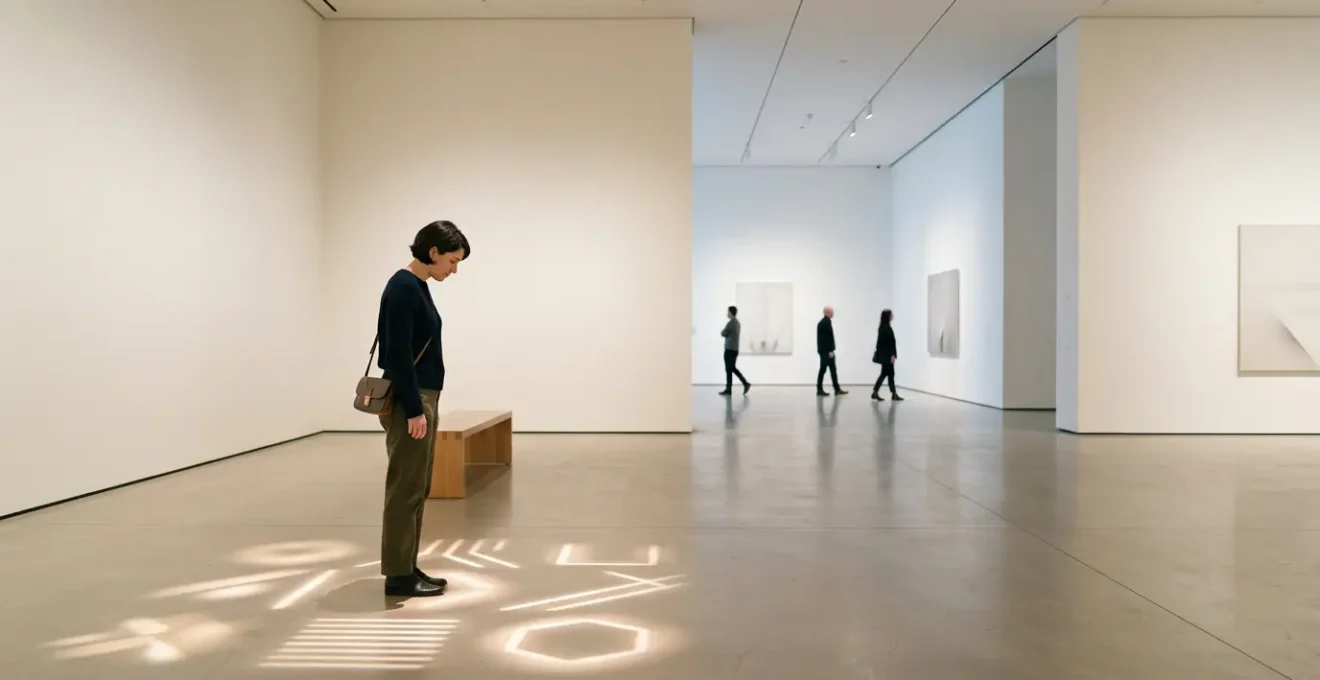
As this image suggests, transitioning between different haptic zones—from smooth concrete to a subtly textured surface with embedded vibration elements—can guide and comfort visitors. This use of material contrast and controlled feedback creates an intuitive form of wayfinding and provides opportunities for sensory relief, making the entire gallery more accessible and less intimidating.
How to Balance Olfactory Elements Without Triggering Asthma or Allergies?
Scent is arguably the most potent and challenging sense to incorporate into a public installation. It is deeply tied to memory and emotion, but it is also a common trigger for allergies, asthma, and sensory sensitivities. The primary principle for using olfactory elements isn’t “if” but “how.” The goal must be absolute control and complete transparency, shifting from passive, ambient scenting to active, user-initiated experiences. Bad odors and poor ventilation are known to be particularly bothersome for autistic individuals, so the baseline must be clean, odor-free air.
An effective strategy is the ‘Scent-on-Demand’ system. Instead of filling a room with a fragrance, the scent is contained within a sealed device or container. A visitor must perform a conscious action—such as pressing a button, lifting a lid, or leaning into a “scent cone”—to experience it. This simple mechanism gives visitors complete agency. Those who are sensitive or uninterested can easily bypass it, while those who are curious can engage directly without affecting others in the space. This approach respects individual boundaries and sensitivities while still allowing for a rich, multi-sensory experience.
Furthermore, rigorous safety protocols are non-negotiable. Every scent compound must be documented with Material Safety Data Sheets (MSDS), and clear signage warning of scented areas must be placed well in advance of the installation. This transparency builds trust. Finally, consider the exhibition’s flow. Always provide a scent-free alternative route, ensuring no visitor is forced to pass through a scented area to continue their journey. This combination of controlled delivery, clear communication, and thoughtful spatial design is the only responsible way to integrate olfaction into an inclusive public space.
The High-Contrast Lighting Error That Excludes Visitors with Visual Processing Issues
Designers often use high-contrast lighting—dramatic spotlights on dark walls—to create visual excitement and focus attention. However, for a significant portion of the population, this common technique can make a space unusable. For individuals with visual processing disorders like Irlen Syndrome, which The Irlen Institute estimates affects 12-14% of the general population, high contrast and fluorescent lighting can cause physical discomfort, distortions, and reading difficulties. The sharp difference between light and shadow can be perceived as jarring, creating visual stress that makes it impossible to focus on the art or information being presented.
The solution is not to create flat, boring lighting, but to design a modulable lighting environment. The goal is to reduce glare and extreme contrast while maintaining visual interest. This can be achieved by using diffused light sources, warm color temperatures, and matte finishes on walls and surfaces to prevent reflections. As demonstrated at Cornwall’s Regimental Museum, simple adjustments to lighting can be profoundly effective. This might involve replacing spotlights with wash lights for more even illumination or installing programmable systems that allow for different ‘scenes’—a high-contrast mode for general audiences and a low-contrast, sensory-friendly mode for specific hours or on-demand.
Providing sensory agency in lighting also means empowering the visitor. Tinted glasses or visors can be included in sensory kits, allowing individuals to adjust the visual input to their specific needs. By combining thoughtful ambient design with individualised tools, you create a layered system of support.
A space with carefully controlled, diffused illumination, as depicted here, eliminates harsh shadows and glare. This creates a visually calm environment where the artwork can be appreciated without the added burden of visual stress, making the experience more comfortable and inclusive for everyone, especially for those with sensory sensitivities.
Ambient Soundscapes or Complete Silence: Which Aids Deeper Art Comprehension?
The debate between soundscape and silence presents a false dichotomy. The right answer for a neuro-inclusive environment is rarely “one or the other,” but rather “a spectrum of choice.” Sound is one of an installation’s most pervasive and uncontrollable elements, and sensitivity to it, or hyperacusis, is a common trigger for sensory overload. As noted by UX Magazine, 37% to 69% of autistic individuals live with this sensitivity, making sound design a critical factor for accessibility.
Providing a single ambient soundscape, no matter how carefully composed, assumes a uniform response from all visitors. For some, it may enhance immersion; for others, it can be an inescapable source of distress, adding to their cognitive load and preventing them from engaging with the exhibit. Complete silence can be a relief for those with hyperacusis, but it may feel sterile or unnerving to others. The most effective and empathetic approach is to provide user-controlled audio options, giving visitors agency over their auditory environment.
Sensory intensity can impact any of the senses, but sound is one of the most common triggers. Also called hyperacusis, 37% to 69% of autistic individuals live with the sensitivity.
– Eleanor Hecks, UX Magazine – Designing Inclusive UX for Neurodiverse Audiences
The following table outlines a tiered approach to sound design, moving from broad environmental controls to individualized solutions. The ideal strategy often involves combining several of these methods to create a truly flexible and responsive space.
| Sound Option | Benefits | Best For | Implementation |
|---|---|---|---|
| Complete Silence | Reduces sensory overload | Visitors with hyperacusis | Designated quiet zones |
| User-Controlled Audio | Personal choice and autonomy | Mixed preferences | Quality headphones with options |
| Directional Sound | Contained audio zones | Creating multiple experiences | Sound shower technology |
| Ambient Soundscapes | Enhanced immersion | Neurotypical visitors | Carefully calibrated volumes |
Ultimately, by offering a mix of quiet zones, high-quality headphones with volume control and content choice, and contained directional sound, you transform the auditory experience from a passive imposition into an active choice.
When Should Curators Schedule Dedicated Quiet Hours for Sensory Installations?
Dedicated quiet hours, often called “relaxed openings” or “sensory-friendly mornings,” should not be viewed as a niche add-on but as a strategic pillar of an institution’s accessibility plan. The question is not just *when* to schedule them, but *how* to implement them for maximum impact. These events are most successful when they are co-designed with the target community and serve as a testing ground for broader, permanent improvements. Scheduling should be based on feedback from disability organizations and user groups, who can advise on times that avoid school-run chaos or transport challenges.
A successful relaxed opening is far more than just turning down the lights. It is a holistic adjustment of the museum environment. As pioneered by programs like the Smithsonian’s “Morning at the Museum,” a crucial component is the pre-visit preparation. Sending families a packet containing social narratives, sensory maps showing quiet areas and potential triggers, visual schedules, and tip sheets dramatically reduces the anxiety of visiting a new place. It allows visitors to build a mental model of their visit, giving them a sense of predictability and control before they even walk through the door.
During the event, staff training is paramount. All personnel, from security to curators, must be trained in neurodiversity awareness. The environment itself should be adjusted: fluorescent lights turned off, volumes lowered, and sensory kits with items like fidget toys, noise-cancelling headphones, and sunglasses made readily available. A designated, clearly marked quiet retreat space is essential for anyone who feels overwhelmed. These hours provide a vital service and also offer invaluable insights for designers on what works, informing future, more universally inclusive design.
Your Action Plan: Implementing a Relaxed Opening
- Survey target user groups through partnerships with disability organizations to find optimal scheduling times.
- Train all staff using resources from autism advocacy organizations on neurodiversity awareness.
- Prepare sensory kits including fidget toys, noise-cancelling headphones, and sunglasses.
- Adjust lighting to lower levels and turn off any fluorescent lights where possible.
- Designate and clearly mark a quiet retreat space for overwhelmed visitors.
- Send pre-visit information packets including social narratives and sensory maps to registered families.
Why Do Complex Controller Buttons Immediately Frustrate Visitors Over the Age of 60?
The frustration older visitors experience with complex controllers is not simply about a lack of technical skill; it’s a fundamental issue of cognitive load and feedback loops. As we age, fine motor skills and the ability to process multiple new pieces of information simultaneously can decline. A controller with numerous small, unlabeled buttons and complex multi-press sequences presents a high cognitive barrier. The user must remember what each button does, execute the press accurately, and then interpret the screen’s response. When the feedback is unclear or delayed, the user feels a loss of control, leading to immediate frustration and disengagement.
In contrast, simple, tactile interfaces with clear, one-to-one correspondence between action and result are vastly more successful. The research is unequivocal: a study on haptic museum interfaces found that simple, pushbutton-based controls achieved an 87.5% usability score, far surpassing more complex systems. Participants in the study emphasized the importance of tactile interaction and precise feedback. They want to physically feel a button depress and hear a ‘click,’ confirming their action was registered. This provides a direct, satisfying feedback loop that builds confidence and encourages further exploration.
Designing for this demographic—and, by extension, for a wider neurodiverse audience—means prioritizing clarity and simplicity. This involves using large, well-spaced buttons with clear, high-contrast labels or icons. It means ensuring every action provides immediate and unambiguous auditory or haptic feedback. By reducing cognitive load and providing a strong sense of user control, you create an experience that feels empowering rather than frustrating, inviting participation from visitors of all ages and technical abilities.
Why Do Open-Plan Studio Layouts Improve Cross-Disciplinary Student Collaboration?
The premise of this question is flawed and reveals a common misconception in design for neurodiversity. A standard, undifferentiated open-plan layout does *not* inherently improve collaboration for neurodiverse groups; in fact, it can be a sensory disaster. The constant ambient noise, visual distraction, and lack of personal space can create an environment of high anxiety and low productivity, particularly for students who are sensitive to stimuli or require deep focus. True cross-disciplinary collaboration thrives not in chaos, but in an environment that supports different modes of work and thinking.
The solution is not to revert to siloed, cellular offices but to evolve the open-plan concept into an intelligently zoned model. This approach acknowledges that collaboration is just one of many activities that happen in a creative space. A zoned studio provides a menu of environments within a single, open area, giving students the agency to choose the space that best suits their task and sensory needs at any given moment. This is the essence of creating a modulable environment on an architectural scale.
A zoned model would include distinct areas such as:
- Collaboration Hubs: Spaces with whiteboards and large tables designed for group discussion, with moderate, managed ambient noise.
- Focus Pods: Individual or small-group enclosures made with sound-absorbing materials, offering a sanctuary for quiet, concentrated work.
- Sensory Retreats: Comfortable, low-stimulation areas with dimmable lighting and soft seating, inspired by Snoezelen rooms, for when students feel overwhelmed and need to decompress.
Visual cues, such as color-coding or different flooring materials, can be used to differentiate these zones without relying on text, creating an intuitive form of sensory wayfinding. By providing this variety and choice, a zoned open-plan studio empowers students to manage their own sensory input, enabling them to be their most focused and collaborative selves.
Key takeaways
- Prioritize Sensory Agency: Shift from removing stimuli to providing visitors with control over their own sensory experience.
- Embrace Modulable Environments: Design with flexibility in mind, using adjustable lighting, sound, and interactive elements.
- Simplicity Empowers: Use clear, tactile, and intuitive interfaces to reduce cognitive load and build user confidence.
How to Design Hybrid Physical-Digital Shows for Non-Technical Museum-Goers?
The key to designing successful hybrid experiences for a non-technical audience is to ensure the digital layer feels like a natural extension of the physical world, not a technical hurdle. The goal is to enhance, not complicate. For many visitors, especially older adults or those unfamiliar with complex interfaces, the fear of “doing it wrong” is a major barrier. Therefore, the technology should be as invisible and intuitive as possible, focusing on direct, sensory feedback rather than abstract on-screen menus.
Haptic feedback is a powerful tool for bridging this gap. Instead of asking a visitor to manipulate a complex touchscreen to interact with a virtual object, haptic technology can provide direct physical sensation. For example, a 2024 study on virtual museum interactions found that vibrotactile glove feedback considerably improves user accuracy, efficiency, and satisfaction. Feeling a texture or vibration that corresponds to a digital action makes the interaction feel real and immediate, lowering the cognitive barrier and increasing immersion. This approach respects the user’s existing sensory understanding of the world.
Furthermore, it’s crucial to remember the underlying motivation for visiting. Many people, neurodiverse or not, come to museums for the joy of hands-on experiences and self-guided tours. The digital component should serve this desire for agency and exploration. This could mean using simple proximity sensors to trigger audio descriptions, allowing visitors to explore at their own pace without needing to press any buttons. Or it might involve a single, large, physical lever that controls a complex digital animation on a screen. By grounding digital interactions in familiar, physical, and sensory-rich actions, you create a hybrid experience that is accessible, satisfying, and empowering for everyone.
By moving from a mindset of restriction to one of empowerment, you can create multi-sensory installations that are not just accessible, but are genuinely richer and more engaging for every visitor. Start applying these principles of sensory agency today to transform your spaces from passive galleries into active, empowering environments for all.