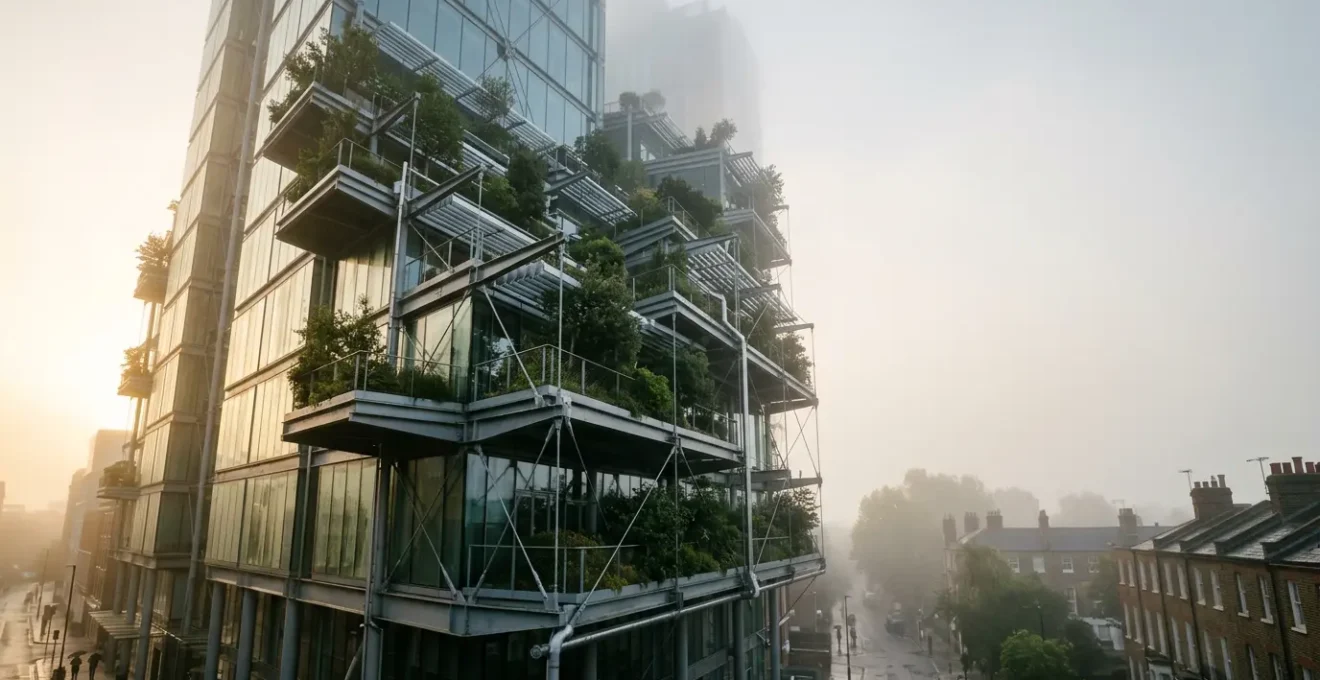
An arboreal facade is not a garden; it is a high-load structural system where horticultural failure cascades into a public safety crisis.
- Success depends on engineering against failure modes, not on aesthetic intent. Wind load, saturated soil weight, and material fatigue are primary threats.
- Systemic redundancy—reinforced planters, independent tethers, and ecological firebreaks—is non-negotiable for mitigating catastrophic collapse.
Recommendation: Prioritise a site-specific structural load and wind-tunnel analysis before any architectural plans are drafted.
The vision is compelling: a verdant, living skyscraper rising above Manchester, echoing Milan’s Bosco Verticale. For a bold property developer, it represents a landmark achievement in sustainable, biophilic design. However, the dream is quickly confronted by a brutal reality: the UK’s harsh and unpredictable climate. The prevailing conversation often revolves around aesthetics, plant selection, and ecological benefits. These are secondary considerations.
The fundamental, and often dangerously overlooked, truth is that a high-rise arboreal facade is an extreme engineering challenge. It is a dynamic system, where every tree acts as a sail, subjecting the structure to complex, fluctuating loads. The weight of soil, when fully saturated by a Manchester downpour, can exceed initial calculations by orders of magnitude. We are not discussing gardening; we are discussing structural mechanics at height.
But what if the key to success isn’t just choosing hardy plants, but in adopting a ruthless, safety-first engineering doctrine? This guide abandons architectural platitudes. Instead, it provides a structural engineer’s uncompromising briefing on anticipating and designing against the critical points of failure. We will dissect the forces at play, the material science required, and the inspection protocols that differentiate a landmark structure from a future liability.
This article provides a technical framework for assessing the viability and structural requirements of such a project. It is structured to address the most critical engineering and regulatory challenges, from foundational load-bearing capacity to the specifics of gaining consent for historic properties.
Summary: A Structural Survival Guide for High-Rise Arboreal Facades
- Why Do Gale-Force Winds Threaten the Root Stability of Balcony-Planted Trees?
- How to Reinforce Concrete Cantilevers to Support 50 Tons of Wet Soil?
- The Pest Control Oversight That Causes Aphid Infestations Across Thirty Luxury Apartments
- Evergreen Conifers or Deciduous Broadleaves: Which Resists Urban Pollution Better?
- When to Inspect the Safety Tethers on Trees Planted 200 Feet in the Air?
- The Weight Distribution Error That Snaps Delicate Aluminium Support Struts
- Reclaimed Antique Bricks or Bespoke Colour-Matched New Bricks: Which Pleases the Council More?
- How to Modernise Historic UK Properties Legally Under Grade II Listed Consent?
Why Do Gale-Force Winds Threaten the Root Stability of Balcony-Planted Trees?
A tree on a high-rise balcony is not in a forest; it is a mast on a ship, exposed to aerodynamic forces it never evolved to withstand. At ground level, wind speed is moderated by surrounding structures and terrain. At 200 feet, a tree is subjected to uninterrupted wind flow, acceleration around corners, and complex vortex shedding. These forces do not apply a simple, static pressure. They create a dynamic load vector, inducing vibration, oscillation, and torsion that is transferred directly to the root ball and its container. The root system, confined to a planter, has no ability to develop the deep, anchoring structures it would in the ground. Its stability is entirely dependent on the engineered system.
The primary failure mode is not the trunk snapping, but a gradual loosening of the root ball within the substrate. This “micro-rocking” creates a gap between the soil and the planter walls, allowing water to channel and further weakening the structure. In a gale, this culminates in the entire tree-and-soil mass acting as a single, unstable lever, prying against its container. As highlighted by structural experts, this exposure is a primary design constraint. According to a study in the journal *Frontiers in Built Environment*:
Tall buildings, due to their height and structural complexity, are particularly vulnerable to wind loads.
– Frontiers in Built Environment, Wind load impact on tall building facades study
The engineering response must therefore treat the tree, root ball, and planter as a single, integrated assembly. This assembly must be designed to resist not just lateral force, but also cyclic fatigue and uplift. Root stabilisation meshes, subsurface tethers, and aerodynamically shaped planters are not aesthetic choices; they are fundamental safety components to prevent catastrophic failure at the horticultural-structural interface.
How to Reinforce Concrete Cantilevers to Support 50 Tons of Wet Soil?
The romantic image of a tree on a balcony belies the immense static and dynamic loads involved. A single mature tree can require a planter containing 10-15 cubic metres of soil. Dry, this substrate may weigh 15-20 tons. Following a prolonged period of rain, typical in the UK climate, this soil becomes fully saturated. Its weight can easily double, reaching 40-50 tons. This load is not distributed; it is a point load concentrated on a concrete cantilever extending from the main structure. Standard residential balcony design is wholly inadequate for this task. Failure to engineer for this maximum saturated load is a primary cause of structural failure.
Reinforcement requires a multi-faceted approach beyond simply using more steel rebar. High-tensile carbon fibre or basalt fibre reinforcement mesh should be integrated into the concrete mix, particularly in the upper sections of the cantilever where tensile stress is highest. This provides superior strength-to-weight performance and resistance to fatigue. Furthermore, the design must incorporate significant structural redundancy. The cantilever should not be the sole point of support. It must be supplemented by high-tensile steel support struts or cables tying it back to the primary structural frame of the building, ensuring a distributed load path in the event of localised material fatigue.
This level of engineering is evident in pioneering projects like the Bosco Verticale, which supports around 800 trees. The solution involves not just robust cantilevers, but an entire ecosystem of support. Strain gauges should be embedded within the concrete during construction. These allow for ongoing, non-destructive monitoring of the cantilever’s structural integrity over its entire lifecycle, providing early warning of stress fractures or deflection long before they become a visible or critical threat.
The Pest Control Oversight That Causes Aphid Infestations Across Thirty Luxury Apartments
A vertical forest is not a collection of individual plants; it is a vertically distributed ecosystem. An oversight in pest management on a single balcony will not remain a localised issue. Wind currents, particularly updrafts along the building’s facade, will transport pests like aphids, spider mites, and scale insects from one level to the next with alarming efficiency. A monoculture planting strategy—using the same species of tree or shrub across all levels for aesthetic uniformity—is a catastrophic error. It creates a “super-highway” for pests, allowing an infestation to sweep across the entire building, potentially affecting dozens of apartments and compromising the health of the entire facade.
The solution is an Integrated Pest Management (IPM) strategy engineered from the outset. This begins with creating ecological firebreaks through a patchwork planting strategy. By alternating species and families of plants, you create barriers that a species-specific pest cannot easily cross. For example, the design for Frankfurt’s EDEN Tower illustrates this principle, where a careful selection process involving a significant diversity of species was paramount. A robust design will incorporate a strategy that involves using over 15 different plant species to build inherent resilience.
This proactive approach prevents problems before they start, moving beyond reactive spraying. A sound IPM strategy is a deliverable of the engineering and design phase, not an afterthought for the maintenance crew. It is a critical system for ensuring the long-term viability and safety of the arboreal facade.
Action Plan: Integrated Pest Management for High-Rise Facades
- System Design: Design aerodynamic baffles and variegated facade textures on lower floors to disrupt the vertical wind tunnels that carry pests upward.
- Ecosystem Integration: Incorporate insect hotels and nectar-rich companion plants at strategic, sheltered intervals to attract and sustain populations of predatory insects like ladybirds and lacewings.
- Resilience Planning: Implement a patchwork planting strategy mixing multiple tree species and families to create the ecological firebreaks that halt the rapid spread of species-specific pests.
- Proactive Monitoring: Install a network of smart monitoring systems (e.g., digital traps, leaf-wetness sensors) for early pest and disease detection across all facade levels, feeding data back to a central building management system.
- Biological Seeding: Establish robust beneficial insect populations (e.g., releasing predatory mites) *before* the primary plantings are fully established, creating a natural defence system from day one.
Evergreen Conifers or Deciduous Broadleaves: Which Resists Urban Pollution Better?
The choice between evergreen and deciduous species is not merely aesthetic; it is a technical decision with significant consequences for year-round performance, maintenance, and impact on the building itself. Urban pollution consists of gaseous pollutants (like NOx and SOx) and, more critically, Particulate Matter (PM2.5 and PM10). The ability of the arboreal facade to mitigate this pollution is a key performance indicator. There is no single “better” choice; there is an engineered trade-off.
Evergreen conifers offer consistent, year-round foliage, providing a permanent surface for trapping particulate matter. Their needle-like structure creates a large surface area, which is effective at capturing fine particles. However, this same foliage can become coated with a layer of urban grime during winter months when rainfall is less effective at washing it clean, reducing its photosynthetic efficiency. Deciduous broadleaves, conversely, offer peak performance in summer. Their large leaves are highly efficient at both trapping particulates and providing cooling through evapotranspiration. In winter, they are dormant, offering no filtration benefits and creating a significant leaf-litter management issue that must be engineered into the building’s maintenance plan.
The table below outlines the core performance differences. As research from green infrastructure experts shows, this choice also has a profound impact on the building’s thermal performance. An effective green wall can reduce the temperature fluctuations at a wall’s surface from a range of 10-60°C to one of 5-30°C, a critical factor in reducing energy consumption.
| Characteristic | Evergreen Conifers | Deciduous Broadleaves |
|---|---|---|
| Year-round Performance | Continuous but reduced efficiency in winter | High efficiency in summer, dormant in winter |
| Particulate Matter Capture | Consistent PM2.5 trapping on needles | High seasonal capture on broad leaves |
| Heat Island Effect | Minimal impact; dark surfaces can absorb heat | Significant cooling via evapotranspiration and shading |
| Maintenance Requirements | Requires periodic cleaning of winter grime from foliage | Requires engineered solution for seasonal leaf management |
A truly engineered solution often involves a hybrid approach: using evergreen species on facades exposed to prevailing winter winds to act as a buffer, and deciduous species on south-facing facades to maximise summer cooling and light penetration in winter. The decision is driven by a micro-climate analysis of the specific building, not by a catalogue of plants.
When to Inspect the Safety Tethers on Trees Planted 200 Feet in the Air?
Safety tethers are the last line of defence against catastrophic failure. They are not a “fit and forget” component. The environment of a high-rise facade—constant vibration, UV exposure, moisture, and wind-induced abrasion—is exceptionally hostile to any material. A fixed, calendar-based inspection schedule is insufficient and demonstrates a fundamental misunderstanding of the risks. The inspection protocol must be dynamic and risk-based.
The baseline is a comprehensive annual inspection by a qualified rope-access arborist. This involves a tactile and visual check of every single tether, anchor point, and tensioning device on the building. The arborist will look for signs of corrosion, fraying (on synthetic tethers), metal fatigue around anchor points, and improper tension. However, this is merely the baseline. A series of trigger-based inspections are mandatory:
- Post-Storm Inspection: An immediate inspection of all tethers is required following any Met Office named storm or any recorded wind gusts exceeding 70 mph at the building’s height.
- Biennial Load Testing: Every two years, a random sample of tethers (e.g., 10%) should be subjected to non-destructive load testing to verify their continued tensile strength and the integrity of their anchorages.
- Growth-Cycle Adjustment: As a tree grows, its centre of gravity and wind profile change. Tethers must be inspected and potentially repositioned or re-tensioned every 3-5 years to accommodate this growth and prevent girdling of the trunk.
This rigorous protocol must be written into the building’s operational and maintenance manual from day one. The cost of this specialist work is a fundamental operating expense, not an optional extra. Failing to budget for and execute this level of inspection is gross negligence. It is the single most important activity in ensuring the long-term safety of the building and the public space below.
The Weight Distribution Error That Snaps Delicate Aluminium Support Struts
The use of lightweight materials like aluminium for support structures in arboreal facades is driven by a desire to reduce the overall dead load on the building. While logical, this can introduce a critical point of failure if the principles of weight distribution are not strictly observed. Aluminium, while strong for its weight, is susceptible to fatigue and has a lower shear strength than steel. A design that concentrates the entire weight of a planter onto a few “delicate” aluminium struts is a catastrophic error waiting to happen. The error is not in using aluminium, but in designing a system that allows for point-load concentration.
A successful engineering solution prioritises load distribution. Consider the system used in the EDEN Tower in Frankfurt: the planters are not simply bolted on. Instead, they are part of a system where fire-resistant mats weighing 40 kilograms hang from 10 robust columns, with the plants rooting into this distributed mineral wool substrate. This design avoids concentrating the entire weight onto small, delicate brackets. The load is spread across a much larger, more resilient vertical structure. This is the fundamental principle: transform a point load into a distributed load.
For systems using individual planters, this means that a planter must never be supported by its own discrete struts alone. It must be integrated into a larger sub-frame that spans multiple structural anchor points on the building’s primary frame. This sub-frame, which can be made of steel or a heavier-gauge aluminium alloy, takes the primary load and distributes it, while the “delicate” struts serve merely to position the planter within the frame. This creates redundancy and ensures that the failure of a single component does not lead to the complete detachment of a multi-ton planter.
Reclaimed Antique Bricks or Bespoke Colour-Matched New Bricks: Which Pleases the Council More?
When dealing with heritage-sensitive locations or listed buildings, the choice of facade material is often a point of intense negotiation with the local planning authority and its conservation officers. The aesthetic appeal of using reclaimed antique bricks to “blend in” is a common proposal. From a purely structural engineering standpoint, this is a non-starter. The question is not what “pleases the council” visually, but what satisfies their non-negotiable duty to ensure public safety and structural longevity.
The argument against using reclaimed materials for a structural application like a high-rise planter system is absolute. As one building engineering consultant notes in a technical analysis of material selection for heritage modifications:
The technical argument against antique bricks highlights the unsuitability of reclaimed bricks due to variable porosity, potential frost damage, and unknown load-bearing capacity for the high-performance demands of a structural planter system.
– Building Engineering Consultant, Material selection for heritage building modifications
Reclaimed bricks lack certification. Their provenance is unknown, their exposure to sulfates is unquantified, and their compressive strength is variable. They are prone to spalling from frost action, a critical risk when they are constantly exposed to moisture from soil. Proposing their use for a load-bearing element is indefensible from an engineering and liability perspective. The correct approach is to use bespoke, colour-matched new bricks. Modern brick manufacturing can produce new, fully-certified, frost-resistant bricks that perfectly match the colour, texture, and size of historic brickwork. This approach satisfies the aesthetic requirements of the conservation officer while providing the verifiable structural performance and durability that a project of this nature demands. The council is pleased by a proposal that is both respectful to heritage and impeccably safe.
Key Takeaways
- An arboreal facade’s primary challenge is structural, not horticultural. Underestimate wind and water loads at your peril.
- Systemic redundancy is mandatory. Single points of failure (e.g., a cantilever without tie-backs, a monoculture planting) are unacceptable risks.
- Material selection must be driven by certified performance data (e.g., new bricks, carbon fibre), not aesthetics (e.g., reclaimed bricks).
How to Modernise Historic UK Properties Legally Under Grade II Listed Consent?
Proposing an arboreal facade on a Grade II listed building is one of the most complex planning challenges in UK development. The default position of any conservation officer is to refuse any intervention that alters the historic fabric of the building. Success is not achieved by arguing about aesthetics, but by presenting an overwhelmingly robust case built on the principle of reversibility and preservation. The entire green facade system must be designed as a “kit-of-parts” that is demonstrably independent of the original structure.
The legal framework for gaining Listed Building Consent in this context requires a detailed process. The application must prove, with verifiable engineering analysis, that the original building fabric will remain undamaged. This means the system cannot be chased into the historic brickwork. It must bolt onto existing, robust structural elements (like the primary floor slabs) with specialist, non-corrosive fixings. A comprehensive Heritage Impact Assessment is the central document, focusing on how you will mitigate water drainage and prevent any possibility of root ingress into the historic mortar and masonry. Waterproofing membranes, air gaps, and root barriers are not optional features; they are the core of the proposal.
Crucially, the proposal should be framed not as an alteration, but as an ecological enhancement that aligns with the council’s own sustainability targets. Providing data on the benefits can be persuasive. For example, presenting evidence that green walls can result in up to 41% sound absorption can frame the project as a benefit to the building’s occupants and the surrounding area, reducing ambient noise by a documented 8 dB. By combining a technically flawless, reversible design with a clear articulation of its environmental benefits, you shift the conversation from “damage” to “enhancement,” providing the conservation officer with the justification needed to grant consent.
Your next step is not to brief an architect on aesthetics. It is to commission a specialist structural engineer and heritage consultant to conduct a site-specific feasibility study, structural load analysis, and preliminary Heritage Impact Assessment. This foundational due diligence is the only responsible path forward.