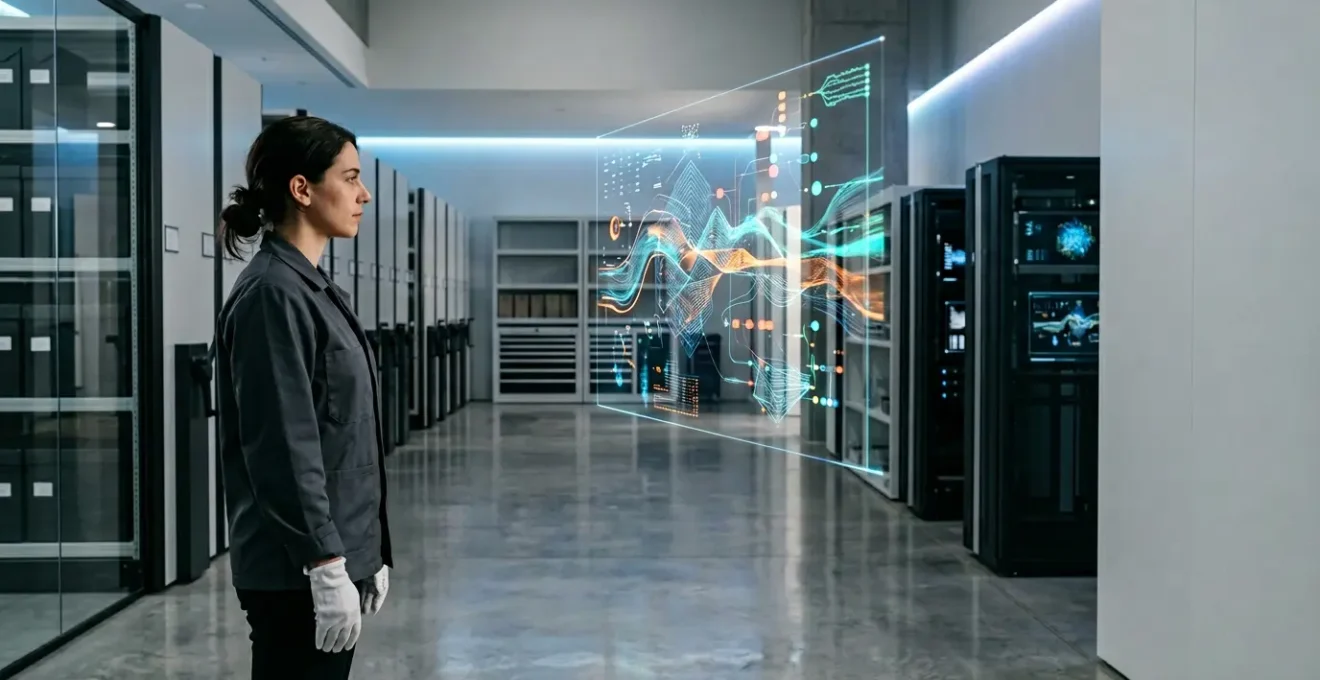
The preservation of digital art is not a passive act of storage but an active process of managing inevitable decay through self-sufficient “preservation arks”.
- Proprietary formats and consumer-grade storage are guaranteed failure points, necessitating a shift to open standards and enterprise-grade, self-healing systems.
- True authenticity in interactive art requires preserving not just the visuals, but the specific behavioral quirks of the original environment, often through full system virtualization.
Recommendation: Shift focus from creating static “backups” to building dynamic, multi-layered preservation packages that include the artwork, its operational context, and its verifiable provenance.
For the museum archivist, there is no more chilling silence than that of a failed digital artwork. You double-click a file from the 1990s—a seminal piece of interactive art—and are met not with the artist’s vision, but with an error message, a garbled screen, or nothing at all. The realization dawns: 30% of your digital collection is not just stored, it is actively decomposing on its storage medium. The common wisdom to ‘make backups’ and ‘use open formats’ feels tragically inadequate when faced with the complex decay of custom software, proprietary codecs, and obsolete hardware dependencies.
This reality is the starting point for any serious conversation about digital preservation. The standard advice, while not incorrect, fails to address the unique instability of video and interactive art. These are not static objects like a JPEG or a PDF; they are complex, dynamic systems of software, hardware, and data, each with its own ticking clock. The files decay, the hardware fails, and the software environment that gives the work meaning evaporates with the next operating system update. We are not merely archiving files; we are attempting to preserve behavior, interaction, and experience.
But what if the core premise of ‘freezing’ a digital object in time is flawed? The paradigm must shift from passive storage to active, managed decay. The true long-term strategy is not to build a fortress against time, but to construct a ‘Preservation Ark’—a self-contained, self-validating package that can navigate the shifting tides of technology. This is not about preventing loss, but about shepherding a work’s essential character across technological epochs with verifiable integrity.
This article will deconstruct this strategy layer by layer. We will move from the microscopic level of the file codec to the macroscopic level of institutional policy, outlining a robust, technical framework for ensuring that today’s digital masterpieces do not become tomorrow’s digital ghosts.
To navigate this complex but critical subject, this guide is structured to address the key points of failure in digital art preservation, from the file itself to the institutional framework that supports it. The following summary outlines the path we will take to build a comprehensive archival strategy.
Summary : An Archival Framework for Managing the Decay of Digital Art
- Why Do Proprietary Video Codecs Guarantee the Eventual Erasure of Digital Masterpieces?
- How to Migrate Interactive Flash Projects onto Modern Emulation Platforms?
- The Hard Drive Storage Flaw That Causes Silent Data Corruption Over a Decade
- Physical LTO Tape Backups or Cloud Redundancy: Which Survives Institutional Bankruptcies Better?
- When is the Critical Moment to Transfer Files Before the Original Hardware Dies?
- Why Do Photogrammetry Scans Preserve Curatorial Intent Better Than Video Tours?
- Why Do Paper Certificates Falter While Blockchain Provenance Remains Immutable?
- How to Archive Ephemeral Exhibitions for Global Remote Access Post-Closure?
Why Do Proprietary Video Codecs Guarantee the Eventual Erasure of Digital Masterpieces?
The first point of failure in digital preservation is almost always the file format itself. A video artwork encoded in a proprietary codec from the early 2000s, such as an obscure variant of RealVideo or a specific version of Sorenson Spark, is a ticking time bomb. The company that created the decoder may no longer exist, the software may not run on modern operating systems, and the technical specifications may have been lost to time. Relying on a single, closed-source format is not archiving; it is gambling with cultural heritage. The probability of being able to decode and render the file correctly in 50 years approaches zero.
The antidote to this planned obsolescence is to build a “Digital Rosetta Stone” for each artwork. This is not merely a file conversion but the creation of a self-contained preservation package—an ‘ark’—that contains everything needed for future archivists to reconstruct the work. The core principle is to decouple the artwork from any single technology. This package should include the original proprietary file (as a ‘source artifact’), a migrated version in a well-documented, lossless, open-source format like FFV1 (Fast Forward Video 1), and, crucially, the tools and documentation to understand and validate both.
This approach acknowledges the reality of ‘managed decay’. We cannot stop technological change, but we can provide a clear pathway for migration. By packaging the art with its own means of interpretation and verification, we give future generations a fighting chance to experience the work as intended, long after the original software and hardware are gone.
Your Action Plan: The Digital Rosetta Stone Strategy
- Export the video file in its original proprietary format alongside a lossless open-source alternative (FFV1, VP9).
- Include a validated open-source transcoder executable (FFmpeg) with specific version documentation.
- Create a human-readable technical specification document detailing codec parameters, frame rates, color spaces, and compression algorithms.
- Generate frame-accurate checksums (MD5/SHA256) for both the proprietary and open formats to verify integrity.
- Package all components in a TAR archive with PREMIS metadata describing relationships between files.
How to Migrate Interactive Flash Projects onto Modern Emulation Platforms?
The demise of Adobe Flash in 2020 created a mass extinction event for a generation of interactive art. For archivists, the challenge is not just preserving a video stream, but preserving interactivity, idiosyncratic timing, and the unique ‘feel’ of the ActionScript engine. Simple conversion to a video file destroys the essence of the work. This is where the distinction between functional emulation and full environmental simulation becomes critical for maintaining behavioral authenticity.
Functional emulation tools like Ruffle are heroic efforts that can restore functionality for a large percentage of Flash content directly in modern browsers. However, they are reverse-engineering a complex, often undocumented platform, leading to inevitable inaccuracies in physics, animation timing, or event handling. For a significant portion of artworks that relied on specific bugs or quirks of the Flash Player, this level of emulation is insufficient. It preserves the look, but not the behavior.
For these high-value, complex works, only full environmental simulation suffices. This involves creating a virtual machine (VM) that runs a period-correct operating system (e.g., Windows XP) and the specific version of the Flash Player plugin the artist used. The artwork runs natively within this sealed environment, preserving every nuance. While resource-intensive, this method provides the highest degree of behavioral authenticity. The choice between these methods is a curatorial and conservation decision based on the specific needs of the artwork.
This comparative analysis from a study published in *Nature* highlights the critical trade-offs between different preservation approaches for Flash media, showing that there is no one-size-fits-all solution. As the data in this research on preserving Flash-based art demonstrates, the choice between low-resource emulation and high-fidelity virtualization is a central question in modern digital conservation.
| Approach | Tools Required | Preservation Quality | Resource Requirements |
|---|---|---|---|
| Functional Emulation (Ruffle) | Ruffle WebAssembly runtime | 70-80% compatibility, loses timing quirks | Low: Browser-only |
| Full Environmental VM | VirtualBox/QEMU + Period OS + Flash Plugin | 95-99% authentic experience | High: 20-50GB per artwork |
| Community Archive Integration | Flashpoint launcher + curated database | Variable, crowd-verified | Medium: 1TB+ for full archive |
The visual difference can be subtle but profound. As seen in the comparison, the emulated version on the right may exhibit slight variations in rendering or timing, artefacts that could fundamentally alter the experience of a work sensitive to such details. The VM approach, while more cumbersome, remains the gold standard for capturing the work’s original soul.
The Hard Drive Storage Flaw That Causes Silent Data Corruption Over a Decade
Once a file is correctly formatted and packaged, the next existential threat is the storage medium itself. The assumption that digital data is permanent once written is dangerously false. All storage media, from spinning hard disk drives (HDDs) to solid-state drives (SSDs) and LTO tapes, are subject to a slow, insidious process known as ‘bit rot’ or silent data corruption. This is the spontaneous, uncommanded flipping of a binary bit (a 0 to a 1, or vice versa) due to cosmic rays, manufacturing defects, or simple charge decay over time. While consumer-grade storage may lose data rapidly, even enterprise-grade drives are not immune over the long term.
This problem is particularly acute because traditional filesystems like NTFS or HFS+ have no mechanism to detect it. They will happily serve a corrupted file, assuming the data is exactly as it was written years ago. A single flipped bit in a compressed video file can cause a cascade of visual artifacts, while in an executable it can render the program completely inoperable. For an archive, this means the integrity of the collection is constantly, silently eroding. Annual checksum validation is a necessary but reactive measure; it tells you what you have *already lost*.
A truly robust archival strategy requires a proactive approach. As the Digital Preservation Coalition notes, this means moving beyond passive storage to systems that actively maintain data integrity. This perspective, highlighted in a key report, is crucial for long-term preservation.
Self-healing file systems like ZFS or Btrfs don’t just detect silent corruption (bit rot) but actively repair it using parity data, offering a truly resilient long-term solution.
– Digital Preservation Coalition, Digital Art Preservation Best Practices Report
These enterprise-grade filesystems perform regular “scrubs” of the data, reading every block and comparing it against its checksum. If a mismatch is found (indicating bit rot), the system automatically reconstructs the correct data from parity information stored elsewhere. This transforms storage from a passive, decaying repository into an active, self-healing ecosystem. For an institution committed to preserving digital assets for decades or centuries, adopting a self-healing filesystem is not an optional upgrade; it is a foundational requirement.
Physical LTO Tape Backups or Cloud Redundancy: Which Survives Institutional Bankruptcies Better?
With a stable file format and a self-healing local storage system, the next layer of risk is institutional. What happens to the archive if the museum faces a budget crisis, a natural disaster, or even bankruptcy? The choice between physical, on-premise backups like LTO tape and off-site cloud storage has profound implications for institutional sovereignty and long-term survival.
Cloud storage offers convenience, scalability, and immediate access. However, it creates a dependency on a commercial vendor. The data is held hostage to continuous payments; a billing dispute, a vendor’s change in terms, or a simple credit card failure could result in the archive being locked or deleted. Over a 30-year timeframe, the cumulative cost of cloud storage can become astronomically higher than physical media, creating a perpetual financial vulnerability for the institution.
LTO (Linear Tape-Open) tape, by contrast, represents a capital expenditure. Once purchased, the tapes and the data on them are owned outright by the institution. They can be stored off-site in a climate-controlled vault, immune to cyber-attacks and billing systems. While access is slower, this “air-gap” provides a powerful defense against digital threats. In a bankruptcy scenario, LTO tapes are a physical asset the institution controls, whereas cloud data access could be terminated by creditors or the provider. An academic analysis of digital preservation strategies provides a stark comparison of these models, emphasizing the long-term risks associated with vendor dependency.
| Factor | LTO Tape (Physical) | Cloud Storage | Hybrid Escrow |
|---|---|---|---|
| Control During Bankruptcy | Full institutional control | Dependent on payment continuity | Legal protection via escrow agreement |
| Access Speed | 24-48 hours (tape retrieval) | Immediate | Varies by agreement |
| 30-Year Cost (1PB) | $50,000-100,000 | $500,000-1,000,000 | $200,000-400,000 |
| Data Hostage Risk | Zero | High (billing disputes) | Low (legal safeguards) |
The most resilient strategy is not an either/or choice but a diversified, multi-layered approach. A “3-2-1” rule for institutions might involve having the master preservation copies on ZFS servers (Copy 1, On-site), a secondary set on LTO tapes in an off-site vault (Copy 2, Off-site, Physical), and a third, access copy in a non-profit or escrowed cloud service (Copy 3, Off-site, Cloud). This hybrid model balances access with sovereignty, mitigating the risks of any single point of failure—be it technological, financial, or organizational.
When is the Critical Moment to Transfer Files Before the Original Hardware Dies?
For many early digital artworks, the original hardware is not just a playback device; it is an integral part of the piece. A specific CRT monitor’s color profile, a particular computer’s processing speed, or a custom-built interface are all part of the work’s identity. Preserving the software is only half the battle; the hardware itself is on a path to inevitable failure. The critical question for the conservator is not *if* the hardware will die, but *when*, and how to act before that moment.
Waiting for a component to fail is a reactive and dangerous strategy. The moment of failure can cause catastrophic damage, like a dying power supply taking the motherboard with it. The process must be one of managed decay, moving from reactive repair to predictive conservation. This involves actively monitoring the health of critical hardware components. For hard drives, this means leveraging the Self-Monitoring, Analysis, and Reporting Technology (S.M.A.R.T.) data that modern drives produce. Key indicators like ‘Reallocated Sector Count’ or ‘Spin Retry Count’ are early warnings of mechanical failure.
According to research on predictive failure monitoring shows that S.M.A.R.T. data can predict up to 64% of drive failures with a very low false-positive rate. This transforms conservation from guesswork into data-driven risk management. The critical moment to transfer files is not when the hardware is dead, but when the monitoring data indicates an unacceptably high risk of imminent failure. At this point, the conservator must act: image the drives, document the system, and either migrate the environment to a virtual machine or prepare for a controlled, documented hardware replacement. This proactive stance is the only way to stay ahead of the inevitable decay of physical electronics.
Why Do Photogrammetry Scans Preserve Curatorial Intent Better Than Video Tours?
Preserving an artwork often extends beyond the object or file itself to include its context: the space in which it was exhibited. A traditional video tour is a linear, passive record, guided by the fixed perspective of the videographer. It documents what the work looked like, but it fails to capture the crucial element of curatorial intent—the network of spatial relationships between artworks, the viewer’s path, and the carefully planned sightlines that define an exhibition’s narrative.
Photogrammetry, the science of creating 3D models from overlapping photographs, offers a far more complete archival solution. By capturing the entire gallery space as a high-fidelity, navigable 3D model, it preserves the volumetric and spatial qualities of the exhibition. A researcher can then “re-enter” the virtual space and move freely, discovering relationships that a linear video would completely obscure. They can analyze why the curator placed a small, quiet piece in conversation with a large, loud one, or how a specific doorway frames the first view of a key artwork.
This method preserves not just the objects, but the space between the objects, which is often where curatorial meaning resides. A case study from the Archive of Digital Art demonstrates how multiple visualization interfaces built upon 3D scans enable researchers to explore these spatial dynamics in ways impossible with video. They can study the intended visitor flow, analyze proximity relationships, and even experience the sightlines planned by the curatorial team. The 3D model becomes a primary source document for studying the exhibition as a complete, intentional composition.
A user can explore these relationships freely, discovering sightlines intended in the physical space, which a linear video tour completely destroys.
– LACMA Time-Based Media Conservation Team, Further Tales of Saving Digital Media
In essence, a video tour is a secondary interpretation of the exhibition, while a photogrammetry scan is a primary data set. It allows for future analysis and re-interpretation, preserving the curatorial vision in a far more profound and research-rich format. For institutions serious about documenting their exhibition history, this technology represents a fundamental leap in archival practice.
Why Do Paper Certificates Falter While Blockchain Provenance Remains Immutable?
The provenance of an artwork—its chain of ownership, exhibition history, and conservation record—is as much a part of its identity as its physical form. For decades, this information has been entrusted to paper certificates of authenticity, file folders, and institutional memory. This system is fragile, siloed, and susceptible to loss, forgery, and disputes. A paper certificate can be easily copied, damaged in a fire, or lost during an acquisition. When a gallery closes, its records may vanish entirely, creating a permanent gap in the artwork’s history.
Blockchain technology offers a robust, decentralized solution to the fragility of paper-based provenance. By recording an artwork’s key information on a distributed ledger, it creates a record that is cryptographically secure, immutable, and permanent. A blockchain entry cannot be secretly altered or forged. Each transaction, such as a sale, loan for an exhibition, or a conservation action, is added as a new, timestamped block to the chain, visible to all permissioned parties. This creates a single, unified, and unbreakable source of truth for the artwork’s entire lifecycle.
This approach addresses the core weaknesses of traditional methods. As this comparative analysis of provenance tracking shows, the advantages of a distributed ledger are overwhelming in terms of security and resilience.
| Authentication Factor | Paper Certificate | Blockchain Record |
|---|---|---|
| Forgery Resistance | Low (physical copying possible) | Cryptographically impossible |
| Multi-party Verification | Single gallery authority | Multiple co-signers (artist, gallery, museum) |
| Exhibition History Tracking | Manual updates required | Automatic on-chain logging |
| Conservation Action Records | Separate documentation | Integrated in transaction history |
| Survival of Institution Bankruptcy | Physical document may be lost | Distributed ledger persists |
Crucially, because the ledger is distributed across many computers worldwide, it is not dependent on the survival of any single institution. If a museum, gallery, or artist’s studio goes bankrupt, the blockchain record persists independently. This ensures that the vital contextual data that constitutes an artwork’s history and value is preserved for future generations, creating a level of archival permanence that paper could never achieve.
Key Takeaways
- Active Management Over Passive Storage: True preservation requires self-healing filesystems (like ZFS) and predictive hardware monitoring, not just storing files and hoping for the best.
- Context is the Artwork: A digital file is meaningless without its operational context. Archiving must include the software environment, curatorial intent, and verifiable provenance.
- Diversified Sovereignty: A resilient strategy combines the physical control of LTO tapes with the accessibility of non-profit or escrowed cloud services to mitigate technological and financial risks.
How to Archive Ephemeral Exhibitions for Global Remote Access Post-Closure?
The ultimate archival challenge is preserving the un-preservable: ephemeral exhibitions designed to change, decay, or disappear over time. These works, which may involve audience interaction, perishable materials, or time-based degradation, defy traditional documentation. A single photograph or video captures only one frozen moment in a continuous process. How can an archivist capture the entire narrative arc of such an exhibition for future researchers?
The solution lies in moving from single-point-in-time documentation to a time-layered archival model. This involves a systematic process of capturing the exhibition space at multiple key stages of its lifecycle. Using photogrammetry and 3D scanning, the archivist creates a series of complete, navigable models of the space: one of the pristine, newly-installed exhibition; another mid-run, documenting wear, audience contributions, and evolving elements; and a final scan at the close, showing the full extent of the work’s intended or unintended degradation.
These temporal layers are then integrated into a single virtual environment. A researcher can access this archive and use a timeline slider to move between the different states, observing the exhibition’s transformation. This is a powerful tool for understanding the work’s process and duration. The model can be further enriched by embedding contextual ‘hotspots’—linking a specific area to an artist interview about that element, a conservation note about material decay, or an archive of social media posts from visitors who interacted with it. This creates a rich, multi-faceted “deep map” of the ephemeral event, preserving not just its form but its process and public reception.
Your Action Plan: Time-Layered Exhibition Archive Creation Process
- Capture Phase 1 (Opening): 3D scan empty gallery, then with fresh installation, record visitor interactions and initial artwork states.
- Capture Phase 2 (Mid-Run): Document wear patterns, artwork degradation, visitor contributions, and evolved interactive elements.
- Capture Phase 3 (Closing): Final scan showing complete deterioration arc, accumulated audience modifications.
- Integration: Create temporal navigation system allowing users to toggle between time layers in virtual environment.
- Enhancement: Embed contextual nodes with artist interviews, conservation notes, and social media archives at specific spatial points.
To secure the future of our digital cultural heritage, the archivist’s role must evolve. We must become proactive managers of decay, architects of resilient data arks, and stewards of an artwork’s entire context. Begin by auditing a single at-risk artwork in your collection, not as a file to be saved, but as a candidate for its own self-sustaining preservation package.