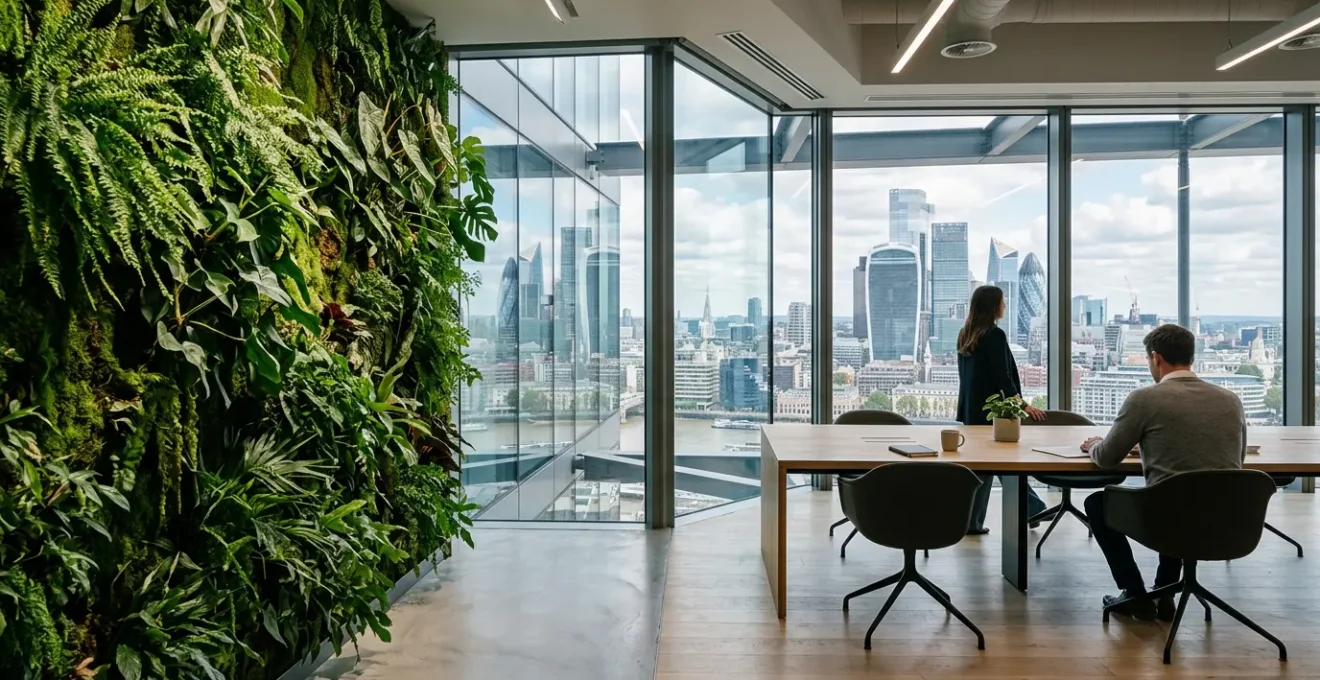
Successfully integrating living systems into a London high-rise is an exercise in infrastructure engineering, not interior decorating, with direct impacts on asset value and talent retention.
- The primary benefits—reduced sick days and higher productivity—are quantifiable metrics that justify the initial capital outlay.
- Success hinges on preemptive structural planning, particularly for lighting, irrigation, and drainage, to avoid catastrophic failures.
Recommendation: Shift the perspective from viewing biophilia as a cost centre to treating it as a performance-enhancing building system with a clear wellness ROI.
For any corporate real estate director managing a portfolio of high-density London office towers, the challenge is constant: how to enhance asset value while combatting staff turnover and burnout. The prevailing narrative often points towards biophilic design, the practice of integrating nature into the built environment. The common advice suggests adding a few potted plants or perhaps a trendy moss wall, framing nature as a decorative layer to soften the harshness of concrete and glass. This approach is seen as a quick fix for employee well-being, a simple nod to a more humane workplace.
But if the true goal is to measurably reduce staff turnover and genuinely improve mental health, is this surface-level approach sufficient? What if the real key lies not in the aesthetic application of plants, but in the rigorous, architectural integration of living systems? The conversation must shift from decoration to infrastructure. This guide moves beyond the platitudes to address the critical engineering, maintenance, and financial considerations that underpin a successful biophilic retrofit in a demanding corporate environment like London. It reframes the decision as a strategic investment in biophilic infrastructure, a core building system that delivers a quantifiable wellness ROI.
This article provides an architect’s-level framework for this process. We will dissect the measurable benefits, tackle the critical engineering hurdles of drainage and lighting, compare system maintenance demands, and define a strategic approach that aligns with the operational realities of a premier corporate building. Explore this structured guide to transforming your assets from sterile towers into thriving, high-performance ecosystems.
Summary: A Strategic Guide to Biophilic Integration in Corporate London
- Why Do Green Walls Measurably Reduce Sick Days in Open-Plan Corporate Environments?
- How to Engineer Proper Drainage for Indoor Trees Without Flooding the IT Department?
- The Lighting Miscalculation That Kills £10,000 Worth of Tropical Ficus in Three Months
- Potted Hydroponics or Integrated Soil Systems: Which Demands Less Weekend Maintenance?
- When to Schedule Heavy Pruning to Avoid Disrupting Important Boardroom Meetings?
- Mixed-Use Creative Zones or Dedicated Museums: Which Sustains Long-Term Growth?
- Why Do Open-Plan Studio Layouts Improve Cross-Disciplinary Student Collaboration?
- How Modern Architectural Design Enhances Creative Learning in UK Communities?
Why Do Green Walls Measurably Reduce Sick Days in Open-Plan Corporate Environments?
The link between green walls and reduced absenteeism is not a matter of aesthetic preference; it’s a measurable outcome of improved environmental psychology and air quality. In sterile, open-plan offices, employees often suffer from high levels of background stress and exposure to airborne volatile organic compounds (VOCs). A strategically placed living wall directly counteracts these negatives. Firstly, it offers a point of “soft fascination,” a natural texture and pattern that allows the mind to rest and recover from directed attention fatigue, a common affliction in data-heavy corporate roles. This micro-restorative experience, repeated throughout the day, lowers cumulative stress and strengthens immune response.
Secondly, the plants and their associated microbial ecosystems actively scrub the air. They metabolise pollutants like formaldehyde and benzene, common in office furnishings, while increasing humidity to healthier levels. This bio-filtration reduces the incidence of sick building syndrome symptoms, such as headaches, dry throats, and respiratory irritation, which are frequent causes of short-term sick leave. The impact is quantifiable; comprehensive research from Interface shows that offices incorporating natural elements can see a 15% productivity increase, partly driven by improved well-being and reduced absence. This transforms the green wall from an expense into an investment in a healthier, more present workforce.
Action Plan: Implementing a Health-Focused Biophilic Design
- Exposure Analysis: Identify high-traffic areas and sightlines to position living walls for maximum visual exposure and air circulation.
- System Specification: Install living walls with diverse plant species to maximize air purification and provide rich visual variety.
- Performance Metrics: Monitor key air quality metrics (e.g., VOCs, CO2, humidity) before and after installation to quantify the pollutant reduction and build the business case.
- Psychological Zoning: Use tall plants and green dividers to create ‘prospect-refuge’ zones, offering psychological safety while maintaining an open feel.
- Integrated Lighting: Implement circadian lighting systems that sync with natural daylight to support both human and plant health cycles.
Ultimately, a green wall is a performing asset. It actively works to create a healthier indoor environment, and the resulting reduction in sick days is a direct, measurable return on that investment.
How to Engineer Proper Drainage for Indoor Trees Without Flooding the IT Department?
The fear of water damage is the single greatest barrier to installing ambitious living systems in high-density office towers, especially in retrofits. The nightmare scenario of a leak cascading down to a server room is a valid concern, but one that is entirely preventable with robust engineering. Treating an indoor tree or a large planter as “decoration” is the first mistake; it must be treated as a permanent plumbing and structural installation. The key is to design a closed-loop or failsafe drainage system from the outset, viewing it as critical biophilic infrastructure.
Modern solutions move far beyond a simple tray under a pot. For large-scale installations, integrated planters with sealed, waterproof membranes connected to the building’s greywater or sanitary system are the gold standard. These systems incorporate leak detection sensors tied to the Building Management System (BMS), which can automatically shut off irrigation and alert facilities management at the first sign of an anomaly. For modularity, cassette-based green wall systems often feature self-contained irrigation and drainage, minimising risk. The choice of system has significant implications for installation complexity, maintenance, and suitability for different building types, including London’s many listed properties.
As this cross-section illustrates, a successful installation is a layered system of substrates designed for optimal aeration and water management. The selection of the right drainage system is a crucial early decision, balancing risk with the building’s structural and heritage constraints. A detailed analysis from the Royal Horticultural Society provides guidance on various wall systems.
| System Type | Installation Complexity | Maintenance Requirements | Risk Level | Suitable for Listed Buildings |
|---|---|---|---|---|
| Modular Cassette Systems | Medium | Low – automated irrigation | Low | Yes – minimal structural impact |
| Hydroponic Systems | High | Medium – regular monitoring | Medium | Limited – requires infrastructure |
| Traditional Soil Planters | Low | High – manual watering | High | Yes – standalone units |
| Felt Pocket Systems | Medium | Low – drip irrigation | Low | Yes – lightweight option |
By specifying the correct system and integrating it fully into the building’s infrastructure, the risk of water damage is not just mitigated; it is engineered out of the project entirely.
The Lighting Miscalculation That Kills £10,000 Worth of Tropical Ficus in Three Months
The most common and costly failure in corporate biophilic projects is not disease or pests; it’s a fundamental misunderstanding of light. A real estate director might sign off on a £10,000 installation of mature Ficus trees for a lobby, only to watch them shed their leaves and die within a single quarter. The cause is almost always a critical miscalculation of light intensity (measured in foot-candles or lux) and duration. A beautiful, light-filled atrium that feels bright to the human eye may be a “dark zone” for a tropical plant accustomed to hours of direct sun. Relying on ambient architectural lighting or proximity to a north-facing window is a recipe for failure.
Successful biophilic infrastructure requires a dedicated lighting strategy. This involves a professional audit of natural light patterns throughout the year and the specification of supplemental, full-spectrum horticultural grow lights. These are not the harsh purple lights of a laboratory; modern solutions are architecturally integrated, with high Colour Rendering Index (CRI) values that appear as clean, natural white light to the human eye. They must be timed to provide the specific daily light integral (DLI) required by the chosen plant species. The cost of this lighting system should be factored into the initial budget, as it is non-negotiable for the long-term survival of the plant investment. The failure to do so doesn’t just waste the capital on the plants themselves; it forfeits the associated wellness benefits, as research from the University of Exeter demonstrates a 15% productivity boost when healthy houseplants are present.
Case Study: 20 Fenchurch Street Sky Garden
A prime London example of getting it right is the Sky Garden. Its success relies on a massive, structurally-integrated glazing system designed to maximise natural light, which is then supplemented by sophisticated, concealed horticultural lighting to ensure the diverse Mediterranean and South African flora thrive year-round. It is a testament to a “light-first” design approach.
Investing in a professional lighting plan is the insurance policy that protects the far larger investment in the living assets themselves, ensuring they deliver their promised wellness ROI for years to come.
Potted Hydroponics or Integrated Soil Systems: Which Demands Less Weekend Maintenance?
For a corporate real estate director, operational expenditure and out-of-hours maintenance are primary concerns. When choosing between biophilic systems, the question of weekend and holiday upkeep is critical. Traditional soil-based systems, especially individual potted plants, represent a significant hidden labour cost. They require frequent manual watering, are prone to drying out over long weekends, and can become a vector for pests if not meticulously managed. This often leads to reliance on expensive third-party maintenance contracts with frequent, disruptive visits.
In contrast, modern potted hydroponic and modular living wall systems are engineered specifically to reduce this maintenance burden. These systems typically feature large, integrated water reservoirs that can sustain plants for two to four weeks between services. Automated, sensor-driven irrigation delivers precise amounts of water and nutrients, eliminating the guesswork and manual labour of watering. Many systems now come with smartphone connectivity, allowing facilities managers to monitor water levels and system health remotely. This dramatically reduces the need for weekend call-outs and allows maintenance to be consolidated into less frequent, scheduled visits during standard business hours.
While the initial capital expenditure for a hydroponic system may be higher, the total cost of ownership is often lower when factoring in reduced labour, water usage, and plant replacement rates. Furthermore, these clean, soil-free systems eliminate pest issues and can even be framed as an employee wellness perk, as seen with interactive herb gardens. The key is to select low-maintenance species like Pothos, Snake Plants, and ZZ Plants that are resilient and thrive in these automated environments. Some London firms even specialise in quarterly “deep maintenance” contracts, aligning perfectly with a corporate operational schedule.
By opting for systems designed for low-touch maintenance, a director can deliver a high-impact biophilic experience without creating an unsustainable operational headache for the facilities team.
When to Schedule Heavy Pruning to Avoid Disrupting Important Boardroom Meetings?
The integration of large-scale biophilic systems introduces a new logistical challenge into the corporate calendar: “maintenance choreography.” Heavy maintenance, such as pruning, soil replenishment, or pest treatment, can be disruptive, noisy, and messy. Scheduling these activities requires the same level of strategic planning as any other facilities management operation, with the goal of being invisible to the building’s occupants, especially high-level executives. The key is to align the horticultural needs of the plants with the natural lulls in London’s corporate rhythm.
The two most opportune windows for major plant maintenance are typically late August and the extended break between Christmas and New Year. During these periods, office occupancy is at its lowest, reducing the potential for disruption to meetings and daily work. Pruning can be conducted efficiently without concerns for noise or cordoning off high-traffic areas. This requires advance coordination with building management to arrange security clearance and access for maintenance crews, as well as adherence to any borough-specific restrictions on out-of-hours work. For minor, ongoing maintenance, it’s best to schedule it for very early mornings or late evenings on specific days of the week.
An innovative approach is to reframe maintenance as a positive corporate event rather than a disruption. A scheduled trimming of a feature tree, for example, can be positioned as a “botanical sculpting” demonstration, adding a touch of theatre and cultural value akin to Japanese ikebana. This turns a logistical necessity into a visible and engaging expression of the company’s commitment to its green infrastructure. This requires a shift in mindset from purely functional maintenance to curated workplace experience, a hallmark of a truly successful structural symbiosis between the building and its living systems.
Ultimately, a well-planned maintenance schedule ensures that the biophilic infrastructure remains a source of silent, constant benefit, rather than a periodic operational problem.
Mixed-Use Creative Zones or Dedicated Museums: Which Sustains Long-Term Growth?
Once the decision to invest in significant biophilic infrastructure is made, a key strategic question arises: what is its purpose? Should it be a “museum piece”—a stunning, untouchable installation in the lobby designed purely for visual impact and prestige? Or should it be a “mixed-use zone”—an interactive, accessible space where employees can work, meet, and relax amidst nature? For a corporate real estate director focused on long-term value and employee retention, the mixed-use approach almost always delivers a superior wellness ROI.
The “museum” approach, while creating a powerful first impression for visitors, offers only passive benefits to employees. It is something to be looked at, not lived in. In contrast, a mixed-use creative zone actively draws people in. By integrating comfortable seating, charging ports, and collaborative work surfaces within a plant-rich environment, you create a “third space” that is neither a formal desk nor a sterile meeting room. These zones encourage serendipitous encounters between colleagues, foster informal collaboration, and provide a genuine escape for mental decompression. This active engagement is what translates the presence of plants into measurable improvements in creativity, well-being, and ultimately, staff loyalty.
The choice between these models has direct implications for budget, space allocation, and maintenance, as one encourages interaction while the other prohibits it. A hybrid model can also be effective, with a high-impact “museum” piece at the main entrance and smaller, interactive “mixed-use” pockets throughout the upper floors.
Case Study: Barbican Centre Conservatory
London’s Barbican Centre provides a world-class public blueprint for the mixed-use model. Its famous conservatory is both a breathtaking botanical collection (a museum) and a vibrant social space used for events, cafes, and quiet contemplation (mixed-use). It demonstrates that prestige and active engagement are not mutually exclusive and serves as an inspiration for corporate biophilic zones that balance brand impact with genuine employee utility.
| Aspect | Museum Approach | Mixed-Use Approach | Hybrid Model |
|---|---|---|---|
| Initial Investment | High – statement pieces | Medium – functional design | High – dual installations |
| Employee Engagement | Visual appreciation only | Active interaction encouraged | Varied by zone |
| Maintenance Complexity | Professional only | Some employee involvement | Zone-dependent |
| Brand Impact | Maximum prestige | Culture-focused | Best of both |
| Space Efficiency | Single-purpose areas | Multi-functional zones | Optimized by location |
For sustained, long-term growth in employee satisfaction and retention, designing for active engagement consistently outperforms passive appreciation.
Why Do Open-Plan Studio Layouts Improve Cross-Disciplinary Student Collaboration?
While the context of this question is academic, the principles translate directly to the corporate world, particularly for innovation-led companies seeking to break down departmental silos. The success of open-plan layouts in fostering collaboration is not automatic; it depends entirely on how the space is structured to manage sightlines, acoustics, and movement. Simply removing walls can lead to a chaotic, distracting environment. The strategic use of biophilia, however, can provide the necessary ‘soft architecture’ to make open-plan work.
The solution lies in creating “biophilic neighbourhoods.” Instead of solid partitions, rows of tall plants (e.g., Ficus or Kentia palms) can be used to create visual boundaries between teams. These natural screens provide a sense of psychological separation and reduce visual distraction without completely isolating departments, maintaining a feeling of a larger, connected space. Hanging planters can be used to define circulation paths, subtly guiding movement and creating “collision zones” at intersections where spontaneous cross-disciplinary conversations are more likely to occur. Furthermore, dense living walls act as excellent acoustic barriers, absorbing ambient noise and reducing the sound transmission that plagues many open-plan offices.
This approach directly fosters collaboration by making the environment more comfortable and conducive to both focused work and informal interaction. The very presence of this greenery has a profound impact; Wageningen University research demonstrates that 71% of people feel healthier and more comfortable in spaces with living walls, creating a positive baseline for interaction. By using plants as a design tool, an architect can sculpt an open-plan space that encourages connection while respecting the individual’s need for focus and a degree of privacy.
Plants become more than just objects in the space; they become the very fabric that defines productive and collaborative team zones.
Key Takeaways
- Biophilic design is a structural and engineering investment, not an aesthetic overlay, with quantifiable ROI in productivity and employee retention.
- Technical planning for lighting, irrigation, and drainage is non-negotiable and must be factored into the initial project budget to prevent costly failures.
- The greatest long-term value comes from creating interactive, mixed-use green spaces that employees can actively engage with, rather than passive ‘museum’ installations.
How Modern Architectural Design Enhances Creative Learning in UK Communities?
The principles that enhance creative learning in community and academic settings are directly applicable to fostering an innovative corporate culture. Modern architectural design, particularly in the UK, is increasingly drawing on a deep-seated cultural appreciation for nature to create environments that stimulate the mind. This goes beyond simply adding plants; it’s about a structural symbiosis where the building’s form, light, and living systems work together to create a restorative and inspiring experience. This connection between nature and well-being is not a new-age trend but has deep roots in British history.
As design experts have noted, this understanding of nature’s restorative power is a core part of the UK’s cultural heritage. It’s a principle that can be powerfully leveraged in corporate retrofits to enhance the ‘creative learning’ of an organisation.
The recognition of this connection as a vital aspect of the restoration, and maintenance, of health and wellbeing, can be evidenced as far back as Victorian times. Seaside resorts gained popularity as a means to obtain rest and relaxation and for individuals to benefit from the sea air. The natural world was celebrated during these times.
– OP Group Design Experts, The Biophilic Office: Design Principles & Workplace
Today’s architect translates this by creating spaces with abundant natural light, views of nature, and direct access to green spaces like terraces or atriums. They use natural materials and patterns that mimic those found in nature (biomimicry). In the dense urban fabric of London, this often manifests as bold living walls that become community landmarks, such as the one at MTV’s Camden office, which incorporates over 18,000 plants, many chosen specifically for their ability to reduce air pollution. These installations serve as powerful, visible statements of a company’s commitment to well-being and environmental responsibility, enhancing its brand while fostering a healthier internal culture.
For the corporate real estate director, this means the next retrofit is an opportunity not just to modernise a building, but to invest in a sophisticated, performance-enhancing system that cultivates the company’s most valuable asset: its people.
Frequently Asked Questions on Integrating Living Plant Systems
When is the optimal time for major plant maintenance in London offices?
Late August and the Christmas-New Year break are ideal periods when office occupancy is typically lowest in London’s corporate calendar.
How can pruning be reframed as a positive corporate event?
Position scheduled trimming as a mindful ‘botanical sculpting’ demonstration, similar to Japanese ikebana, adding cultural value to the maintenance process.
What coordination is required with London building management?
Security clearance for maintenance crews, compliance with union regulations, and adherence to borough-specific noise restrictions for out-of-hours work must be arranged in advance.