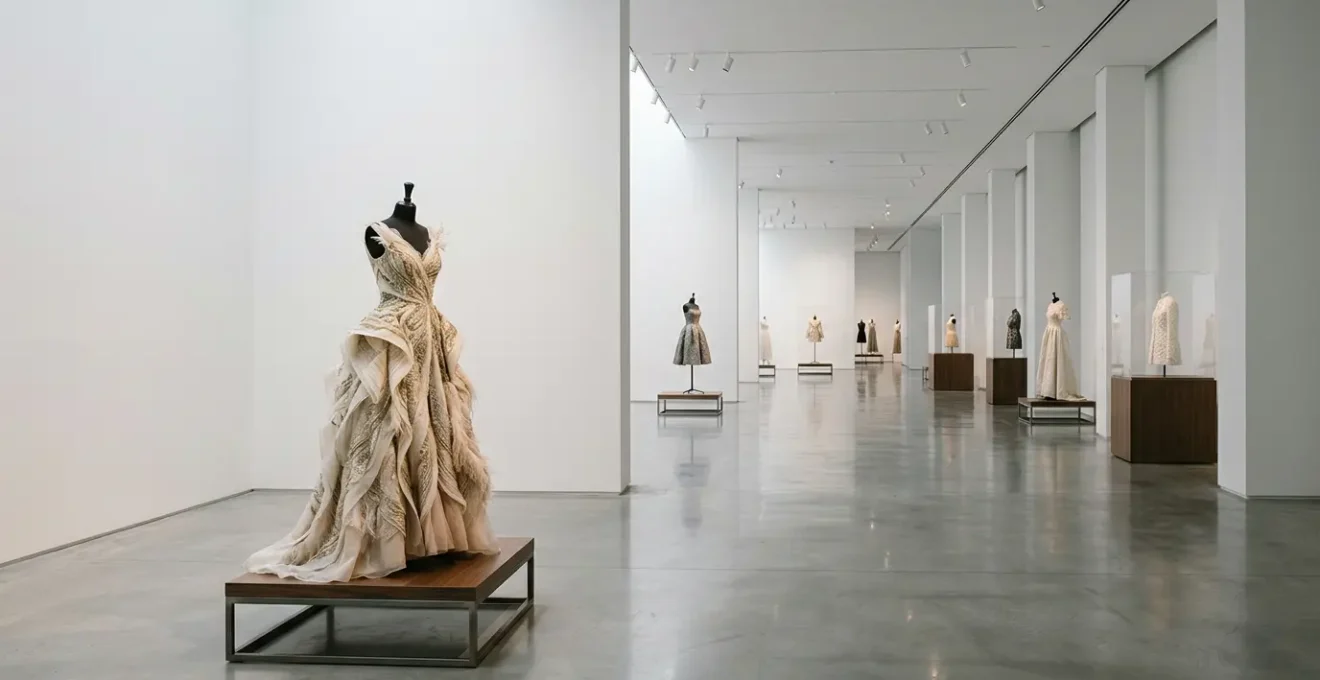
Securing a place in an institution like the V&A is not about the aesthetic value of your garments, but about the academic and narrative power of your archive.
- Curators acquire collections that function as scholarly resources capable of generating new cultural discourse.
- Strategic, early donations and meticulous, museum-standard cataloguing are non-negotiable prerequisites.
Recommendation: Shift your mindset from ‘showcasing a collection’ to ‘presenting a research-ready thesis’ supported by your life’s work.
For an iconic designer approaching the culmination of a multi-decade career, the transition from commercial relevance to historical significance is the final, most critical act. The desire to see a life’s work preserved within the hallowed halls of an institution like the Victoria & Albert Museum, rather than languishing in a warehouse, is a question of legacy. Many believe this path is paved with beautiful clothes, pristine portfolios, and high-level networking. While not irrelevant, these are merely the surface-level components of a much deeper institutional logic.
The common approach focuses on the aesthetic merit of the objects themselves. However, leading curators operate on a different plane. They are not merely acquiring dresses; they are acquiring data, evidence, and narrative potential. They are seeking archives that can support academic theses, inspire future generations of designers, and fuel cultural conversations for years to come. The fundamental misstep is presenting a collection as an end-product, when it must be framed as a beginning—a vital resource for scholarly inquiry.
But if the true key is not simply aesthetic beauty, but rather the archive’s power as an academic asset, how does a designer strategically build and present their work to meet this exacting standard? This requires a profound shift in perspective: one must learn to think not as an artist, but as a historian and curator. This guide outlines the institutional logic behind fashion acquisitions, detailing the precise, often counter-intuitive, steps required to transform a personal archive into a national treasure. It moves beyond the what—the collection—to the why and how: the narrative, the strategy, and the meticulous preparation that cement a designer’s place in history.
This article provides a comprehensive framework, from curatorial priorities to digital preservation, for designers determined to secure their legacy. Explore the strategic steps that transform an archive from a private collection into a public institution’s prized asset.
Summary: A Strategic Framework for Archival Legacy
- Why Do Curators Prioritise Narrative Depth Over Simple Aesthetic Beauty in Fashion Exhibits?
- How to Catalogue a 40-Year Wardrobe Archive to Museum-Grade Standards?
- The Mannequin Selection Error That Warps Historical Garments Out of Shape
- Solo Exhibition or Thematic Group Show: Which Cements a Designer’s Legacy Faster?
- When Should a Living Designer Begin Donating Key Pieces to National Archives?
- Why Do Tate Memberships Serve as the Ultimate Stepping Stone for New Patrons?
- Why Do Photogrammetry Scans Preserve Curatorial Intent Better Than Video Tours?
- How to Archive Ephemeral Exhibitions for Global Remote Access Post-Closure?
Why Do Curators Prioritise Narrative Depth Over Simple Aesthetic Beauty in Fashion Exhibits?
In the world of institutional acquisitions, a fashion archive is judged not by the beauty of its individual pieces, but by its capacity to tell a compelling, coherent story. Curators at major institutions are fundamentally academic storytellers; they seek collections that can serve as the primary source material for a significant cultural or historical thesis. A garment is not just an object of beauty; it is evidence. It is a data point in the history of technology, a marker of social change, or a commentary on artistic movements. Therefore, an archive that demonstrates a clear, research-backed narrative is infinitely more valuable than a disparate collection of beautiful, but intellectually disconnected, items.
The ability of an archive to serve as a wellspring for new ideas is a critical factor. As noted by academic Monika Murzyn-Kupisz in a study on museum activities, institutions with deep historical roots often support the contemporary fashion industry, with their collections acting as a ” unique reservoir of inspiration and information for contemporary fashion producers.” This highlights the institutional mandate: an archive must not only preserve the past but also actively inform the future. Your collection’s value is measured by the number of PhD theses, future exhibitions, and new designs it can potentially inspire.
This principle is demonstrated by the Phoenix Art Museum’s innovative “living exhibition” model. Instead of a static display, they rotated over 100 pieces over 18 months. This approach allowed them to trace the evolution of their collection and build compelling historical vignettes. It proves that narrative-driven curation creates sustained visitor and scholarly engagement far beyond the initial impact of aesthetic appeal. The goal is to position your archive as an indispensable tool for understanding a specific facet of cultural history, making its acquisition a strategic necessity for any serious institution.
How to Catalogue a 40-Year Wardrobe Archive to Museum-Grade Standards?
Once the narrative potential of an archive is established, the next imperative is its technical and logistical viability. An uncatalogued collection, no matter its cultural significance, presents an enormous—and often prohibitive—cost to an institution. Presenting an archive that adheres to museum-grade cataloguing standards is not a mere courtesy; it is a powerful demonstration of strategic foresight and a crucial part of the negotiation. It signals that you understand and respect the institutional logic of collections management, dramatically lowering the barrier to acquisition.
This process begins with a robust Collection Management System (CMS). While it may be tempting to use a simple spreadsheet, adopting a professional-grade software platform is a non-negotiable step. Systems like TMS Collections, Axiell, or PastPerfect—which is used by over 12,000+ museums globally—are designed to manage the complex data associated with each object. This includes provenance (history of ownership), exhibition history, conservation records, material composition, and high-resolution photography. This meticulous data entry transforms each garment from a mere object into a fully documented archival asset.
The choice of system depends on the scale and ambition of the archive. A detailed comparison reveals the different strengths of each platform, from scalability for large institutions to user-friendliness for smaller collections.
| System | Best For | Key Features | Standards Compliance |
|---|---|---|---|
| TMS Collections | Large institutions | Scalable, conservation workflows, multi-site support | International standards |
| Axiell Collections | Global museums | Browser-based, UNICODE compliant, mobile access | SPECTRUM, ISAD(G), CIDOC |
| PastPerfect | Small-medium museums | Integrated CRM, affordable, user-friendly | Basic museum standards |
Beyond software, cataloguing involves a physical dimension. Every detail, from the weave of the fabric to the faintest signs of wear, must be documented. This micro-level analysis provides invaluable data for future conservators and researchers, solidifying the archive’s scholarly value.
Ultimately, a professionally catalogued archive is a statement. It declares that the collection is not a burden to be managed, but a turnkey scholarly resource ready for immediate integration. It shifts the conversation from “Can we afford to take this?” to “How soon can we begin working with it?”.
The Mannequin Selection Error That Warps Historical Garments Out of Shape
A subtle but critical error that can undermine an entire archival presentation is the improper selection of mannequins. Using modern, off-the-shelf mannequins with contemporary body proportions to display historical garments is a mark of amateurism that curators spot instantly. It not only presents a historically inaccurate silhouette but can cause irreversible damage to the garment’s structure. The delicate seams, bias cuts, and specific draping intended by the designer are warped by a form they were never designed to fit. This is not merely an aesthetic issue; it is a failure of conservation and curatorial intent.
Leading institutions understand that the mount is as important as the object. The Museum at FIT, whose permanent collection includes more than 50,000 garments and accessories from the 18th century to the present, exemplifies this principle. Their conservation department invests heavily in custom-built mannequins and advanced mounting techniques. They recognize that preserving the garment’s intended shape is integral to maintaining its historical accuracy and structural integrity. A garment that is stretched or stressed on an improper form for even a short exhibition period can suffer permanent strain, compromising its value as an archival object.
For a designer preparing their archive, this means treating mannequin selection as a strategic investment. It demonstrates a sophisticated understanding of material culture and a commitment to long-term preservation that resonates deeply with institutional partners. Budgeting for bespoke solutions or using conservation-grade techniques is a powerful bargaining chip, showing that you are not simply donating objects, but a collection that has been thoughtfully preserved.
Action Plan: Professional Mannequin Selection for Archives
- Document Strain Patterns: Before any mounting, meticulously photograph and document existing areas of stress on garments, especially shoulder seams on heavy or beaded pieces.
- Commission Custom Forms: Where budget allows, commission conservation-grade mannequins based on the original fit model’s measurements or period-specific body shapes.
- Explore ‘Ghost Mounts’: For garments with unique structural forms or delicate materials, investigate invisible mounting solutions using wire, perspex, or other custom-built structures.
- Consider Historical Context: Choose or create mannequins that make a deliberate statement about body politics and historical accuracy, rather than simply opting for a generic aesthetic.
- Budget as an Investment: Frame the budget for bespoke mounting solutions as a critical investment in the archive’s authenticity and long-term value.
By addressing the issue of mounting with professional rigour, you align your practice with the highest museum standards, making your archive a far more attractive and viable proposition.
Solo Exhibition or Thematic Group Show: Which Cements a Designer’s Legacy Faster?
The ambition for many designers is a major solo retrospective, viewed as the ultimate institutional validation. However, from a strategic standpoint, this is often a long-term goal, not an initial entry point. A more effective and rapid path to cementing a legacy within an institution is often the thematic group show. While less glamorous, participating in a curated group exhibition offers a powerful, low-risk way for a museum to “test drive” an archive and for a designer to build crucial internal allies.
The logic is simple: a solo show requires a massive institutional commitment of resources, space, and marketing. A curator must build an unassailable case for why one single designer merits this level of focus. A group show, by contrast, allows a curator to use a designer’s key pieces to support a broader academic thesis—be it on a specific technique, a cultural movement, or a material innovation. This is a far easier internal proposition to justify.
Participating in a thematic show allows an archive to get inside the institution, build internal champions, and use the museum’s own platform to build the case for a future solo retrospective.
– Fashion Exhibition Strategy Expert, Strategic Approaches to Museum Fashion Exhibitions
By placing your work in dialogue with other masters, you are not diluting your legacy but rather contextualizing it. It allows the institution to see how your work holds up and contributes to a larger conversation. Furthermore, the reach of such exhibitions can be vast, introducing an archive to a global audience. For instance, the Fashion Museum Bath’s objects were viewed by 1.2 million people globally in 2024 through various on-site and touring exhibitions, demonstrating the immense power of institutional platforms. Each successful inclusion in a group show builds the case for a solo exhibition, creating a track record of scholarly relevance and public interest that curators can leverage for future, more ambitious projects.
When Should a Living Designer Begin Donating Key Pieces to National Archives?
The timing of donations to an institution is a matter of profound strategic importance. Many designers wait until retirement to consider their archive, aiming for a single, monumental donation. This is often a mistake. The most successful archival legacies are built incrementally, through a series of carefully timed “breadcrumb” donations that begin while the designer is still active. This approach allows a designer to establish a foothold in a permanent collection, build a relationship with the curatorial team, and, most importantly, shape the narrative around their own work.
Institutions like The Metropolitan Museum of Art’s Costume Institute actively encourage this. Their acquisition strategy relies on the generosity of designers, and they invite them to make contact with proposals for potential donations. As they state, their collection, now the largest and most comprehensive in the world, is the result of the cumulative impact of such strategic gifts over time. A single, culturally significant piece donated after a major awards ceremony or a pivotal runway show can be the seed from which a deep institutional relationship grows. It places your name in the permanent collection catalogue and on the curatorial radar for future projects.
Furthermore, donating while you are alive gives you the unique opportunity to provide first-person testimony. You can record the stories behind the garments, the technical challenges, and the cultural context. This oral history is an invaluable and irreplaceable part of the archive, transforming a piece of clothing into a rich historical document. It allows you to frame your own intellectual inheritance directly, rather than leaving it to the posthumous interpretation of others. A small, early donation is not a minor gift; it is the foundational act of building a legacy on your own terms.
Why Do Tate Memberships Serve as the Ultimate Stepping Stone for New Patrons?
While the Tate is a benchmark for modern art patronage, the principles of its tiered membership and committee structure offer a vital lesson for a designer seeking to place an archive in any major cultural institution, including fashion-focused ones like the V&A or The Met. Simply writing a large cheque is the most basic form of philanthropy. True strategic influence is gained by navigating the institution’s internal social and governance structures, moving from a passive donor to an active, influential patron.
The journey often begins with a standard high-level membership, which grants access and visibility. However, the real work of influence happens at the next level: the specialized committees. A museum patronage advisor notes that the most effective strategy involves joining or influencing specific, lower-profile groups such as a ‘Fashion and Textiles Circle’ or a ‘Young Patrons Group’. These committees are where programming decisions are discussed, acquisition priorities are debated, and exhibition concepts are born. Being in these rooms provides invaluable intelligence and a platform to advocate for a particular vision or, indeed, an acquisition.
The Metropolitan Museum of Art’s structure provides a perfect parallel in the fashion world. The creation of the ‘Friends of The Costume Institute’ established a dedicated group that supports the department’s specific programs, from exhibitions to acquisitions. This model demonstrates how patrons can evolve from general supporters of the museum into key funders and advocates for a specific curatorial area. By funding a lecture series or sponsoring the conservation of a specific type of textile, a patron builds institutional commitment and demonstrates a level of expertise and dedication that transcends mere self-interest. For a designer or their estate, strategically placing allies within these committees is a sophisticated, long-term game that can ultimately shape the institution’s collecting-and-display priorities from the inside.
Key Takeaways
- Narrative Over Aesthetics: An archive’s value is measured by its ability to support a scholarly thesis, not just its visual appeal.
- Documentation is Curation: Museum-grade cataloguing with professional software is non-negotiable and signals strategic readiness.
- Strategy Defines Legacy: Incremental donations, participation in thematic shows, and navigating patronage committees are more effective than a single, late-career push.
Why Do Photogrammetry Scans Preserve Curatorial Intent Better Than Video Tours?
As a designer’s legacy increasingly extends into the digital realm, the method of preservation becomes as critical as the physical conservation of garments. While a video tour of an exhibition can capture its atmosphere, it is a passive, linear medium. Photogrammetry—the process of creating a high-fidelity, interactive 3D model from hundreds of photographs—offers a far superior method for preserving not just the look of an exhibition, but its deep curatorial intent. Research on fashion archives confirms that museums are increasingly digitalizing collections with photogrammetry, recognizing it as a technology that moves beyond simple documentation.
A video dictates the viewer’s path and gaze. A photogrammetry model, however, creates a “digital sandbox.” It allows a user—whether a student, a researcher, or a future curator—to explore the spatial relationships between objects, examine textures from any angle, and understand the exhibition’s layout in a way a 2D video can never replicate. This is crucial for fashion, where the interplay between garments, lighting, and space is a key part of the curatorial argument. The 3D model becomes a dataset, a virtual reconstruction of the curator’s thesis.
The true power of this technology lies in its ability to embed data directly onto the digital object. A curator can attach conservation notes, material specifications, provenance details, and academic essays to the 3D surface of a garment within the model. This creates a multi-layered, data-rich asset that is future-proofed for emerging technologies like virtual and augmented reality. It transforms the record of a past exhibition into an active teaching tool and a permanent scholarly resource, preserving the intellectual framework of the show long after its physical components have been returned to storage.
How to Archive Ephemeral Exhibitions for Global Remote Access Post-Closure?
The closure of a physical exhibition no longer signifies the end of its life. For an archive, the digital preservation of a temporary show is a strategic imperative for extending its reach, creating new revenue streams, and solidifying its scholarly impact globally. A well-conceived digital archiving strategy ensures that the immense investment of time and resources in an ephemeral exhibition continues to generate value for years. The key is to move beyond a one-size-fits-all digital replica and develop a tiered system of access that serves different audiences.
Leading institutions are already implementing such models. The Costume Institute’s vast collection, for example, is increasingly accessible through varied digital channels, serving everyone from casual tourists to dedicated scholars. This approach recognizes that the general public, fashion students, and academic researchers have different needs and are willing to engage at different levels. A successful digital archive mirrors this by creating a structured ecosystem of content and access.
A typical framework involves several tiers. Public access might be free, offering low-resolution video tours and a selection of images, designed to spark interest and drive traffic. A second tier, aimed at enthusiasts and students, could be a subscription-based model providing access to high-resolution photogrammetry models and detailed digital catalogues. The final tier, for research and institutional use, would offer licensing access to the raw, data-rich models and the complete archival database.
| Access Tier | Target Audience | Content Type | Revenue Model |
|---|---|---|---|
| Public Access | General visitors | Low-res video tours, basic images | Free with optional donation |
| Enthusiast Level | Fashion students, collectors | High-res photogrammetry, detailed catalogs | Paid subscription |
| Research Access | Academics, curators | Data-rich models, raw archives | Institutional licensing |
By designing a digital afterlife for your exhibitions, you are not only preserving a record but creating a new, sustainable asset. It provides a global platform for your work, ensures its continued relevance in academic discourse, and demonstrates a forward-thinking approach to legacy management that is highly attractive to institutional partners.
The journey from a designer’s studio to a museum’s permanent collection is a meticulous and strategic process. It requires a fundamental shift in perspective, where garments become arguments, collections become data, and the archive itself becomes a thesis. By anticipating the needs of curators and thinking in terms of narrative, documentation, and long-term scholarly value, you can lay the groundwork for a legacy that not only endures but continues to inspire. The first step is to begin the process of auditing your own archive not for what it was, but for what it could become: a vital part of cultural history.