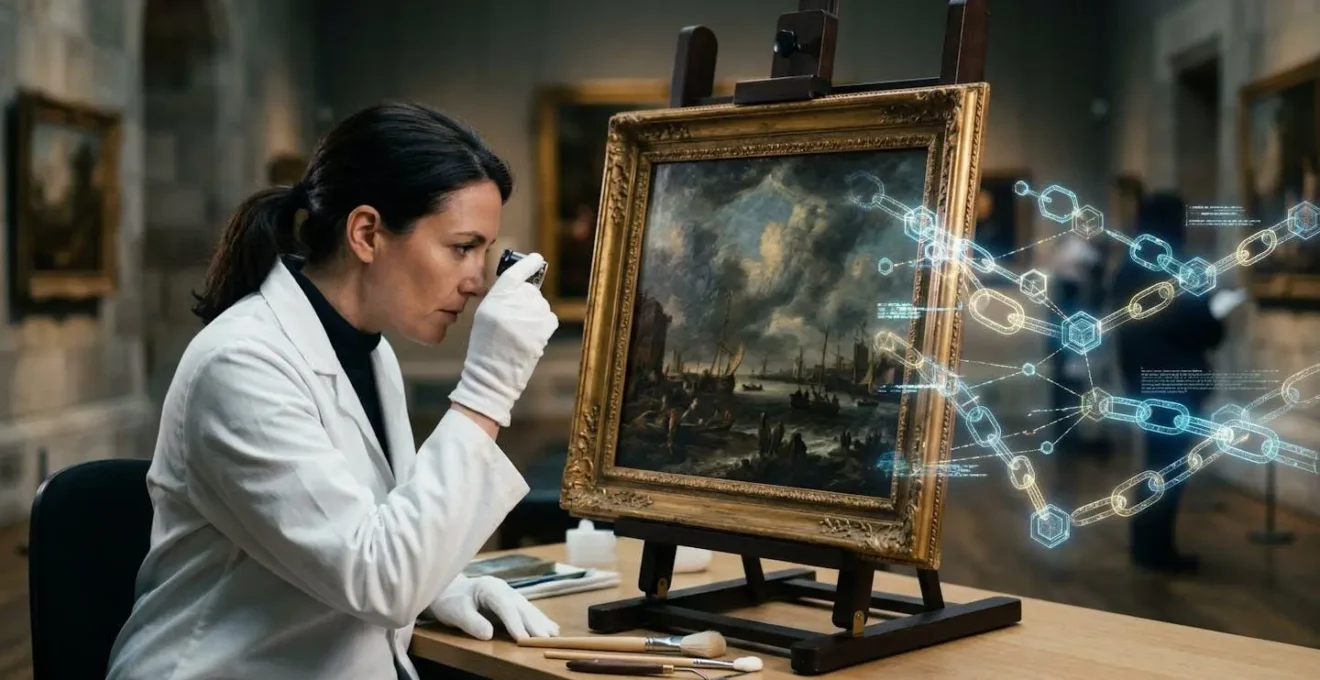
Securing a physical artwork with a blockchain ledger is not a one-time event but the start of a rigorous digital asset management lifecycle.
- The integrity of your proof of ownership depends on a secure physical link, robust wallet security, and a viable long-term data archival plan.
- Simply minting a token is insufficient; you must verify the on-chain data, understand transfer protocols, and plan for digital inheritance.
Recommendation: For any high-value art acquisition, demand a transparent and documented digital provenance strategy from the seller, covering everything from cryptographic twinning to metadata storage.
The acquisition of a significant work of art—a £20,000 sculpture, for instance—is a moment of profound satisfaction. Yet, it is often accompanied by a persistent, nagging concern: the fragility of its provenance. For centuries, the art world has relied on paper certificates of authenticity, documents that are susceptible to loss, damage, and sophisticated forgery. The rise of blockchain technology is frequently touted as the definitive solution, a digital panacea that promises an immutable, unforgeable record of ownership and history. This narrative, however, is dangerously simplistic.
While blockchain does offer a paradigm shift in provenance tracking, treating the creation of a digital token as the final step is a critical error. The true measure of security for your physical artwork does not lie in the mere existence of a token on a ledger. It resides in the robustness of the entire digital asset lifecycle. This includes the cryptographic method used to link the physical object to its digital twin, the security protocols governing the wallet that holds your proof of ownership, the legal and technical processes for transferring that proof, and, most critically, the long-term strategy for archiving the associated data against institutional failure and technological obsolescence.
This guide moves beyond the hype to provide a technical framework for the cautious buyer. We will dissect each stage of the digital provenance lifecycle, equipping you with the critical questions and verification steps necessary to ensure the digital certificate for your sculpture is as enduring and secure as the artwork itself. It’s about transforming a simple token into an institutional-grade proof of authenticity that withstands the tests of time, technology, and scrutiny.
To navigate this complex but essential topic, we have structured this guide to follow the complete lifecycle of digital authentication. The following sections will provide a clear roadmap for securing, verifying, and preserving the provenance of your physical art.
Summary: Securing Physical Art with Digital Ledgers
- Why Do Paper Certificates Falter While Blockchain Provenance Remains Immutable?
- How to Link a Physical Canvas to a Smart Contract Without Damaging the Artwork?
- The Wallet Security Flaw That Permanently Deletes Your Proof of Ownership
- Ethereum or Polygon: Which Network Offers Cheaper Minting for Physical Sculptures?
- When Should a Gallery Transfer the Authentication Token to the New Buyer?
- How to Validate the Authenticity Certificates Provided by Broker Intermediaries?
- Physical LTO Tape Backups or Cloud Redundancy: Which Survives Institutional Bankruptcies Better?
- How to Formulate a Long-Term Archival Strategy for Unstable Interactive Art?
Why Do Paper Certificates Falter While Blockchain Provenance Remains Immutable?
The fundamental weakness of traditional paper-based certificates of authenticity (COAs) is their physicality. A paper document can be lost in a fire, damaged by water, or simply misplaced over generations. More critically, it can be forged. As experts from The Fine Art Ledger note, the art market is rife with fraudulent documentation. Their analysis confirms that ” Fake certificates are common in the art market. Blockchain-based art authentication works to eliminate forgery by creating immutable, verifiable records on decentralized networks.” The ease with which a high-quality scanner and printer can replicate a COA undermines the very trust it is meant to instill.
In contrast, blockchain technology establishes provenance through cryptography and decentralization. Each transaction, from the initial creation (minting) by the artist to every subsequent sale, is recorded as a block of data and cryptographically linked to the previous one. This creates a verifiable and unbroken chain of custody. This ledger is not stored on a single server but is distributed across thousands of computers worldwide, making it virtually impossible for a single entity to alter or delete a record without being detected and rejected by the network consensus.
However, this immutability is not absolute magic. The system’s integrity relies on the security of the underlying code. While extremely costly and difficult, theoretical vulnerabilities like 51% attacks (where a single entity gains control of the majority of the network’s computing power) exist. More practical risks stem from vulnerabilities in the smart contract code itself, which necessitates rigorous code audits and adherence to established token standards like ERC-721 to prevent exploits. Therefore, while blockchain provides a monumental leap in security over paper, its trustworthiness is contingent on a well-architected and verified technical implementation.
How to Link a Physical Canvas to a Smart Contract Without Damaging the Artwork?
The most critical challenge in digital provenance is creating an unforgeable link between the physical artwork and its digital record—a process often called cryptographic twinning. This bridge must be secure, tamper-evident, and, crucially, non-damaging to the art piece itself. Simply taking a photo is insufficient, as photos can be duplicated. The solution lies in embedding a physical object with a unique, secure digital identity.
A leading method involves the use of specialized Near Field Communication (NFC) chips or Radio-Frequency Identification (RFID) tags. These are not standard, off-the-shelf chips. They are designed for security applications and are often encapsulated in tamper-evident casings. Art conservators can affix these chips to the artwork’s stretcher bar, the base of a sculpture, or another discreet location using pH-neutral, archival-quality adhesives that will not degrade the artwork’s materials over time. Any attempt to remove the chip would visibly damage its casing or the artwork’s surface, breaking the physical link and invalidating the digital proof.
As detailed in a research paper outlining the ArtProtect system, this process goes further. The NFC chip itself can generate a public-private key pair. The public key is registered on the blockchain within a smart contract (typically an ERC-721 non-fungible token or NFT), while the private key remains securely on the chip. To verify authenticity, a user taps the chip with a smartphone, which initiates a cryptographic challenge-response protocol. The chip uses its private key to sign a piece of data, which the smartphone application then verifies against the public key on the blockchain. This proves the physical presence of the authentic chip, and by extension, the authentic artwork, without ever exposing the private key.
The Wallet Security Flaw That Permanently Deletes Your Proof of Ownership
Once you acquire a physical artwork with a blockchain-based certificate, you are not just the owner of a sculpture; you are the custodian of a critical digital asset. The NFT representing your proof of ownership is held in a digital wallet, and the security of this wallet is paramount. The single greatest flaw in this system is not a technological loophole but a human one: the loss of the private key or recovery phrase. If you lose access to your wallet, the NFT—and therefore your immutable proof of ownership—is permanently and irretrievably lost. It cannot be recovered by a central authority because none exists.
For an asset worth £20,000 or more, relying on a simple software wallet on a personal computer or phone is an unacceptable risk. A sophisticated collector must adopt an institutional-grade security mindset, which includes robust backup procedures and, most importantly, a clear plan for digital inheritance. This is the domain of digital estate planning, a crucial but often overlooked component of managing high-value digital assets. Without it, your heirs could face an impossible task of accessing and proving ownership of the artwork’s digital twin after your death.
To mitigate this risk, a multi-layered security approach is essential. This involves using hardware wallets (physical devices that store private keys offline), creating redundant physical backups of recovery phrases in secure locations, and establishing clear protocols for access and transfer. For collectors, planning for the inevitable is not just prudent; it is a core responsibility of digital asset stewardship.
Your Digital Estate Security Checklist: Securing Your Provenance Token
- Implement multi-signature wallets that require authorisation from two or three trusted individuals (e.g., family members, a lawyer) before any transfer can be executed.
- Use advanced cryptographic methods like Shamir’s Secret Sharing to split a recovery key into multiple parts, distributing them among trusted parties so that no single person holds the complete key.
- Document all wallet access instructions, hardware locations, and contact information for trusted parties within your traditional estate planning documents, stored securely with your legal counsel.
- For extremely high-value collections, consider using institutional-grade custodians like Fireblocks, which provide enterprise-level security and insurance for digital assets.
- Explore time-locked smart contracts that can be programmed to automatically transfer ownership to a designated heir’s wallet after a specific period of inactivity, unless otherwise cancelled.
Ethereum or Polygon: Which Network Offers Cheaper Minting for Physical Sculptures?
The choice of blockchain network on which to mint the artwork’s digital certificate is a strategic decision with long-term implications for cost, security, and market perception. For a high-value physical sculpture, the two most common contenders are the Ethereum mainnet and its leading layer-2 scaling solution, Polygon. While both are fully compatible from a technical standpoint (EVM compatibility), they serve different market segments and carry vastly different cost structures.
Ethereum is the most decentralized and battle-tested smart contract platform, giving it the status of a “blue-chip” network. Its unparalleled security and network effect can add a perceived layer of prestige and value to the artwork’s digital provenance. However, this security comes at a high cost. Transactions on Ethereum, including minting and transfers, require “gas” fees that can fluctuate wildly, often ranging from $50 to over $200 for a single operation. For an artist or gallery minting hundreds of works, this is prohibitive, but for a single £20,000 sculpture, it can be viewed as a worthwhile investment in premium security.
Polygon, on the other hand, was built to solve Ethereum’s scalability issues. It offers drastically lower transaction costs, often fractions of a cent, making it ideal for projects requiring high volume or frequent interactions. While it inherits much of Ethereum’s security, it is less decentralized, relying on a smaller set of validators. The following table, based on data from cost analysis studies, breaks down the key differences.
| Factor | Ethereum | Polygon |
|---|---|---|
| Initial Minting Cost | $50-$200 (varies with gas) | $0.01-$0.05 |
| Secondary Sale Fees | $30-$100 per transfer | $0.001-$0.01 |
| Network Security | Highest (most decentralized) | High (but less validators) |
| Market Perception | Premium/Blue-chip status | Practical/Volume-oriented |
| Smart Contract Complexity | Full EVM compatibility | Full EVM compatibility |
For a unique, high-value sculpture, the premium market perception and maximum security of Ethereum often justify the higher costs. The choice signals that no expense was spared in securing the artwork’s legacy. Conversely, using a low-cost network for a premium piece could, in the eyes of some discerning collectors, diminish its perceived digital value.
When Should a Gallery Transfer the Authentication Token to the New Buyer?
The transfer of the digital authentication token is the most delicate moment in the art sale process, second only to the physical handover of the artwork. A premature transfer could expose the seller to fraud (a buyer claiming non-receipt of the art after receiving the token), while a delayed transfer could frustrate the buyer. Establishing a clear, secure, and mutually agreed-upon protocol is essential for a smooth transaction and maintaining the integrity of the on-chain chain of custody.
Leading institutions have already set a precedent for best practices. In a landmark 2018 collaboration, Christie’s partnered with the blockchain registry Artory to register the sale of a major private collection. They implemented a dual-confirmation system where both the buyer and seller had to cryptographically verify the physical receipt of the artwork before the digital token was transferred from an escrow contract. This model prevents either party from taking possession of both the art and its title simultaneously, creating a trustless environment.
Galleries and private sellers can adopt one of several battle-tested transfer models depending on the circumstances of the sale. The most secure is an in-person, air-gapped transfer, where both parties meet with their hardware wallets, execute the on-chain transfer, and immediately confirm the physical handover. For remote transactions, a broker-as-custodian model is common, where the auction house or gallery holds the token in a secure escrow smart contract, releasing it only upon receiving shipping and delivery confirmation. A third option is a time-locked smart contract, which automatically releases the token to the buyer’s wallet after a pre-agreed inspection period (e.g., 30 days), unless a dispute is formally filed on-chain, which freezes the asset.
How to Validate the Authenticity Certificates Provided by Broker Intermediaries?
When purchasing art through a broker or on the secondary market, you may be presented with a pre-existing digital certificate of authenticity. While this on-chain record is powerful, it is not infallible. A cautious buyer should never take it at face value but instead conduct their own on-chain forensic analysis to verify its legitimacy. This process involves using public blockchain explorers—websites like Etherscan for Ethereum—to scrutinize the token’s history and its associated smart contract.
Your first step is to locate the smart contract address on the block explorer. Check if the contract’s code is “verified,” meaning the source code has been publicly uploaded and matches the compiled code on the blockchain. An unverified contract is a major red flag. Next, analyze the token’s origin by tracing its transaction history back to the very first “mint” event. Does the wallet that created the token belong to the artist or the primary gallery? A legitimate provenance platform will always have a clear and publicly known minting address. You should then review every subsequent transaction. Each transfer should align with the artwork’s documented sales history, which can be cross-referenced with off-chain databases like Artnet or auction records.
Reputable platforms and advisors already integrate these verification steps into their workflow, understanding that transparency is key to building collector trust. As Wendy Posner, a respected art advisor, stated regarding her use of the Fine Art Ledger platform:
FAL is an invaluable tool for Posner Fine Art, allowing us to seamlessly manage and authenticate artworks on behalf of our collectors using the latest blockchain technology. We’ve implemented FAL for exhibitions, enhancing transparency and streamlining artwork management.
– Wendy Posner, Art Advisor
This level of professional adoption underscores the importance of due diligence. Validating the certificate is not a sign of distrust; it is the responsible act of a knowledgeable collector securing their investment.
Physical LTO Tape Backups or Cloud Redundancy: Which Survives Institutional Bankruptcies Better?
A common and dangerous misconception is that all information related to a digital certificate is stored “on the blockchain.” In reality, due to high storage costs, only the core ownership record and a link to the metadata are stored on-chain. The actual metadata—the high-resolution image of the artwork, its detailed description, artist statements—is typically stored “off-chain.” If this off-chain storage provider goes bankrupt or shuts down, the link from your token will point to a dead end, severely devaluing your proof of authenticity. Therefore, the choice of storage method for this metadata is a critical component of your long-term archival strategy.
Traditional digital archival solutions like LTO (Linear Tape-Open) tapes or centralized cloud storage (like Amazon S3) are ill-suited for this task. LTO tapes have a lifespan of only 15-30 years and require active management and migration. Centralized cloud storage creates a single point of failure; if the company fails or you stop paying the recurring fees, the data is lost. Neither of these options guarantees the perpetual availability required for an artwork’s legacy.
The superior solution lies in decentralized storage networks like the InterPlanetary File System (IPFS) and Arweave. These platforms store data across a global network of nodes, eliminating single points of failure. IPFS ensures data integrity through content-addressing, where files are identified by a cryptographic hash of their content. Arweave goes a step further by creating a “permaweb,” where users pay a single, one-time fee to store data permanently, with its cryptoeconomic model incentivizing miners to store it for 200+ years. The durability of these methods far surpasses traditional options, as shown in long-term storage durability analyses.
| Storage Method | Expected Lifespan | Institutional Risk | Cost Model |
|---|---|---|---|
| LTO Tape | 15-30 years (needs migration) | High (requires maintenance) | Recurring (hardware refresh) |
| Cloud Storage | Indefinite (with payment) | High (vendor dependency) | Recurring monthly |
| Arweave | 200+ years (cryptoeconomic guarantee) | None (decentralized) | One-time payment |
| IPFS + Filecoin | Indefinite (with incentives) | Low (distributed network) | Storage deals renewable |
When acquiring an artwork, you must demand to know where its metadata is stored. If the answer is a centralized server or standard cloud provider, you should view it as a significant long-term risk.
Key Takeaways
- The security of a physical artwork’s digital provenance relies on an unbroken chain of security, from the physical link to the long-term archival of its data.
- Wallet security and a clear digital estate plan are not optional extras; they are fundamental to preventing the permanent loss of your proof of ownership.
- The choice of blockchain network and metadata storage solution are critical strategic decisions that impact the long-term value, security, and perception of the artwork’s certificate.
How to Formulate a Long-Term Archival Strategy for Unstable Interactive Art?
While this guide has focused on static objects like sculptures, the principles of long-term archival become even more complex and vital for unstable or interactive media art, which may rely on specific software, hardware, or operating systems that will inevitably become obsolete. For these works, a comprehensive digital preservation strategy is not just about storing a token and a file; it’s about preserving an entire technological ecosystem. The goal is to ensure the work can be experienced by future generations as the artist intended.
A robust archival strategy for any digital art asset, whether static or interactive, should follow the proven 3-2-1 backup rule. This entails maintaining at least three copies of the provenance data, on two different types of media, with at least one copy stored off-site in a geographically separate location. For a blockchain certificate, this might mean having the primary record on the blockchain, a backup of all metadata on a decentralized network like Arweave, and a complete offline copy stored on a hardware wallet in a secure vault. For interactive art, this strategy must also include the containerization (e.g., using Docker) of the work’s entire software environment to ensure it can be run on future hardware.
This level of diligence requires a professional approach, moving beyond the role of a passive collector to that of an active digital conservator. As the Arts Management and Technology Lab at Carnegie Mellon University advises, this is a serious institutional challenge:
Museums must invest in staff training, build partnerships with blockchain experts, and develop robust governance structures to manage these digital systems responsibly.
– Arts Management and Technology Lab, Blockchain in Museums for Art Ownership
While an individual collector may not have the resources of a museum, adopting this mindset is crucial. It means recognizing that the digital certificate is not a self-maintaining asset. It requires a proactive, long-term strategy to ensure its survival.
For any significant art investment, your due diligence must extend into the digital realm. The next time you consider acquiring a high-value piece, make the digital provenance strategy a central part of your negotiation. Demand a clear, documented plan from the artist or gallery that addresses cryptographic twinning, wallet security recommendations, and, most importantly, a permanent, decentralized archival solution for all associated data. Treating digital authenticity with this level of seriousness is the only way to ensure your artwork’s legacy is truly secure.