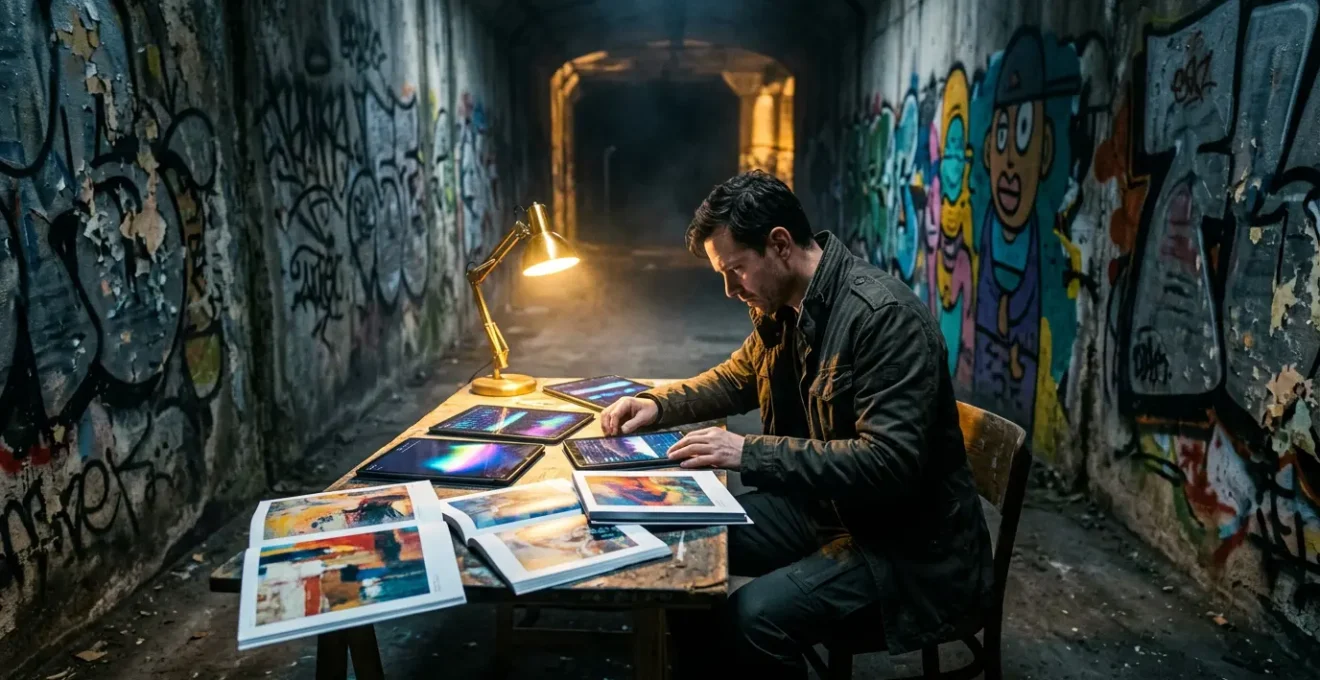
The real money in urban art isn’t found in sterile galleries; it’s made by executing ‘cultural arbitrage’—spotting an artist’s authentic street credibility before the mainstream market prices it in.
- Value originates from unsanctioned work that survives, earning a “survival premium” and community respect.
- An artist’s transition to the fine art market is signalled by specific triggers, like a first print run, not just social media hype.
Recommendation: Stop looking for a finished product. Start hunting for artists with documented street origins and verifiable peer respect, as these are the strongest indicators of future commercial success.
Every investor is looking for the next Banksy. They hit the art fairs, scroll through Instagram, and listen to what the established galleries are pushing. That’s the playbook, and it’s why most of them are already too late. By the time an artist is hanging on a white wall, the explosive growth phase is over. You’re not buying in at the ground floor; you’re paying the premium for someone else’s foresight. The chatter is always about finding a “unique style” or “following trends,” but that’s just noise. It’s subjective and leaves you vulnerable to hype cycles.
The street has its own language of value, and it has nothing to do with gallery representation or auction house records. It’s a raw, unfiltered meritocracy. The mistake most collectors make is they try to apply the rules of the fine art world to a game that was invented to break them. They chase the polished portfolio when the real indicators of future value are often gritty, unsanctioned, and technically illegal. This isn’t about simply buying graffiti; it’s about understanding the specific signals that predict when an artist’s cultural cachet is about to be converted into hard commercial value.
But what if the key wasn’t about being in the right gallery at the right time, but about reading the writing on the walls—literally? This guide isn’t another art history lesson. It’s a dealer’s framework for spotting and valuing the authentic transition signals of an artist moving from the street to the market. We’ll break down why a weathered Bristol mural is a better investment signal than a sold-out gallery show, how to commission talent without falling into the corporate “authenticity trap,” and ultimately, how to calculate if the risk of betting on an unknown name is worth the potential reward.
This article provides a complete framework for the savvy investor. From understanding the origins of value on the street to calculating the final risk-to-reward ratio, the following sections will equip you with an insider’s perspective on this high-stakes market.
Summary: A Dealer’s Guide to Profitable Urban Art Investment
- Why Do Unsanctioned Bristol Street Murals Suddenly Appreciate in Value?
- How to Commission a Local Graffiti Artist for Commercial Office Fronts?
- The Authenticity Trap That Ruins Corporate Attempts at Street Art Culture
- Subsidised Graffiti Walls or Guerrilla Tags: Which Holds More Cultural Cachet?
- When Does a Niche Urban Artist Officially Transition into the Fine Art Market?
- How to Assess the Long-Term Investment Potential of a First-Time Exhibitor?
- Why Do Social Media Engagement Spikes Predict a 20% Increase in Auction Prices?
- How to Calculate the Risk-to-Reward Ratio of Buying Unrepresented UK Talent?
Why Do Unsanctioned Bristol Street Murals Suddenly Appreciate in Value?
Value in the street art world doesn’t start in a studio. It begins on a cold, public wall, often without permission. An unsanctioned mural is a high-risk opening statement. Most get painted over by the council or tagged over by rivals within days. The ones that don’t? They start to accumulate something far more valuable than paint: a ‘Survival Premium’. When a piece endures, it’s because the local community has unofficially adopted it. It becomes a landmark, a point of pride, and people actively protect it. This is the first, most authentic form of validation, and it’s a signal you can’t fake.
Take the scene in Bristol. Works like Banksy’s Mild Mild West on Stokes Croft haven’t just survived; they’ve become cultural assets. The story of the Grim Reaper mural, originally on the Thekla social boat, is a perfect case study. After years of exposure and public affection, it wasn’t just left to fade; it was preserved and moved to the M Shed museum. This is the lifecycle of valuable street art: from illegal act to protected landmark to institutionalised treasure. The initial risk of its creation morphs into a powerful provenance that galleries can only dream of.
This ‘Survival Premium’ has a tangible financial impact. It’s not just about cultural value; it’s about cold, hard cash. When a piece becomes a beloved fixture, it elevates the entire area. In fact, research shows that real estate developers have seen how commissioned and protected graffiti increases property values by 12-22%. An unsanctioned mural that earns its keep becomes an anchor of value, and the artist behind it develops a proven track record of creating work that the public genuinely wants. That’s a leading indicator for a collector that’s worth its weight in gold.
How to Commission a Local Graffiti Artist for Commercial Office Fronts?
Once you’ve identified an artist with genuine street credibility, the next step is to engage them. Commissioning a piece for a commercial space is a smart move; it gives you a direct-from-the-source work and helps build a relationship with emerging talent. But this is where many investors get it wrong. You’re not just hiring a decorator; you’re collaborating with an artist whose value is tied to their authenticity. Your approach has to respect their process, or you risk getting a sterile, corporate-looking piece that has none of the energy you were trying to buy.
The process should be a collaboration, not a top-down directive. As shown above, the best results come when artists can bring their world into the commercial context. This means giving them creative freedom. Forget dictating brand colours and logo placements. Provide them with a theme or a feeling, and then let them run with it. The goal is to get their work on your wall, not a sanitised version of it. The more freedom you give them, the more authentic the final piece will be—and the more valuable it will become as their star rises.
Before you even approach an artist, you need a plan. Getting this right means navigating both the legal and cultural landscape. It’s about creating a project that is both a sound investment for you and a credible move for the artist.
Your Blueprint for Commissioning an Artist (and Not Messing It Up)
- Clear the Path: Handle the boring stuff first. Get written permission from the property owner and double-check all local council regulations on public-facing murals. A project that gets shut down is a waste of everyone’s time and money.
- Define the Deal, Not the Art: Be crystal clear on the commercial terms: the fee, the payment schedule, the timeline, and who owns the final image rights. Put it in a simple contract. Leave the artistic brief open to interpretation.
- Respect the Transition: Understand you’re asking an artist to move from unsanctioned work to a paid gig. Frame it as a professional collaboration that respects their voice, not a corporate job that silences it.
- Leverage the Network: Don’t just rely on Instagram DMs. Tap into the local scene. Talk to smaller, independent gallery owners or other artists. A warm introduction is always better than a cold call.
- Document Everything: From the first sketch to the final spray, document the process. This documentation becomes part of the work’s provenance, adding to its story and its long-term value.
The Authenticity Trap That Ruins Corporate Attempts at Street Art Culture
There’s a fine line between a smart collaboration and a cringeworthy sellout, and big brands cross it all the time. This is the ‘Authenticity Trap’: the moment a corporation tries to co-opt street culture without understanding or respecting it. They see graffiti as a cool, edgy aesthetic to be slapped on a product, and in doing so, they strip it of the very authenticity that made it valuable in the first place. For an investor, understanding this trap is crucial, because it teaches you what *not* to do and how to spot an artist who knows how to partner correctly.
A successful collaboration elevates the artist without erasing their identity. Think of the long-standing partnership between KAWS and Uniqlo. As one Artsper analysis noted, these kinds of projects have been instrumental in raising the profile of street art. The key is that the artist’s vision leads the project. It’s a KAWS design on a Uniqlo T-shirt, not the other way around. The artist maintains creative control, and the brand gets access to their cultural credibility. When an artist you’re watching lands a collaboration, your first question should be: who is in the driver’s seat?
The Bristol model provides another powerful lesson in genuine integration. The city didn’t just invite artists in; it created an environment where they could thrive on their own terms first. Initiatives like Upfest and the creation of designated art zones by the city council gave artists space and support. Only after this organic culture was established did property developers start commissioning murals for new developments. They weren’t trying to manufacture a scene; they were investing in one that already existed. This is the ultimate sign of a healthy ecosystem: community investment before commercial gain. When you see this pattern, you know the artists emerging from that scene have a foundation of true authenticity.
Subsidised Graffiti Walls or Guerrilla Tags: Which Holds More Cultural Cachet?
This is one of the most fundamental questions for an urban art investor. On one hand, you have the legal, subsidised graffiti walls—safe, sanctioned spaces where artists can work for hours in broad daylight. On the other, you have the raw, illegal guerrilla tags and murals, executed quickly under the cover of darkness. A novice investor might think the polished piece from the legal wall is the better bet. The smart money knows that cultural cachet—the street-level respect and credibility that translates into future market value—is almost always born from risk.
The ‘Provenance Paradox’ is at the heart of this. The very illegality of a piece is often a key component of its value. An artist who is willing to risk arrest to get their work up demonstrates a level of commitment and belief that a legal wall simply can’t confer. It’s a filter; it weeds out the hobbyists from the truly dedicated. This is why market data consistently shows that works with documented street origins command a 30-50% premium at auction. The story behind the art—the risk, the location, the execution—is baked into its price.
This isn’t to say legal walls have no place. They are crucial training grounds where artists can hone their technical skills without looking over their shoulder. They are where an artist develops their handstyle, masters can control, and experiments with complex compositions. However, as an investor, you should view legal walls as the gym, not the main event. The work an artist does there demonstrates their technical ability, but the work they do illegally demonstrates their ambition and their voice. The ideal emerging artist has a foot in both worlds: the technical mastery of a seasoned painter and the audacious spirit of a true guerrilla artist.
When Does a Niche Urban Artist Officially Transition into the Fine Art Market?
The jump from the street to the gallery is the moment of ‘cultural arbitrage’ you’re looking for. It’s not a single event, but a series of ‘Transition Triggers’. Spotting these triggers early is the key to getting in before the artist’s prices skyrocket. The most obvious sign, a solo gallery show, is actually one of the last. By then, the primary market is already established. The real tells happen months or even years earlier. The most significant early trigger is the move from painting walls to creating physical, sellable objects—specifically, a limited edition print run.
The Banksy print market is the definitive case study here. Before his paintings were selling for millions, he was releasing small, often unsigned print editions. These prints were the first opportunity for collectors to own a piece of his work. As his fame grew, the value of this early work exploded. Market analysis from MyArtBroker shows just how dramatic this can be: between January and March 2022, £6.3 million worth of Banksy prints were sold at auction, a 319% increase from the same period just two years prior. An artist releasing a high-quality, limited-edition screen print is a massive signal that they are thinking commercially and building a market for their work.
Beyond prints, you should look for other artists who are following this playbook. As market experts point out, artists like Stik and Invader are seeing their auction prices rise, making them solid investments. Specifically, certain works act as bellwethers for the artist’s market. For Stik, the Sleeping Baby prints have recently been commanding high prices, indicating a surge in demand for his most iconic imagery. When you see a specific series or image from an artist’s street work start to gain traction in the secondary print market, that is a powerful signal that the wider market is waking up to their investment potential.
How to Assess the Long-Term Investment Potential of a First-Time Exhibitor?
So you’ve found an artist. They have street cred, they’ve dropped a successful print run, and now they’ve landed their first solo show in a small, independent gallery. This is a critical moment. Is this a flash in the pan or the beginning of a serious career? To make that call, you need to look past the opening night hype and assess the artist against a concrete set of investment criteria. This is where you shift from being a trend-spotter to a disciplined investor. Your job is to evaluate their long-term viability.
First, look for consistency. A strong artist has a clear, recognisable style and a coherent body of work. They aren’t just jumping from trend to trend. This consistency shows they have a unique artistic identity and a vision they are committed to. Second, assess their recognition beyond their own social media bubble. Have they been featured in reputable art blogs, won any small awards, or, most importantly, earned the respect of other, more established artists? A co-sign from a respected name is a powerful vote of confidence. Finally, consider their marketability. Do they have a professional approach to their career? This includes everything from their online presence to their ability to talk about their work.
This initial entry into the gallery world is often the most accessible price point for an investor. You’re not paying the established-artist premium yet. According to insights from art market advisors, a smart investor can often acquire an early piece from a promising artist with a budget of around £850 to £2,500 (€1,000 to €3,000). This is the sweet spot. It’s a significant enough investment to secure a quality piece, but not so high that you’re taking on an unmanageable amount of risk. The key is to buy the best piece you can afford from their first show, as these early works often become the most sought-after later in an artist’s career, assuming they pass the long-term viability test.
Why Do Social Media Engagement Spikes Predict a 20% Increase in Auction Prices?
In the old days, an artist’s buzz was built through word-of-mouth and reviews in art magazines. Today, it’s forged in the fires of social media. But don’t be a fool and just look at follower counts—that’s a vanity metric that can be easily bought. The real signal is in the quality and source of the engagement. A spike in likes after being featured by a major influencer or a reputable online publication is a leading indicator of a coming price surge. It’s the digital equivalent of a rave review in a top newspaper, and it directly fuels market demand.
When an artist gets a major media spotlight, it exposes their work to a massive new audience of potential buyers. This creates a surge of interest that translates directly into sales velocity. We’re not talking about a slow burn; we’re talking about a rapid, measurable impact on an artist’s market. The hype machine is real, and it has a direct correlation with auction results. When you see an artist you’re tracking suddenly get a feature in a major style publication or on a respected art platform, the clock is ticking. The market is about to re-price their work.
A perfect example is the recent trajectory of certain breakout UK artists. As a 2024 Artsy market report noted about one emerging Nigerian artist in the UK, being dubbed ‘the most talked-about young artist in the U.K.’ by a publication like GQ leads to a “meteoric rise in profile.” This kind of third-party validation from a high-status cultural outlet is an incredibly powerful authenticity signal. It tells the market that this artist is not just an Instagram phenomenon; they are a culturally significant figure. For an investor, monitoring these media mentions is just as important as tracking their work on the street. It’s the bridge between cultural cachet and commercial validation.
Key Takeaways
- Value Starts on the Street: The most valuable provenance comes from unsanctioned work that survives, earning a ‘Survival Premium’ from community validation.
- Authenticity is Non-Negotiable: Successful corporate collaborations are led by the artist’s vision; anything less is a trap that devalues the work. Guerrilla work holds more cultural cachet than sanctioned pieces.
- Prints are the Primary Trigger: An artist’s first limited-edition print run is the most significant early signal of a commercial transition, often preceding a massive jump in market value.
How to Calculate the Risk-to-Reward Ratio of Buying Unrepresented UK Talent?
Let’s be clear: investing in emerging, unrepresented artists is a high-risk game. There are no guarantees. The art market can be volatile, and for every artist who makes it, a hundred others fade back into obscurity. You are not buying a blue-chip stock; you are acting as a venture capitalist for culture. Your investment could go to zero. This is the risk, and you must go into it with your eyes wide open. The potential for failure is very real.
However, the rewards can be astronomical, far outstripping anything you could hope to achieve in the traditional art market. The whole principle of ‘cultural arbitrage’ is based on this asymmetry. You are buying in when the artist’s primary value is their cultural credibility, which is not yet fully reflected in their price. You are betting that their talent and authenticity will eventually be recognised by the mainstream market, leading to an exponential increase in value. This is where fortunes are made.
Consider the returns generated by early investors in Banksy. Steve Lazarides, one of Banksy’s first dealers, has explained how early pieces he sold for around £150 were worth upwards of £300,000 to £400,000 a decade later. That’s a staggering return of over 250,000%. This is the ‘reward’ side of the equation. It’s a life-changing return on investment that is only possible when you have the conviction to bet on raw talent before anyone else. Your job as an investor is to build a small portfolio of these high-potential artists, knowing that one big win can more than cover the losses from the others.
Ultimately, investing in grass-roots urban art is not for the faint of heart. It requires diligence, patience, and a genuine passion for the culture. But by using this framework to identify the real signals of value, you can move beyond simple speculation and start making calculated investments with the potential for massive returns. Start training your eye on the streets, not just the gallery walls.