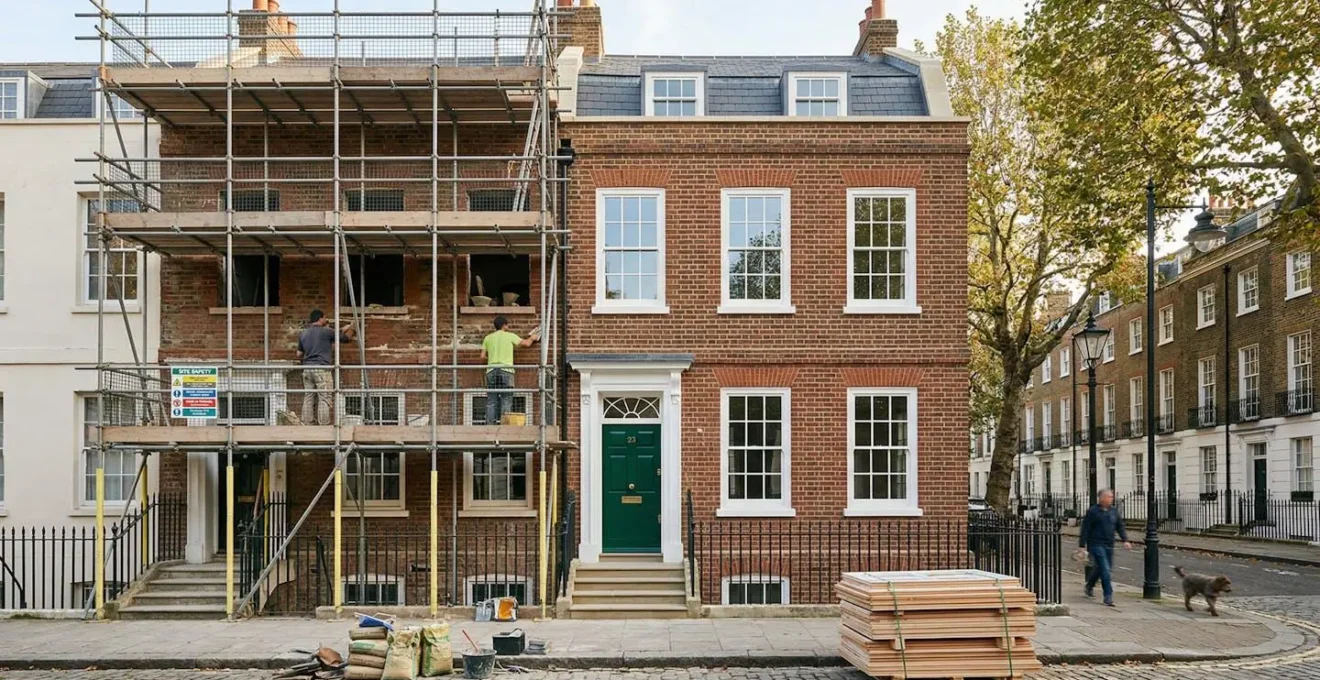
Successfully modernising a Grade II listed property hinges not on fighting the rules, but on mastering the art of ‘sympathetic intervention’—a strategic negotiation between modern ambition and historical integrity.
- Engage in collaborative pre-application dialogue with conservation officers before detailed plans are drawn.
- Prioritise the principle of ‘reversibility’ for all modern services like HVAC and wiring to protect the original building fabric.
- Understand the science behind traditional materials; using the wrong mortar or brick is a costly, irreversible mistake.
Recommendation: Approach your project as a custodian, not just an owner. Your goal is to add the next thoughtful chapter to the building’s story, a process that begins with understanding the conservation officer’s mindset.
The acquisition of a historic property is often the realisation of a profound dream, an opportunity to become the custodian of a tangible piece of the United Kingdom’s history. Yet, for the owner of a newly acquired 18th-century manor, the dream of installing underfloor heating can quickly collide with the bureaucratic reality of Listed Building Consent. The fear of a lengthy, adversarial process, culminating in rejected plans or, worse, enforcement action, is a common and understandable anxiety. Many homeowners approach this process assuming it is a battle to be won against an obstinate council.
This perspective is the root of most problems. Standard advice often revolves around platitudes like “use traditional materials” or “don’t use uPVC,” but fails to explain the fundamental principles driving conservation policy. With an incredible 99% of England’s population living within a mile of a listed building, understanding how to sensitively adapt these structures for modern life is a crucial national skill. These buildings are not meant to be fossils; they are homes, workplaces, and community hubs that must evolve to survive.
The true key to unlocking your property’s potential lies in shifting your mindset from confrontation to collaboration. This guide will move beyond the generic to offer a conservation architect’s perspective, focusing not just on what the rules are, but *why* they exist. It is about mastering the art of ‘sympathetic intervention’ and learning to speak the language of conservation. By understanding the principles that guide a conservation officer’s decisions, you can frame your proposals not as demands, but as thoughtful, respectful solutions that enhance the building’s legacy.
This article will deconstruct the most common and daunting challenges in modernising a listed property. We will explore the specific technical and legal reasoning behind decisions on windows, services, materials, and extensions, providing you with the strategic insight to navigate the process successfully.
Summary: A Strategic Guide to Modernising Historic UK Properties
- Why Do Local Conservation Officers Immediately Reject Standard Double-Glazing Applications?
- How to Sneak Modern HVAC Systems Behind Original Georgian Plaster Cornices?
- The Unapproved Cement Mistake That Forces Homeowners to Rebuild Walls at Their Own Expense
- Reclaimed Antique Bricks or Bespoke Colour-Matched New Bricks: Which Pleases the Council More?
- When Should You Invite the Heritage Officer for the Initial Pre-Application Site Visit?
- How to Retrofit Victorian Civic Buildings for High-Tech Multimedia Arts?
- How to Digitize Large-Format Vellum Drawings Without Distorting Scale Proportions?
- How Modern Architectural Design Enhances Creative Learning in UK Communities?
Why Do Local Conservation Officers Immediately Reject Standard Double-Glazing Applications?
The immediate rejection of a standard uPVC or aluminium double-glazing application is almost a rite of passage for new owners of listed buildings. This isn’t arbitrary obstructionism; it is rooted in a core conservation principle: preserving the building’s historic ‘character’ and ‘fabric’. Standard double-glazed units are rejected primarily due to their visual impact. The thickness of the units, the width of the frames, and the modern, flat reflection of the glass fundamentally alter the delicate ‘sight lines’ and proportions of historic windows, particularly the slender timber profiles of Georgian and Victorian sash windows. This is a critical issue when you consider that 92% of all 379,443 listed buildings in England are Grade II, where character is paramount.
Conservation officers are trained to see a building as a complete work of art. The play of light and shadow on original, slightly imperfect crown glass is part of that composition. A modern, perfectly flat, sealed unit destroys this subtle texture. Furthermore, original windows are considered ‘fabric’—part of the essential material of the building. The default position is always to repair rather than replace. A well-maintained and draught-proofed original sash window is a historic asset.
However, the need for thermal efficiency is recognised. The conversation is not about ‘no’; it’s about ‘how’. The correct approach is to demonstrate that you have exhausted all other options and are proposing a technically sophisticated and visually sensitive solution. This includes options like high-performance secondary glazing, which leaves the original window untouched, or specialist, ultra-slim vacuum-sealed double-glazing units that can be installed into original or replica timber frames without compromising the historic sight lines. A successful application presents a thoroughly researched argument, proving your proposal is the least harmful way to achieve the necessary functional upgrade while respecting the building’s character.
How to Sneak Modern HVAC Systems Behind Original Georgian Plaster Cornices?
Introducing modern heating, ventilation, and air conditioning (HVAC) into a building with delicate, irreplaceable plasterwork presents a significant challenge. The guiding principle here is reversibility. Any modern intervention should, in theory, be removable in the future without causing permanent damage to the historic fabric. Cutting large channels into original lathe and plaster walls or boxing in ornate cornices to hide bulky ductwork is an act of vandalism in conservation terms and will be rejected outright.
The solution lies in meticulous planning and the use of innovative, minimally invasive technology. Instead of thinking about standard domestic systems, the project must adopt a more surgical approach. High-velocity or ‘mini-duct’ systems are a favoured solution. These use much smaller, flexible tubes (often only 2-3 inches in diameter) that can be carefully threaded through existing voids, such as the space between floor joists, within disused chimney flues, or behind the ‘shadow gap’ of a cornice without disturbing the plaster itself. The outlets are small, discreet, and can often be finished to match the surrounding decor, making them almost invisible.
Case Study: Battersea Arts Centre HVAC Integration
The award-winning restoration of the Grade II* listed Battersea Arts Centre provides a masterclass in this approach. Following a major fire, the team had to integrate comprehensive modern services. As detailed in a RIBA conservation guide, they successfully used high-velocity small-duct systems, threading the narrow, flexible tubes through existing voids and behind the magnificent original plasterwork. This maintained the principle of reversibility and allowed the building’s historic character to shine, proving that modern comfort and historic integrity can coexist.
This cross-section view demonstrates how modern, slimline ducts can be intelligently concealed within the ceiling void, running behind the profile of original Georgian plasterwork without any physical contact or damage.
The key is to conduct a thorough survey of the building first, identifying all existing voids and pathways. This ‘services strategy’ should be one of the very first documents produced, often requiring small, exploratory openings to be made under the supervision of a heritage expert. It is this level of forensic, respectful investigation that earns the trust of a conservation officer and leads to a successful consent.
The Unapproved Cement Mistake That Forces Homeowners to Rebuild Walls at Their Own Expense
Of all the technical mistakes one can make on a listed building, using modern Portland cement instead of traditional lime mortar is arguably the most damaging and costly. To the untrained eye, mortar is just the ‘glue’ that holds bricks together. To a conservation officer, it is the building’s respiratory system. The consequences of getting this wrong are not merely aesthetic; they are structural, and enforcement action can be financially ruinous. While not directly related to cement, reports of enforcement cases show that the average cost to remove and replace unauthorised uPVC windows can be £35,000—a figure that can be easily surpassed when entire walls need to be rebuilt due to mortar damage.
Historic buildings were designed to be ‘breathable’. Walls were constructed with soft, porous bricks or stone and a flexible, vapour-permeable lime mortar. This system allows moisture that penetrates the wall from driving rain or rises from the ground to evaporate harmlessly out through the mortar joints. When this is ‘repaired’ with a hard, impermeable Portland cement mortar, you effectively seal the wall in a plastic bag. Moisture becomes trapped within the masonry. In winter, this trapped water freezes, expands, and blows the face off the bricks or stone—a process known as spalling. The wall, unable to breathe, begins to decay from the inside out.
Furthermore, old buildings are designed to move and settle over centuries. Flexible lime mortar accommodates this slight movement. Rigid cement does not; it cracks, and worse, it forces any stress into the surrounding masonry, causing the bricks themselves to crack. The differences are critical, as this table illustrates.
| Property | Traditional Lime Mortar | Modern Portland Cement | Impact on Listed Building |
|---|---|---|---|
| Breathability | Vapour-permeable | Impermeable | Lime allows moisture to escape; cement traps it causing damage |
| Flexibility | Flexible, moves with building | Rigid, prone to cracking | Lime accommodates thermal movement; cement causes stress cracks |
| Appearance | Soft, off-white, textured | Hard, grey, uniform | Lime matches historic aesthetic; cement looks modern and out of place |
| Reversibility | Can be removed without damage | Difficult to remove, damages masonry | Lime repairs are conservation-compliant; cement may require wall rebuilding |
Using the correct type of lime mortar (there are several, and analysis of the original is often required) is non-negotiable. It is a fundamental aspect of protecting the building’s fabric, and getting it wrong is one of the quickest ways to receive a stop-work notice and an enforcement order to undo the damage at your own expense.
Reclaimed Antique Bricks or Bespoke Colour-Matched New Bricks: Which Pleases the Council More?
When extending or repairing a historic brick building, the choice of brick is a highly scrutinised decision. The intuitive response for many homeowners is to find a perfect match, often assuming that expensive, genuinely antique reclaimed bricks are the gold-standard that will please any conservation officer. The reality is more nuanced and is guided by a principle known as ‘material honesty’. The council’s preference depends entirely on the context: are you patching an existing wall or building a new extension?
For patching small areas of damaged brickwork within an existing historic wall, the priority is a seamless repair. In this context, high-quality reclaimed bricks that match the original in terms of size (historic bricks are often a different ‘imperial’ size), colour, texture, and weathering are almost always the preferred solution. The goal is to make the repair disappear, maintaining the integrity of the original facade.
For a new extension, however, the thinking often reverses. Creating a new structure that is a perfect, deceptive copy of the old can be seen as “pastiche” and is often discouraged. It can confuse the building’s historical narrative, making it difficult to read what is original and what is a modern addition. In this scenario, many conservation authorities prefer an approach of ‘material honesty’, where the new extension is clearly of its own time, yet respectful and harmonious with the original. This might mean using new, bespoke bricks that are colour-matched to complement the tones of the old building but are uniform in shape and texture, clearly identifying them as new. The new work should be a high-quality, contemporary interpretation, not a fake replica.
As the experts at Clear Architects note in their authoritative guide, this can be a surprising revelation for homeowners:
It is a common misconception that alterations and extensions must ‘match’ the existing building’s style. Often the opposite is true and the planning authority may prefer to see the difference between old and new
– Clear Architects, Complete Guide to Listed Building Consent
The best strategy is to present the conservation officer with physical samples of your proposed options and a clear ‘Heritage Statement’ explaining the rationale for your choice, whether it is for a seamless patch or an honest contemporary addition.
When Should You Invite the Heritage Officer for the Initial Pre-Application Site Visit?
The advice to “talk to your local conservation officer” is ubiquitous, but it lacks the most critical component: timing. Engaging too early with no clear ideas is a waste of everyone’s time. Engaging too late, with fully developed architectural drawings, can lead to a defensive and costly refusal if your architect has misunderstood a fundamental principle. The strategic moment for the first pre-application site visit is a delicate balance: after you have developed initial concepts, but before you have committed to detailed design and expense.
At this stage, you should have a clear understanding of what you want to achieve (your brief) and your architect should have translated this into initial concept sketches or massing models. These should be high-level proposals that explore possibilities without being set in stone. The goal of this initial meeting is not to ask for ‘permission’, but to open a collaborative dialogue. You are presenting your ambitions and asking for the officer’s expert guidance on the key heritage constraints and opportunities.
This is your chance to build a relationship, to show that you are a respectful custodian, and to get invaluable feedback that will shape the rest of the design process. An officer might point out a particularly significant historic feature you were unaware of, or suggest an alternative approach for an extension that would be more likely to gain support. Incorporating this feedback early on saves thousands in abortive design fees and dramatically increases the chances of a smooth consent process.
Case Study: A Successful Pre-Application Strategy
The successful conversion of St Margaret’s, a Grade II listed property, into four separate dwellings illustrates this perfectly. The project team scheduled the conservation officer’s visit after developing initial concept sketches. This timing allowed them to present their vision while remaining flexible. The officer’s early feedback was instrumental in shaping the final design, leading to a collaborative process that resulted in permission not only for the renovation but also for a contemporary new building within the grounds. This strategic engagement transformed a potentially contentious application into a celebrated success.
Treat this meeting as the start of a professional partnership. Arrive prepared with your concept sketches, a basic understanding of the building’s history, and a list of open questions. This approach demonstrates respect for the officer’s role and expertise, setting a positive tone for the entire project.
How to Retrofit Victorian Civic Buildings for High-Tech Multimedia Arts?
Adapting grand, solid-built Victorian civic buildings for the demands of high-tech multimedia arts—with their need for acoustic isolation, vast data cabling, and heavy equipment—is a complex conservation challenge. The key is to work with the building’s robust structure, not against it, by creating technically advanced yet discrete and reversible interventions within the historic shell.
The primary challenges are acoustic control, cable management, and structural loading. A direct, destructive approach—such as chasing walls for cables or bolting rigs to ornate plaster ceilings—is unacceptable. The modern solution is to insert independent, lightweight structures within the original rooms. This ‘box-in-a-box’ approach allows for the creation of acoustically isolated studios or black-box performance spaces without touching the historic walls. Raised access floors are another vital tool, creating a void to conceal miles of power and data cabling while protecting original tiled or timber floors beneath. This entire infrastructure can be removed in the future, leaving the Victorian hall in its original state.
Case Study: York Art Gallery’s Multimedia Transformation
The refurbishment of the York Art Gallery, a building from the 1879 Yorkshire Fine Art Exhibition, is an exemplary case. The project required the integration of state-of-the-art multimedia capabilities. The team implemented ‘box-in-box’ studios for sound and video installations and used raised access floors to hide all modern services. To support modern lighting rigs without damaging the Victorian structure, they used discrete, high-strength carbon fibre reinforcement strips—a modern engineering solution that is both incredibly strong and minimally invasive visually.
This table summarises the shift in thinking from traditional, often damaging, methods to modern, conservation-compliant solutions for retrofitting these historic buildings.
| Challenge | Traditional Approach | Modern Solution | Conservation Benefit |
|---|---|---|---|
| Acoustic Control | Heavy masonry walls | Floating floors with isolation pads | No structural intervention required |
| Cable Management | Surface-mounted trunking | Raised access floors using existing voids | Completely reversible installation |
| Structural Loading | Steel beam insertion | Carbon fiber reinforcement strips | Minimal visual impact, high strength |
| Climate Control | Visible radiators | Underfloor heating mats | Preserves wall surfaces and sight lines |
By embracing these modern, reversible techniques, it is possible to transform historic civic buildings into vibrant, 21st-century creative hubs, ensuring their continued use and appreciation for generations to come.
How to Digitize Large-Format Vellum Drawings Without Distorting Scale Proportions?
The digitisation of historic architectural drawings, particularly large-format plans on delicate or distorted materials like vellum or linen, is a specialist task far removed from a standard office scanner. The primary goals are to capture the maximum detail without damaging the original document and, crucially, to ensure the resulting digital file is geometrically accurate and scaleable. A distorted scan is useless for any serious architectural or academic purpose, such as creating a modern BIM (Building Information Modelling) model from a historic plan.
The process requires professional-grade equipment and a meticulous workflow. Standard flatbed or roller-fed scanners can damage fragile vellum and introduce stretching or distortion. The correct tool is a large-format ‘planetary’ or overhead scanner, which captures the image from above without any physical contact. To guarantee scale accuracy, every single scan must include a high-precision calibration ruler within the frame. This physical reference point is non-negotiable.
However, the work does not end with the scan. Even with the best equipment, minute distortions can occur. The raw digital image must then be processed using specialist software for ‘georectification’. This involves identifying control points on the scanned calibration ruler and digitally ‘stretching’ or ‘correcting’ the image so that the digital measurements perfectly match the real-world ruler. Only after this correction process is the scan dimensionally accurate and ready for import into CAD or BIM software. This process ensures the digital surrogate is a true and reliable record of the original document.
Action Plan: Professional Digitisation of Historic Drawings
- Use large-format planetary scanners (minimum A0 size) with non-contact scanning to protect delicate vellum.
- Include a high-precision calibration ruler in every scan for accurate scale reference.
- Set scanning resolution to a minimum of 600 DPI for capturing fine detail.
- Apply georectification in post-processing using control points from the calibration ruler.
- Import corrected scans into CAD software for the creation of accurate BIM models.
- Validate measurements against known building dimensions before final archiving.
This rigorous methodology is essential for creating a high-fidelity digital archive that respects the integrity of the original documents and provides a reliable foundation for future conservation and research work.
Key takeaways
- Pre-application dialogue is a strategic tool, not an administrative chore. Timing and preparation are everything.
- The principles of reversibility and material science are non-negotiable foundations of any successful listed building project.
- Material honesty is often preferred over imitation; a high-quality modern addition can be more successful than a poor historical copy.
How Modern Architectural Design Enhances Creative Learning in UK Communities?
The integration of modern architectural design within historic buildings is not just a matter of preservation; it can be a powerful catalyst for enhancing their function, particularly in educational and community settings. Rather than viewing the historic shell as a constraint, a thoughtful contemporary intervention can unlock new possibilities, creating dynamic and inspiring spaces for creative learning. The key is to create a clear, respectful dialogue between the old and the new.
A successful intervention does not try to mimic the past. Instead, it uses modern materials like glass, steel, and engineered timber to create new structures that sit lightly within the original fabric. This contrast can itself become a teaching tool, allowing users to read the building’s history through its layers of development. A modern glass balustrade can provide safety without obstructing the view of a historic staircase; a sleek mezzanine floor can double the usable area of a grand hall while leaving the original cornices and windows fully visible below.
This approach allows for the creation of varied learning environments that a single, monolithic historic space cannot offer. Large, open halls can be retained for group activities and performances, while new, modern insertions can create intimate study pods, breakout spaces, or technically-equipped workshops. This functional enhancement ensures the building’s continued viability, giving it a sustainable future and a renewed purpose within the community.
Case Study: Islington House Educational Adaptation
Architecture for London’s transformation of a Grade II listed house in Islington into a creative learning space is a prime example. They inserted a contemporary mezzanine structure within one of the main rooms. This single move created a large group learning area on the ground floor while adding smaller, more focused study pods above, effectively doubling the building’s educational utility. The stark but elegant contrast between the clean lines of the modern insertion and the building’s original Georgian details is not jarring; it is celebrated, demonstrating how architectural evolution can be a lesson in itself.
By treating the historic building as the main exhibit and the modern addition as a respectful, functional frame, architects can breathe new life into structures, transforming them into vibrant centres for creative learning that serve and inspire their communities.
Embarking on a listed building project requires a partnership built on expertise and respect for heritage. The next logical step for any prospective owner is to assemble a professional team, starting with a conservation-accredited architect, to begin this challenging but ultimately rewarding journey.