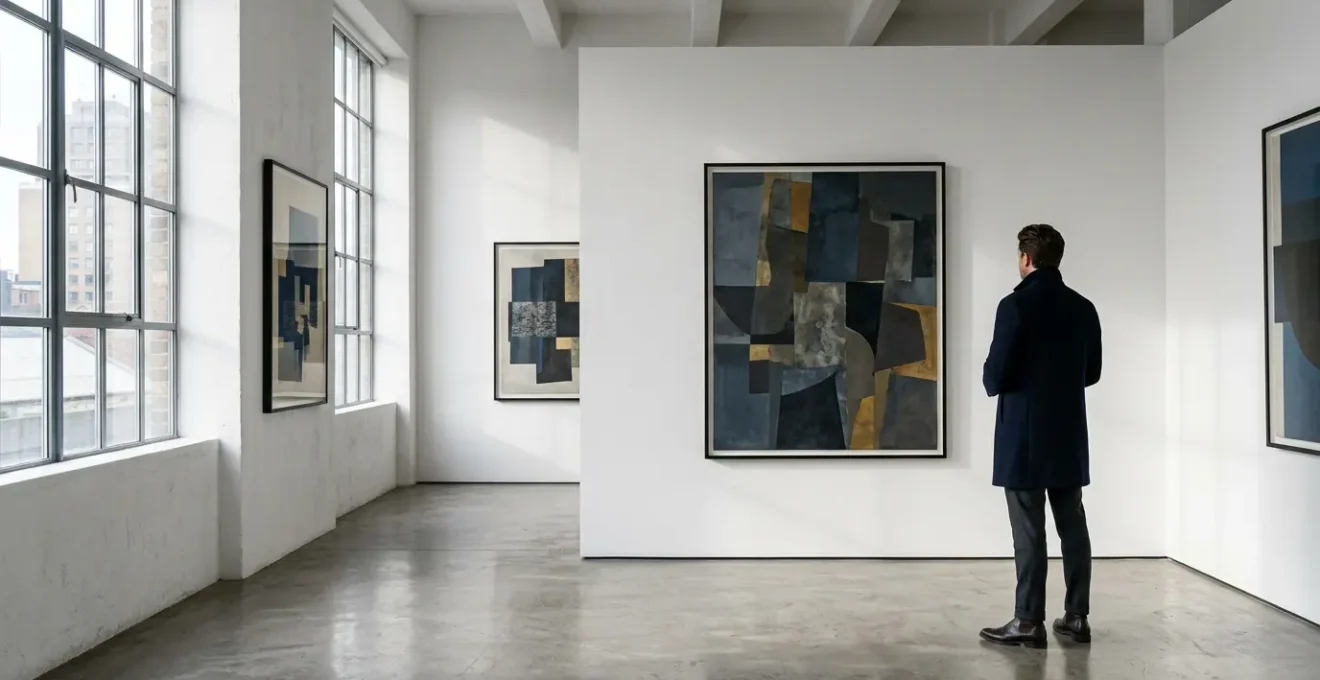
Building a legacy art portfolio is an exercise in strategic risk management, not merely acquisition; its success hinges on treating fine art as an engineered financial asset.
- Blue-chip art demonstrates a low-to-negative correlation with traditional stock markets, offering robust portfolio diversification.
- Value preservation is dependent on a ‘defense-in-depth’ strategy covering authentication, insurance, and timed liquidation to minimise tax liabilities.
Recommendation: The optimal approach involves a Core-Satellite model, balancing stable, museum-grade assets with a calculated allocation to high-growth emerging artists.
For the seasoned investor, the objective transcends simple accumulation. It is about the deliberate construction of a legacy—a portfolio resilient enough to weather market volatility and substantial enough to pass to the next generation. While equities and bonds form the bedrock of traditional wealth management, they remain susceptible to inflationary pressures and systemic market shocks. This has led discerning collectors to re-evaluate the role of tangible assets, particularly blue-chip British art.
The common discourse often revolves around aesthetic appreciation or the platitude of “buy what you love.” However, for a portfolio designed for long-term wealth preservation, this advice is insufficient, even negligent. The true strategy lies not in passion, but in process. It involves a rigorous, analytical approach that treats a David Hockney or Damien Hirst not just as a cultural artefact, but as a financial instrument with specific risk parameters and performance drivers.
The critical question is not *if* art can be a good investment, but *how* one engineers it to be. The key is to move beyond the surface-level discussion of an artist’s auction records. It requires a deep understanding of the mechanics of insurance, the catastrophic risk of authentication errors, the nuances of liquidity between different media, and the strategic timing of acquisition and liquidation to optimise tax efficiency. This guide dissects these critical pillars, providing a framework for structuring a visual asset portfolio that is built to last.
This analysis will navigate the essential strategic considerations, providing a clear pathway from initial acquisition theory to final portfolio construction. The following sections outline the core components for building and managing a high-performance, legacy-focused art portfolio.
Summary: A Strategic Framework for Blue-Chip Art Investment
- Why Do Post-War Blue-Chip Paintings Outperform Traditional UK Stock Portfolios?
- How to Insure a £500k Hirst or Hockney Masterpiece Against Accidental Damage?
- The Authentication Error That Re-renders Blue-Chip Investments Entirely Worthless
- Limited Edition Print or Original Sketch: Which Offers Better Liquidity?
- When Should You Liquidate a Blue-Chip Asset to Minimise HMRC Capital Gains?
- When is the Optimal Financial Quarter to Acquire Museum-Grade Assets?
- How to Balance High-Risk Emerging Artists with Stable Blue-Chip Investments?
- How to Structure a Diversified Visual Asset Portfolio to Hedge Against Inflation?
Why Do Post-War Blue-Chip Paintings Outperform Traditional UK Stock Portfolios?
The fundamental case for including blue-chip art in a sophisticated wealth portfolio rests on its historically low correlation with traditional financial markets. While the FTSE 100 may react to quarterly earnings reports or geopolitical shifts, the value drivers for a Francis Bacon or Lucian Freud are largely disconnected from the economic cycle. This creates a powerful diversification tool. For instance, analysis shows that Contemporary Art and Developed Equities showed a correlation of -0.04 between 1985 and 2021. This negative correlation means that art can act as a stabilising force when equity markets are turbulent.
Furthermore, blue-chip art has proven to be a formidable hedge against inflation. In periods of rising inflation, the tangible, finite nature of museum-quality works provides a store of value that currency-based assets cannot match. The scarcity of masterpieces by established artists, coupled with growing global demand from new high-net-worth collectors, creates upward price pressure. During past periods when inflation was equal to or higher than 3.0%, Post-War & Contemporary art prices had an annual average real price appreciation of 23.2%. This demonstrates not just wealth preservation, but significant real-term growth.
This outperformance is not accidental; it is a function of the asset’s unique characteristics. Unlike a company share, a painting is a singular object with inherent cultural and historical value. This “trophy” status provides a floor for its value, insulating it from the purely financial sentiment that drives stock prices. An investor is therefore acquiring not just potential for appreciation, but a layer of portfolio resilience that is difficult to replicate with other asset classes.
How to Insure a £500k Hirst or Hockney Masterpiece Against Accidental Damage?
Acquiring a significant work by Hirst or Hockney is the beginning, not the end, of the investment process. Protecting this asset is a paramount fiduciary duty. The fine art insurance market is a highly specialised and substantial sector, reflecting the immense value it is tasked to protect. Indeed, the fine art insurance sector has expanded to a global market size of £429.4 billion in 2024. This is not a standard home and contents policy; it is a bespoke contract designed to cover risks from accidental damage and theft to transit and display.
Securing appropriate cover for a £500,000 masterpiece begins with an independent, certified valuation. Insurers will demand a current market appraisal from a reputable firm to establish the “agreed value”—the amount payable in the event of a total loss. This value is reviewed regularly, typically annually, to account for market appreciation. The policy itself, known as a “nail-to-nail” policy, should cover the artwork from the moment it leaves the gallery or seller’s possession until it is securely installed, including all transit phases. Key policy features to demand include coverage for accidental damage, depreciation in value following a partial loss and restoration, and title defects.
Documentation is the bedrock of a successful claim. Meticulous records of the artwork’s condition, professional high-resolution photographs, and all provenance-related documents must be maintained, with copies stored securely off-site or digitally. When selecting an insurer, it is crucial to work with a specialist broker who understands the art market. They can negotiate favourable terms and, crucially, ensure the policy is underwritten by a provider with a proven track record of paying claims on high-value art without contention. The premium, often a fraction of a percent of the work’s value, is a small price for securing a seven-figure asset.
The Authentication Error That Re-renders Blue-Chip Investments Entirely Worthless
While insurance protects against physical loss, it is powerless against the existential threat of a provenance failure. An artwork’s value is inextricably linked to its authenticity. A question mark over its attribution does not merely reduce its value; it can obliterate it entirely, transforming a multi-million-pound asset into a worthless canvas. For this reason, the single greatest risk in art investment is not market fluctuation, but an error in authentication. This risk is amplified in the modern era with the rise of sophisticated forgeries and even AI-generated art, which presents new challenges for verification.
As Robert Read, Head of Art and Private Client at Hiscox, noted in a recent analysis, new technologies bring complications. Hiscox’s research revealed that 42% of art collectors had ethical concerns with AI art, highlighting a growing unease around transparency and originality. The bedrock of an artwork’s value is its story, a verifiable history of ownership stretching back to the artist’s studio. According to Sotheby’s specialist Emma Baker in the Calder Contemporary Blue-Chip Art Guide, “Provenance plays a critical role; a well-documented history of an artwork…can significantly increase its value.” Any break in this chain, any gap or inconsistency, is a red flag that must be investigated with forensic intensity.
A “defense-in-depth” provenance strategy is therefore non-negotiable. This involves more than just accepting a certificate. It means:
- Connoisseurship and Science: Combining the trained eye of a respected art historian with scientific analysis, such as pigment testing or infrared reflectography, to confirm materials and techniques are period-appropriate.
- Catalogue Raisonné Verification: Ensuring the work is listed in the artist’s official and definitive catalogue of works. If it is not, the reason must be unequivocally established.
- Ownership History: Scrutinising every bill of sale, auction record, and exhibition label. This includes due diligence on previous owners to ensure clear and unencumbered title.
- Expert Opinion: Seeking written confirmation of authenticity from the recognised living expert on the artist or the official artist’s foundation.
Failing to undertake this level of due diligence is a critical portfolio management error. The cost of comprehensive authentication is a negligible fraction of the potential loss from acquiring a fake or misattributed work.
Limited Edition Print or Original Sketch: Which Offers Better Liquidity?
For a portfolio manager, liquidity—the ability to convert an asset into cash quickly and without significant loss of value—is a critical metric. A common misconception is that all fine art is inherently illiquid. In reality, liquidity varies dramatically by medium and artist. When considering works by an artist like David Hockney, the choice between an original drawing and a high-quality, limited-edition print presents a classic liquidity trade-off. While an original work offers the allure of uniqueness, it is often the limited edition prints that provide superior liquidity.
The reason lies in market transparency and a wider pool of potential buyers. An edition of 100 prints has 99 other direct comparables. Auction results and private sales for other prints from the same edition are easily tracked, creating a transparent and reliable pricing structure. This reduces buyer uncertainty and shortens the sales cycle. Conversely, an original sketch is a unique object, making direct price comparisons difficult and potentially extending the negotiation and due diligence period. The accessible price point for prints—often starting in the low five figures compared to six or seven for originals—also dramatically expands the market of qualified buyers, further enhancing liquidity.
The performance data for Hockney’s market underscores this point. The following table, based on market analysis, highlights the key differences in investment characteristics between his prints and original works on paper.
| Metric | Limited Edition Prints | Original Works |
|---|---|---|
| Market Transparency | High – Edition size known, comparables available | Lower – Unique works, fewer comparables |
| Entry Price Point | Accessible – From £10,000 | High – Often £100,000+ |
| Sell-Through Rate | Strong across price bands | Variable, dependent on provenance |
| Price Growth Since 2000 | 400%+ for Hockney prints | 137% average for Hockney works |
While an original work may offer greater potential for a monumental, one-off return, the print market offers a more reliable combination of strong, measurable growth and the practical ability to liquidate the asset in a predictable timeframe. For a portfolio that requires a degree of tactical flexibility, a strategic allocation to blue-chip limited editions is an indispensable tool for managing liquidity.
When Should You Liquidate a Blue-Chip Asset to Minimise HMRC Capital Gains?
The successful liquidation of a blue-chip art asset is not simply about achieving the highest sale price; it is about maximising the net return after taxes. In the UK, art is classified as a chargeable asset, and any profit realised upon its sale is subject to Capital Gains Tax (CGT). For a higher-rate taxpayer, this can represent a significant portion of the gain. Therefore, the timing and structure of a sale must be a deliberate, strategic decision designed to legally minimise HMRC’s claim. This becomes even more pertinent as the UK market strengthens with 17% of global art market share, creating more frequent liquidation opportunities.
Several established strategies can be employed. The most fundamental is the use of the annual CGT exemption (£3,000 for 2024/25). While small for a high-value piece, it can be utilised by transferring partial ownership to a spouse to use their exemption as well. A more impactful strategy involves timing. A sale completed after April 6th pushes the tax liability into the next financial year, effectively creating a nearly 22-month delay before the tax is due (by January 31st of the following year), allowing the capital to remain invested for longer. Furthermore, one can engage in ‘tax-loss harvesting’ by selling an underperforming piece in the same tax year to crystallise a loss that can be offset against gains from a successful sale.
For legacy planning, more sophisticated structures are required. Placing high-value art into a trust for heirs can be an effective way to manage future CGT and Inheritance Tax liabilities, though this requires specialist legal and financial advice. Another non-traditional approach is to avoid a sale altogether by using the artwork as collateral. A number of private banks and specialist lenders offer loans against art. This unlocks liquidity from the asset without triggering a taxable event, allowing the owner to access capital while the artwork continues to appreciate. This is a powerful tool for those who need cash flow but wish to retain the asset for the long term.
When is the Optimal Financial Quarter to Acquire Museum-Grade Assets?
In a market as nuanced as blue-chip art, timing the acquisition can be as critical as selecting the right piece. While the art world has its own seasonal calendar—driven by major art fairs and auction seasons—the optimal financial quarter for an astute buyer is often found in the spaces in between. The major public auction seasons in London, New York, and Hong Kong are concentrated in Q2 (May/June) and Q4 (November). These periods see high-profile sales and record-breaking prices, but also the most intense competition. While participation is necessary for market intelligence, the best acquisition opportunities often materialise outside of the auction spotlight.
The periods immediately following major art fairs like Frieze or Art Basel can be particularly fertile. As one market analysis observed, “Galleries are often more motivated to negotiate on unsold premier works to close their books on the event.” This creates a buyer’s window where a gallery, having incurred the significant cost of exhibiting, may be more flexible on price for a major work that did not sell during the fair itself. This allows for discreet, private negotiation away from the competitive frenzy of the fair floor.
Moreover, private sales are an increasingly dominant force in the market. Top auction houses have significantly expanded their private sales divisions, which operate year-round. These channels offer discretion, privacy, and the ability to transact without waiting for a scheduled auction. A recent report noted that auction houses reported 14% growth in private transactions, indicating a structural shift. For a motivated buyer with a clear acquisition target, proactively engaging with an auction house’s specialists in the ‘off-season’ quarters of Q1 and Q3 can lead to opportunities to acquire museum-grade works before they ever reach the public market. This proactive, relationship-driven approach is the hallmark of a strategic acquirer.
How to Balance High-Risk Emerging Artists with Stable Blue-Chip Investments?
A robust, legacy-focused art portfolio cannot be built solely on the established titans of the post-war era. While the stability of a Hockney or Auerbach provides the foundation, true long-term growth often comes from identifying the next generation of blue-chip artists before they become household names. The challenge lies in balancing the predictable, steady returns of established artists with the high-risk, high-reward nature of the emerging market. The solution is a disciplined portfolio construction methodology known as the “Core-Satellite” approach.
This model, borrowed from traditional finance, dictates that the majority of the portfolio—typically 70-80%—should be allocated to the ‘Core’. This consists of stable, museum-grade works by artists with deep, international markets and a long track record of appreciation. These are the assets that provide stability and a reliable benchmark return; Artprice data shows blue-chip art delivering an 8.9% average annual return over 20 years. They are the anchor of the portfolio.
The remaining 20-30% is allocated to the ‘Satellites’. This portion of the portfolio is where calculated risks are taken. It might consist of works by 5-10 carefully vetted emerging or ‘mid-career’ artists. The due diligence for this segment is even more intense. It requires a qualitative and quantitative scoring system to filter out artists driven by social media hype from those with genuine long-term potential. This is the part of the portfolio that can deliver exponential, 10x-type returns, but also where losses are more likely. By containing this risk within a smaller, dedicated portion of the overall portfolio, the manager can pursue significant upside without jeopardising the stability of the core holdings.
Your Action Plan: Implementing a Core-Satellite Art Portfolio
- Core Allocation: Dedicate 70-80% of capital to Grade-A works by artists with established global auction records (e.g., Freud, Auerbach, Hockney).
- Satellite Selection: Reserve 20-30% for a diversified group of 5-10 ‘satellite’ artists, limiting exposure to any single emerging name.
- Vetting Protocol: Score potential satellite artists based on objective criteria: graduation from a prestigious MFA program, representation by a top-tier gallery, and early acquisitions by institutions.
- Critical Validation: Monitor the ratio of serious critical reviews in established art journals versus transient social media hype to gauge institutional momentum.
- Tax-Loss Harvesting: Annually review the satellite portfolio to identify non-performing assets; liquidate these to crystallise a capital loss that can be offset against gains from the core portfolio.
Key Takeaways
- Blue-chip art’s value is driven by scarcity and cultural significance, providing a low correlation to equity markets and a powerful inflation hedge.
- Active risk management through specialised insurance, forensic authentication, and strategic tax planning is more critical than market timing.
- A balanced portfolio utilises a ‘Core-Satellite’ structure, anchoring the majority in stable blue-chips while using a smaller allocation to high-growth emerging artists.
How to Structure a Diversified Visual Asset Portfolio to Hedge Against Inflation?
The final architecture of a legacy art portfolio must be a deliberate construction designed to maximise inflation hedging and manage liquidity across different market conditions. A portfolio consisting solely of large-scale, blue-chip oil paintings, while impressive, may be overly concentrated and lack tactical flexibility. True diversification in the art world means allocating capital across different mediums, each with its own unique risk, reward, and liquidity profile. This creates a more resilient portfolio, where the strengths of one medium can compensate for the temporary weaknesses of another.
A well-structured visual asset portfolio might follow a weighted allocation strategy. The core, representing 40-50%, would remain in unique blue-chip paintings for their unparalleled store-of-value characteristics. However, the remainder of the capital would be strategically deployed into other mediums. Limited edition prints, as discussed, would form a significant tranche (25-30%) to provide enhanced liquidity and access to transparent growth. A further allocation (20-25%) could be made to fine art photography, a market with a lower entry point than painting but a strong global collector base. Finally, a smaller, tactical allocation (5-10%) to sculpture can add a premium for scarcity, though with the understanding that its liquidity can be lower due to logistical challenges.
This diversified approach is summarised in the table below, which outlines a model for asset allocation across mediums to achieve a balanced inflation-hedging portfolio.
| Medium Type | Portfolio Weight | Inflation Correlation | Liquidity Level |
|---|---|---|---|
| Blue-chip Paintings | 40-50% | Strong hedge/Store of value | Moderate |
| Limited Edition Prints | 25-30% | Growth potential | High |
| Photography | 20-25% | Tangible/Lower entry | Moderate-High |
| Sculpture | 5-10% | Scarcity premium | Low-Moderate |
By engineering the portfolio in this manner, an investor creates multiple levers to pull. If immediate cash is needed, the highly liquid prints can be sold without disturbing the core paintings. If the photography market is experiencing a surge, profits can be taken and reallocated. This is the essence of moving from a passive art collector to an active art portfolio manager: structuring a collection of assets that work in concert to achieve the overarching goal of long-term, inflation-proof wealth preservation.
Ultimately, constructing a portfolio of this calibre is the final step in a long process of strategic decisions. The next logical action is to commission a bespoke audit of one’s existing collection or acquisition targets to identify where these principles of risk mitigation and strategic diversification can be most effectively applied.