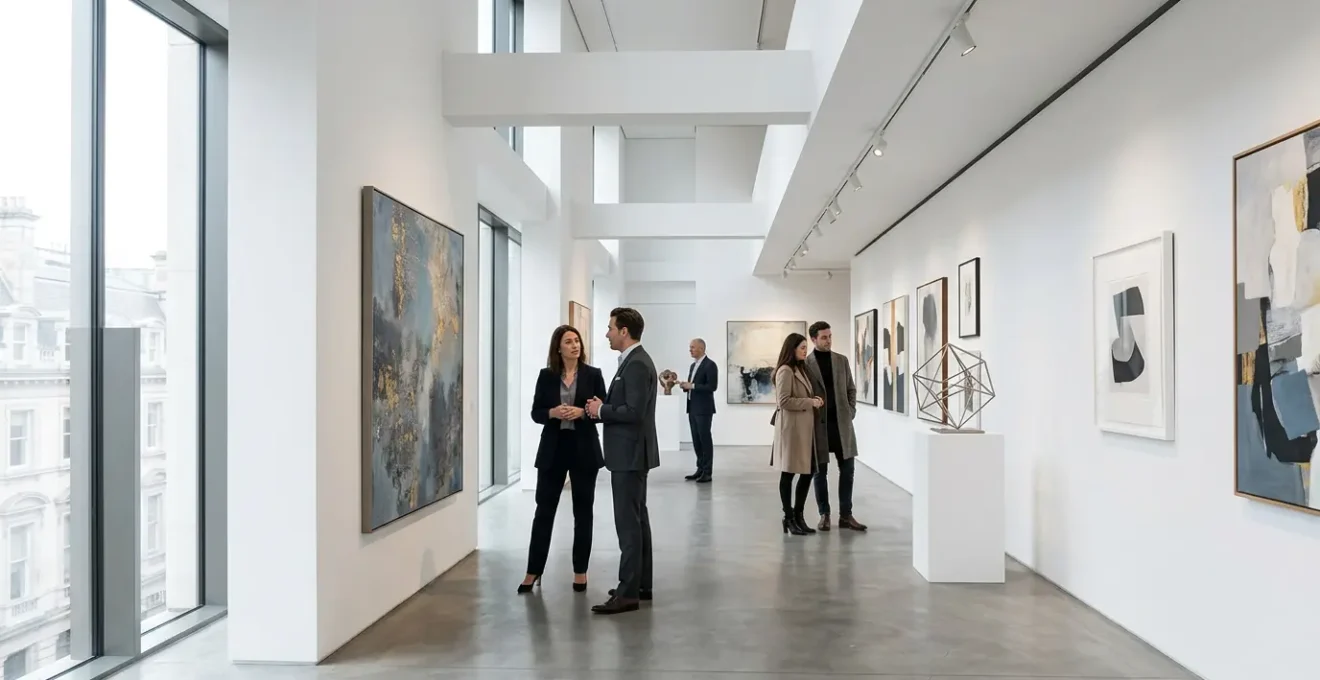
Viewing a fine art collection as a passive store of value is a strategic error; its true potential is unlocked only when managed as a dynamic financial instrument.
- Systematic portfolio architecture, not opportunistic buying, is essential for balancing risk and maximising returns.
- Active management of liquidity and tax liabilities (CGT, VAT) can generate significant “tax alpha” and de-risk the asset class.
Recommendation: A disciplined, framework-driven approach is required to effectively hedge against UK inflation and equity market volatility using visual arts.
In the face of persistent UK inflation and unsettling volatility within the FTSE 100, high-net-worth individuals are rightly scrutinising their portfolios for robust, non-correlated assets. The traditional havens of property and precious metals are well-trodden paths. However, an increasing number of astute investors are turning their attention to fine art, not merely as a passion pursuit, but as a serious component of a sophisticated wealth preservation strategy. The common advice often ends with simplistic notions of buying a famous name and waiting for appreciation.
This approach, however, fundamentally misunderstands the mechanics of art as an asset class. It overlooks the critical risks of illiquidity and the significant tax implications governed by HMRC. The key to unlocking art’s true potential as an inflation hedge lies not in passive ownership, but in treating it as a dynamic financial instrument. This requires a disciplined framework encompassing portfolio architecture, engineered liquidity, and the active pursuit of tax alpha.
This analysis provides that strategic framework. We will deconstruct the macroeconomic case for art investment, present a quantifiable allocation model, and detail the specific UK-centric tax and logistical strategies required to structure, manage, and liquidate a visual asset portfolio for optimal financial performance. This is not about collecting; this is about capital allocation.
The following sections will provide a detailed roadmap, from initial allocation principles to advanced tax-efficiency tactics, enabling you to navigate the complexities of the UK art market with the rigour of a seasoned portfolio manager.
Summary: A Strategic Framework for Art as a Financial Asset
- Why Does Contemporary Art Outperform the FTSE 100 During Major Economic Recessions?
- Why Do Wealth Managers Now Recommend a 5% Portfolio Allocation to Visual Arts?
- How to Balance High-Risk Emerging Artists with Stable Blue-Chip Investments?
- When is the Optimal Financial Quarter to Acquire Museum-Grade Assets?
- Private Storage Facility or Museum Loan: Which Strategy Increases Asset Valuation Faster?
- The Over-Concentration Mistake That Leaves Your £500k Portfolio Completely Illiquid
- When to Rebalance Your Art Holdings to Maximise Capital Gains Tax Efficiency?
- How to Structure Tax-Efficient Art Acquisitions Under HMRC Regulations?
Why Does Contemporary Art Outperform the FTSE 100 During Major Economic Recessions?
The resilience of the contemporary art market during periods of economic downturn is not a matter of coincidence but a function of its systemic non-correlation with traditional equity markets. Unlike stocks, which are intrinsically tied to corporate earnings and economic cycles, the value of high-end art is driven by a distinct set of global factors: wealth concentration, scarcity, and its status as a tangible store of value. During recessions, as central banks often lower interest rates and increase liquidity, a portion of this capital seeks refuge in hard assets that are insulated from corporate performance and currency devaluation.
Empirical data substantiates this phenomenon. For instance, while the S&P 500 experienced a significant decline, analysis shows the blue-chip art index gained 3% in 2022, a year marked by considerable market turmoil. This demonstrates a clear decoupling. The pool of ultra-high-net-worth collectors who drive the top end of the market is often less affected by recessions, and their continued demand for rare, culturally significant works provides a stable floor for prices.
Furthermore, art serves as an effective inflation hedge. During the high-inflationary periods of the 1970s, analysis has shown that contemporary art prices appreciated by approximately 17.5%, significantly outpacing equities and even gold. The global and tangible nature of art makes it a preferred vehicle for wealth preservation when the purchasing power of fiat currency is eroding. This inherent quality is the fundamental reason it acts as a counterbalance to a traditional portfolio heavily weighted in equities.
Why Do Wealth Managers Now Recommend a 5% Portfolio Allocation to Visual Arts?
The inclusion of art in sophisticated wealth management strategies has transitioned from a niche consideration to a mainstream recommendation. The rationale is rooted in modern portfolio theory, which emphasizes diversification to improve risk-adjusted returns. The institutional shift is clear: a recent study revealed that over 90% of wealth managers believe art should be included in their service offerings, a dramatic increase from just 53% in 2014. This consensus is not based on aesthetics but on a rigorous analysis of performance metrics.
A strategic allocation to art, typically around 5% of a total portfolio, has been shown to enhance overall performance by lowering volatility and improving returns. The non-correlation discussed previously means that during periods when equities are falling, art often holds its value or appreciates, smoothing the portfolio’s overall return profile. This effect is quantifiable through key financial metrics such as the Sharpe ratio, which measures risk-adjusted return, and the maximum drawdown, which tracks the largest peak-to-trough decline.
The following table, based on recent modeling of portfolio performance over a 10-year period, illustrates the quantitative benefits of integrating a 5% art allocation into a standard UK equity portfolio.
| Portfolio Type | 10-Year Return | Sharpe Ratio | Max Drawdown |
|---|---|---|---|
| 100% FTSE All-Share | 7.2% | 0.45 | -28% |
| 95% FTSE + 5% Art | 8.1% | 0.52 | -24% |
| Improvement | +0.9% | +15.6% | -14.3% |
The data is unequivocal: the inclusion of art not only increased the absolute return but, more critically, improved the Sharpe ratio by over 15% and reduced the maximum drawdown by 14.3%. For an investor focused on long-term wealth preservation, this reduction in portfolio volatility is a significant strategic advantage.
How to Balance High-Risk Emerging Artists with Stable Blue-Chip Investments?
Once the strategic allocation is determined, the next critical step is designing the internal portfolio architecture. A common error is to either concentrate funds in a single “trophy” asset or to scatter investments without a coherent strategy. A disciplined, tiered approach is essential to balance the stability of established artists with the significant growth potential of emerging talent. The objective is to construct a portfolio that can weather market cycles while capturing upside.
A proven framework for a UK-based art portfolio is the 60/30/10 allocation model. This structure provides a robust balance between risk and reward, tailored to the dynamics of the London art market. It breaks down as follows:
- 60% in Blue-Chip Artists: This forms the bedrock of the portfolio. These are artists with unimpeachable global reputations and extensive, transparent UK auction track records. Think of names like Lucian Freud, Frank Auerbach, or David Hockney. These assets provide stability and are generally more liquid than other segments. Their value is well-established, offering lower but more predictable returns.
- 30% in Mid-Career Artists: This tier targets artists who have established a strong presence but have not yet reached the “blue-chip” stratosphere. Key indicators include representation by major London galleries (e.g., White Cube, Gagosian London) and consistent inclusion in prestigious fairs like Frieze London. These assets offer a compelling blend of established value and significant growth potential.
- 10% in High-Risk Emerging Artists: This is the venture capital arm of the art portfolio. Investments are made in graduates from top UK art schools like the RCA, Goldsmiths, or the Slade School of Fine Art. While the risk of failure is high, a single successful artist in this category can deliver exponential returns, far outstripping the rest of the portfolio. Close monitoring of Turner Prize shortlists and Arts Council England acquisitions can serve as crucial quality indicators for this segment.
This structured approach ensures the portfolio is not overly exposed to the whims of the contemporary art scene while still positioning it to benefit from the market’s most dynamic growth areas.
When is the Optimal Financial Quarter to Acquire Museum-Grade Assets?
The art market, like any other, has its own seasonality and cyclical patterns. While there is no single “perfect” time to buy, understanding the market’s calendar can reveal strategic opportunities for acquisition, particularly for museum-grade assets. The conventional wisdom focuses on the major auction seasons in London, New York, and Hong Kong in the spring and autumn. While these auctions provide excellent price discovery and access to marquee works, they are also periods of maximum competition and peak pricing.
A more nuanced strategy involves looking at the gaps between these high-profile events. As one analysis from a leading London gallery notes, the optimal timing is contingent on the investor’s primary objective. As the London Art Market Analysis in the Maddox Gallery Investment Guide states:
The optimal time to buy depends on the goal: auctions for price discovery, fairs for access to fresh-to-market works, and the gaps in between for negotiated deals.
– London Art Market Analysis, Maddox Gallery Investment Guide 2026
For the discerning investor seeking to acquire significant assets through private treaty sales, the third financial quarter (Q3) often presents a unique window of opportunity. This “summer lull,” typically from July to early September, sees many of the major collectors, dealers, and advisors decamp from the city. This temporary reduction in market activity can create an environment more conducive to negotiation. Sellers may be more receptive to offers outside the high-pressure auction cycle, and advisors have more bandwidth to broker complex, off-market deals. Acquiring a museum-grade asset during this period can often be achieved on more favourable terms than would be possible during the frenzy of the Frieze art fair in October.
Private Storage Facility or Museum Loan: Which Strategy Increases Asset Valuation Faster?
Once an asset is acquired, its management strategy becomes paramount. An artwork stored in a climate-controlled freeport is a preserved asset; an artwork with a documented history of being exhibited in a reputable institution is an appreciated asset. The choice between private storage and a strategic museum loan directly impacts the valuation velocity of the piece. While professional storage is non-negotiable for preservation, it is a passive strategy. A museum loan, by contrast, is an active strategy for value enhancement.
The mechanism at play is the strengthening of an artwork’s provenance. Provenance—the documented history of a work’s ownership, exhibition, and publication—is one of the most significant drivers of value in the art market. A loan to a major museum or inclusion in a significant retrospective acts as a powerful institutional endorsement. It authenticates the work’s importance, places it in a critical art-historical context, and exposes it to a wide audience of critics, academics, and potential future collectors. This seal of approval drastically de-risks the asset in the eyes of the market.
The financial impact is tangible. Analysis of subsequent auction results suggests a clear premium for works with a strong exhibition history. It is not uncommon to see a 15-30% increase in an artwork’s valuation following its inclusion in a major museum retrospective. For a portfolio manager, facilitating such a loan is not an act of philanthropy; it is a calculated investment in the asset’s future marketability and price point. The key is to be selective, targeting loans to institutions whose prestige will confer the greatest value onto the work.
The Over-Concentration Mistake That Leaves Your £500k Portfolio Completely Illiquid
One of the most significant risks in art investment is illiquidity. The platitude that “art is illiquid” is often accepted as an unchangeable fact, but this is a passive mindset. For the strategic investor, liquidity is not something you have, but something you engineer through careful planning. The gravest error is over-concentration in a single high-value work. A £500,000 portfolio consisting of one painting is maximally illiquid; the same value spread across five to seven well-chosen pieces offers far greater strategic flexibility.
A diversified portfolio allows for the implementation of a staggered exit strategy, a crucial tool for managing liquidity and optimising tax liabilities. Attempting to sell multiple works from the same artist or portfolio in a single season can saturate the market and depress prices. A planned, multi-year disposal plan avoids this pitfall and allows the investor to strategically utilise their annual Capital Gains Tax (CGT) allowance, a key component of generating “tax alpha.” The checklist below outlines a disciplined approach to planning portfolio liquidation.
Action Plan: Engineering Portfolio Liquidity and Tax Efficiency
- Map a Multi-Year Disposal Schedule: Plan to sell no more than one or two significant artworks per UK tax year to avoid market saturation and maintain price tension.
- Maximise Annual CGT Allowances: Time sales to fully utilise the annual CGT exemption (£3,000 for the 2024/25 tax year). A sale should ideally be completed before the 5th of April to capture the current year’s allowance.
- Consider Spousal Transfers: If applicable, transfer legal ownership of an artwork to a spouse before the sale. This allows both individuals to use their separate CGT allowances, effectively doubling the tax-free portion of the gain.
- Meticulous Cost Documentation: Maintain a detailed record of all acquisition costs, including buyer’s premium, framing, restoration, and insurance. These expenses are deductible and can significantly reduce the final taxable gain.
- Assess Art-Secured Lending: For short-term liquidity needs without triggering a taxable event, explore options for art-secured loans from specialist financial institutions. This can provide capital while the asset continues to appreciate.
By viewing liquidity as a function of portfolio structure and tax planning, an investor can transform one of the art market’s greatest perceived weaknesses into a strategic advantage.
Key Takeaways
- Active financial management, not passive ownership, is the key to unlocking art’s potential as a hedge against inflation.
- A disciplined portfolio architecture (such as the 60/30/10 model) is non-negotiable for balancing risk and capturing growth.
- Generating “tax alpha” through the strategic application of UK Capital Gains Tax and VAT rules is a primary source of value.
When to Rebalance Your Art Holdings to Maximise Capital Gains Tax Efficiency?
Portfolio rebalancing is a fundamental discipline in managing any asset class, and art is no exception. It is the process of periodically selling certain assets and acquiring others to maintain the desired strategic allocation—for instance, the 60/30/10 model. A successful emerging artist’s work might appreciate to the point where it unbalances the portfolio’s risk profile, necessitating a sale to realise gains and reinvest in other tiers. The timing and structure of these disposals are critical for maximising Capital Gains Tax (CGT) efficiency.
The UK tax code, specifically HMRC’s rules regarding “chattels” (personal possessions), offers significant opportunities for the astute investor. Understanding these rules is essential for generating tax alpha. The cornerstone of this strategy is the £6,000 exemption. Any single artwork, or “chattel,” sold for £6,000 or less is completely exempt from CGT. This rule is particularly powerful when liquidating works by emerging artists or selling off smaller pieces from a larger collection.
For works sold for more than £6,000, the rules become more complex but offer further avenues for optimisation. Investors must be aware that HMRC’s specific chattels exemption rules can treat items sold as a “set” as a single transaction, potentially pushing the total over the £6,000 threshold. Strategic considerations for rebalancing should therefore include:
- Targeting the £6,000 Exemption: Prioritise the sale of individual pieces expected to fetch less than £6,000 to realise tax-free gains.
- Applying the ‘5/3 Rule’: For items sold for between £6,000 and £15,000, a special rule applies where the taxable gain is limited to five-thirds of the excess over £6,000. Calculating the tax liability under both standard CGT rules and this special rule allows the investor to choose the lower amount.
- Structuring ‘Set’ Sales: If selling a diptych, triptych, or a series of works by the same artist that could be considered a set, carefully structure the sales across different tax years or to different buyers to avoid the aggregation rule.
- Gifting to a Spouse: As with a primary liquidation strategy, transferring an asset to a spouse before a sale allows the use of two annual CGT allowances, which is particularly effective when realising a large gain from a mid-career or blue-chip asset.
How to Structure Tax-Efficient Art Acquisitions Under HMRC Regulations?
Just as tax efficiency is critical upon disposal, it is equally important at the point of acquisition. Structuring the purchase of artworks correctly can lead to significant savings, particularly regarding Value Added Tax (VAT). An investor operating in the UK has several mechanisms at their disposal to optimise the tax impact of buying art, whether from UK dealers or international sources. The goal is to minimise tax drag and improve the cash flow efficiency of the portfolio.
For an individual or entity regularly trading art, understanding these structures is not optional, it is fundamental to the profitability of the operation. Key strategies under current HMRC regulations include:
- Using Postponed VAT Accounting (PVA): For artworks imported into the UK, PVA is a crucial tool. It allows the importer to account for the VAT on their VAT return, rather than paying it upfront at the border. This provides a significant cash flow advantage, as the input VAT can be offset against output VAT in the same return.
- Buying via the VAT Margin Scheme: When purchasing from a UK dealer who is using the Margin Scheme, VAT is only payable on the dealer’s profit margin, not the full selling price of the artwork. This results in a substantially lower VAT charge compared to a standard transaction. Always confirm with the dealer if they are applying this scheme.
- Considering a Limited Company Structure: For a high-volume investor, operating through a UK limited company can offer certain advantages. While Corporation Tax rates may apply to gains, this structure provides a formal framework for business expenses and can offer greater privacy. However, the tax treatment on disposal is generally less favourable than personal CGT rates, so this requires careful analysis.
- Leveraging Chattels Exemption on Acquisition: While the £6,000 chattels exemption is a disposal rule, it should inform acquisition strategy. Acquiring a number of lower-value works, each with the potential to be sold for under the £6,000 threshold, can be a deliberate strategy to build a portfolio of future tax-free gains.
By systematically applying these strategies, an investor can significantly reduce the frictional costs associated with building and maintaining a fine art portfolio, thereby enhancing overall net returns.
To implement this framework effectively, a bespoke analysis of your personal financial position, risk appetite, and long-term objectives is the essential next step in translating theory into a high-performing, tangible asset portfolio.
Frequently Asked Questions on Structuring a Visual Asset Portfolio
What is the current UK Capital Gains Tax rate on art?
As of the 2024/25 tax year, the Capital Gains Tax rates on gains from art and other chattels are 18% for basic-rate taxpayers and 24% for higher-rate taxpayers on gains that exceed the £3,000 annual exemption allowance. Rates are subject to change by the government.
How does the chattels exemption work?
The chattels exemption is a valuable relief for personal possessions. If you sell an artwork for £6,000 or less, the sale is completely exempt from Capital Gains Tax. For items sold for between £6,000 and £15,000, a marginal relief known as the ‘5/3 rule’ applies, which often reduces the taxable gain.
Should I acquire art through a company or personally?
This depends on your objectives. Personal ownership allows you to benefit from the more favourable personal Capital Gains Tax rates (18-24%) and the annual CGT allowance. Acquiring through a limited company means gains are subject to Corporation Tax (currently 19-25%). While a company structure can offer better privacy and a framework for business expenses, the tax on disposal is generally higher. A detailed consultation is required to determine the optimal structure for your specific situation.